India Gate, Rashtrapati Bhavan & Lutyens' New Delhi
Lutyens' New Delhi (the planned colonial capital city designed by British architects Edwin Lutyens and Herbert Baker, built 1911-1931 as the new capital of British India, replacing Calcutta) — centred on the 3-kilometre ceremonial axis from India Gate (the war memorial arch) to Rashtrapati Bhavan (the Presidential Palace) via Kartavya Path (formerly Rajpath) — is one of the great examples of 20th-century imperial urban planning, the architectural expression of British imperial power in India at its peak.
- 1
India Gate — War Memorial & National Symbol
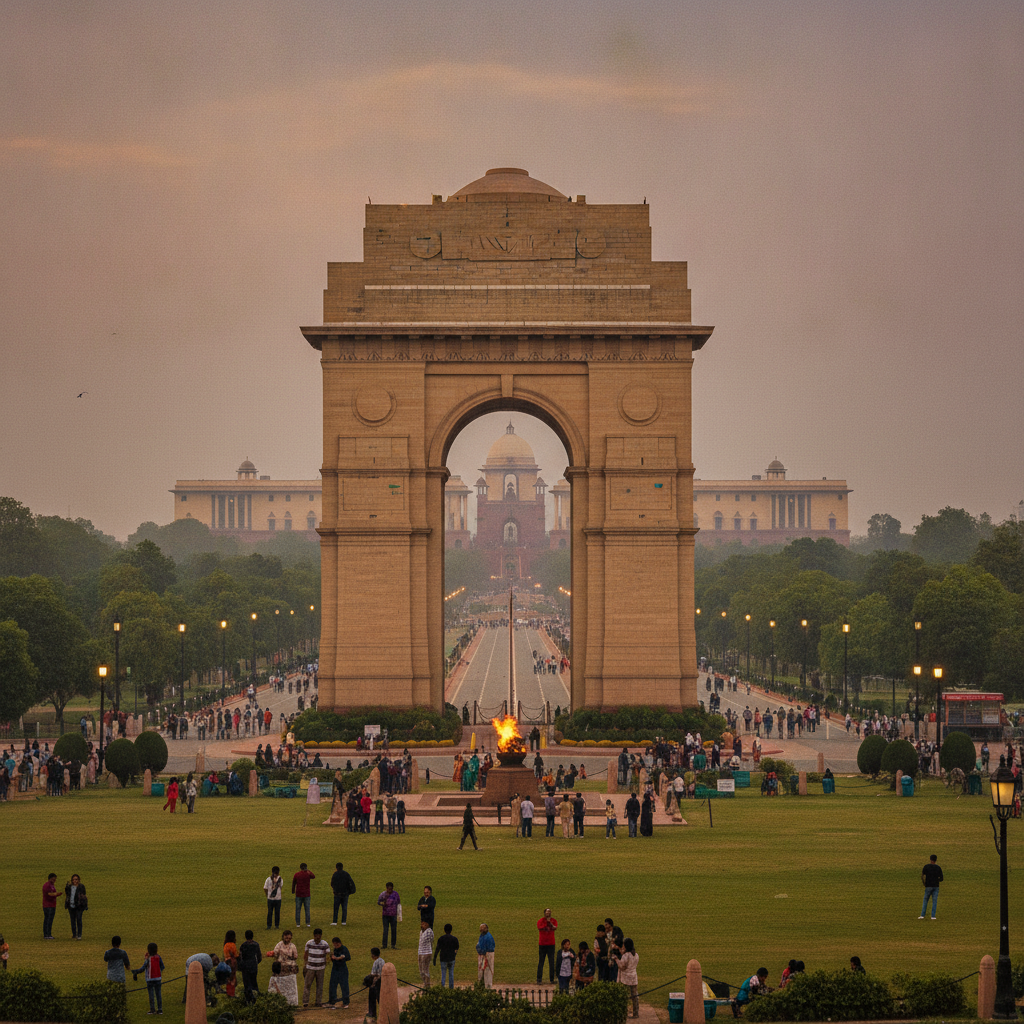
India Gate (All India War Memorial — Kartavya Path, New Delhi, built 1921-1931, designed by Edwin Lutyens, 42 metres tall, built from yellow-brown Bharatpur sandstone): the memorial arch was built to honour the 84,000 Indian soldiers of the British Indian Army who died in World War I (1914-1918) and the Third Anglo-Afghan War (1919); the names of approximately 13,300 soldiers (selected from the 84,000) are inscribed on the arch and the walls of the memorial; beneath the arch burns the Amar Jawan Jyoti (Flame of the Immortal Soldier) — an eternal flame in a black marble plinth beneath an inverted L1A1 self-loading rifle topped by a soldier's helmet, installed in 1971 to honour the soldiers who died in the 1971 India-Pakistan War (the war that resulted in the creation of Bangladesh); India Gate is the most visited monument in Delhi and the gathering point for the Republic Day parade (January 26) and the Independence Day celebrations; the Kartavya Path (Rajpath, 'King's Way') stretches 3 kilometres due west from India Gate to the foot of Raisina Hill.
- 2
Rashtrapati Bhavan — The President's House
Rashtrapati Bhavan (President's House — Raisina Hill, New Delhi, built 1912-1929, designed by Edwin Lutyens, the official residence and principal workplace of the President of India): Rashtrapati Bhavan is the largest residence of any head of state in the world — 340 rooms, 2.5 kilometres of corridors, 190 acres of grounds (including the 15-acre Mughal Garden, open to the public in February-March), 70 acres of gardens, 400 acres of presidential estate; the building (completed 1929) is Edwin Lutyens' masterpiece — a synthesis of classical European architecture (the dome, the colonnaded portico, the Palladian palace plan) with Indian architectural elements (the chhajja (stone sunscreen), the jaali (stone lattice), the chatri (domed kiosk), the red sandstone and cream colour scheme — directly referencing the Mughal monuments of Delhi); the Mughal Garden (now called Amrit Udyan) within the grounds of Rashtrapati Bhavan (open to the public 6 weeks annually in January-March) is one of the finest formal gardens in India, with a symmetrical layout of fountains, rose gardens, herb gardens, and bonsai specimens.
- 3
Parliament House & Vijay Chowk
Parliament House (Sansad Bhavan — Sansad Marg, New Delhi, built 1921-1927, designed by Edwin Lutyens and Herbert Baker, the seat of the Indian Parliament): the original circular Parliament building (Sansad Bhavan, 1927 — the 171-metre diameter drum-shaped building with its prominent colonnade encircling the external perimeter, containing the Lok Sabha (lower house), the Rajya Sabha (upper house), and the former Central Hall where the transfer of power from Britain to independent India took place at midnight on August 14-15, 1947) was supplemented in 2023 by the new Parliament building (designed by architect Bimal Patel, triangular plan, Lok Sabha chamber decorated with a peacock motif, the Rajya Sabha chamber decorated with a lotus motif, the Sengol — the golden sceptre transferred from Lord Mountbatten to Jawaharlal Nehru at independence — installed beside the Speaker's chair); Vijay Chowk (Victory Square — the broad intersection at the foot of Raisina Hill where Kartavya Path meets the North-South ceremonial axis) is the venue for the Beating Retreat ceremony (the traditional military music ceremony held on the evening of January 29, marking the conclusion of the Republic Day festivities).
- 4
Connaught Place & Delhi's Modernist Core
Connaught Place (officially Rajiv Chowk — the large circular shopping and commercial district in central New Delhi, designed by Robert Tor Russell in the 1920s as the commercial heart of Lutyens' New Delhi, named after Prince Arthur, Duke of Connaught, the uncle of King George V): the concentric ring plan of Connaught Place (the inner Connaught Circus and outer Connaught Place colonnaded rings surrounding the central park) was designed to accommodate the shops, offices, banks, hotels, and restaurants that would serve the new capital; today Connaught Place (abbreviated CP by Delhiites) remains the commercial centre of central Delhi and one of the most valuable real estate areas in India, with the colonnaded white-painted buildings accommodating a mix of global and Indian brands, restaurants, bars, and coffee shops on the ground floor and offices above; the central park (Central Park, Rajiv Chowk) contains the National Flag (the tallest flag in Delhi, 30 metres) and is the main transfer point for the Delhi Metro.
- 5
National Museum & Janpath — Arts & Culture
National Museum of India (Janpath, New Delhi — the primary national museum of India, built 1960, housing approximately 200,000 objects spanning 5,000 years of Indian cultural history from the Indus Valley Civilization (2600-1900 BCE) to the 20th century): the National Museum's collection encompasses the finest assemblage of Indus Valley artefacts outside Pakistan (including the celebrated Dancing Girl bronze statuette (c. 2300 BCE) and the Priest-King steatite sculpture from Mohenjo-daro), the largest collection of Buddhist sculptures in India (including the Gandhara school, the Mathura school, and the Amaravati school), masterpieces of Gupta period sculpture (4th-6th century CE — the golden age of Indian art), miniature paintings of the Mughal, Rajput, and Pahari schools, and a comprehensive collection of decorative arts including textiles, metalwork, jade, and jewellery; Janpath (literally 'People's Path' — the north-south shopping street crossing Connaught Place) is the best address in Delhi for government-sponsored crafts from across India (the Central Cottage Industries Emporium, Tibetan Market, and the state government emporia).
- 6
Akshardham Temple — Modern Hindu Monumental Architecture
Swaminarayan Akshardham (the Hindu cultural complex and temple on the eastern bank of the Yamuna river in New Delhi, built 2001-2005 by the BAPS Swaminarayan Sanstha organization): Akshardham is the largest Hindu temple complex in the world (by land area — 100 acres), and the central monument (the Akshardham Mandir, built from Rajasthani pink sandstone and Italian Carrara marble, 109 metres wide, 96 metres deep, 43 metres tall, decorated with approximately 20,000 hand-carved stone figures of animals, flora, and various divine beings) holds the Guinness World Record as the world's largest comprehensive Hindu temple; the complex was built in 5 years using traditional Indian stone-carving techniques by 7,000 artisans and 3,000 volunteers; the water show (Sahaj Anand water show — performed nightly in the outdoor amphitheatre) uses coloured water jets, flames, and laser projections to narrate the Upanishadic story of the nature of the self (atman) — the most spectacular evening light show in Delhi.
Walk this route with audio
Stories play automatically as you reach each stop — no tapping needed.
More in delhi
Agra Day Trip — The Taj Mahal, Agra Fort & Fatehpur Sikri
Red Fort, Chandni Chowk & Old Delhi — Mughal Imperial Heart
Humayun's Tomb, Qutb Minar & Lodhi Garden — Delhi's Medieval Heritage
National Gallery of Modern Art, Safdarjung's Tomb & South Delhi
Delhi Street Food — Paranthas, Chhole Bhature & Old Delhi Culinary Heritage