Deep-Dish Pizza, Blues, Jazz & the Neighborhoods — Wicker Park to Pilsen
Chicago's cultural identity is as much defined by its food, music, and neighbourhood life as by its architecture: the deep-dish pizza invented by Ike Sewell at Pizzeria Uno in 1943, the Chicago blues tradition that transformed Southern Delta blues into the electrified urban sound that became rock and roll, and the neighbourhood diversity that makes Chicago a city of distinct ethnic and cultural enclaves from Wicker Park's artists to Pilsen's Mexican-American muralists.
- 1
Wicker Park & Bucktown — Chicago's Bohemian Northwest
Wicker Park and Bucktown (the adjacent northwest-side neighbourhoods centered on the six-corner intersection of North, Milwaukee and Damen Avenues, approximately 5 kilometres northwest of the Loop — accessible by Blue Line 'L' to Damen): Wicker Park was developed in the late 19th century as an upper-middle-class residential neighbourhood, with many of the finest Victorian mansions in Chicago built along Ewing Street and the streets surrounding the park; it declined in the mid-20th century and was subsequently gentrified from the 1990s onwards, becoming the principal artistic and bohemian neighbourhood of the northwest side; the neighbourhood is now home to some of the best independent restaurants, bars, music venues, vintage and independent retail, and art galleries in Chicago; the six-corner intersection at North, Milwaukee and Damen is one of the most architecturally distinctive intersections in Chicago, with several turn-of-the-century commercial buildings including the Flat Iron Arts Building (1914).
- 2
Pilsen — Chicago's Mexican-American Arts District
Pilsen (the neighbourhood on the near-southwest side of Chicago centered on 18th Street, approximately 5 kilometres southwest of the Loop — accessible by Pink Line 'L' to 18th Street): Pilsen was settled in the late 19th century by Bohemian (Czech) immigrants (the neighbourhood is named after the Bohemian city of Plzeň) and subsequently became the entry point for successive waves of Mexican and Mexican-American immigration from the 1960s onwards; today Pilsen is the cultural heart of Chicago's Mexican-American community and one of the most vibrant arts districts in the city, with an extraordinary concentration of murals (the largest outdoor public mural programme in Chicago), independent art galleries, Mexican restaurants and bakeries (panaderías), and cultural institutions including the National Museum of Mexican Art (1852 West 19th Street — the only Latino museum accredited by the American Alliance of Museums).
- 3
Chicago Blues — Kingston Mines & the Electric Blues
Chicago Blues (the transformation of the acoustic Delta blues tradition brought north by African-American migrants in the Great Migration of 1910-1970 into the amplified, electric urban blues that became the foundation of rock and roll — the work of Muddy Waters, Howlin' Wolf, Buddy Guy, Junior Wells, Little Walter, and Koko Taylor at venues like the Checkerboard Lounge (now closed) and the clubs along the 'Blues Highway' of the South Side): Kingston Mines (2548 North Halsted Street, Lincoln Park — one of the oldest continuously operating blues clubs in Chicago, open 7 nights a week until 4am with live music on two stages): Chicago blues lives on in the clubs of the north and south sides; the Chicago Blues Festival (Grant Park, annually in June) is the largest free blues festival in the world, attracting 500,000 visitors over three days.
- 4
Magnificent Deep-Dish Pizza — Lou Malnati's, Giordano's & Pizzeria Uno
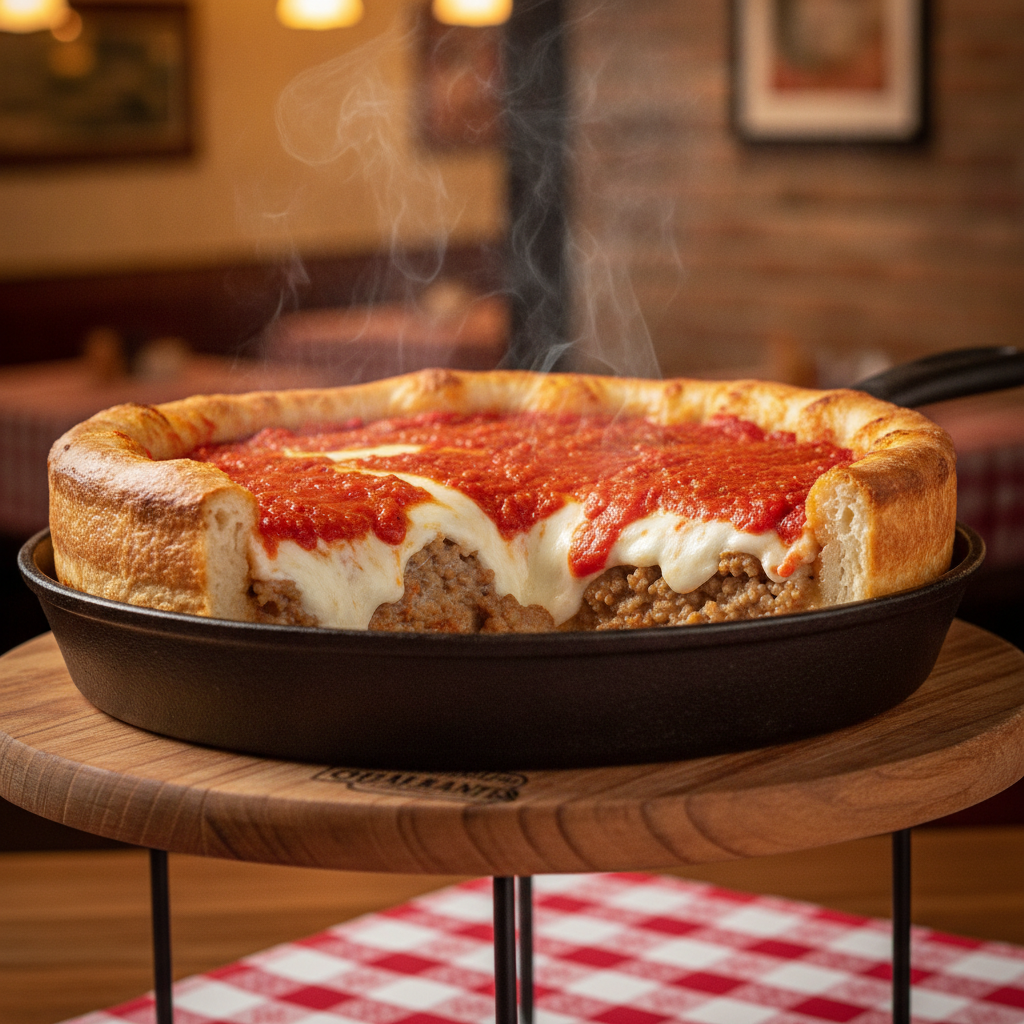
Chicago Deep-Dish Pizza (the thick, cast-iron-pan pizza with high buttery crust walls, filled with layers of cheese, toppings, and chunky tomato sauce — invented by Ike Sewell and Rudy Malnati at Pizzeria Uno (29 East Ohio Street, Near North Side, opened 1943) and subsequently developed by numerous competing pizzerias across the city): the Chicago deep-dish is fundamentally different from New York thin-crust or Italian pizza — the crust is more like a pie pastry than a bread dough (enriched with butter or corn oil), the cheese (usually mozzarella) goes directly on the crust, the toppings go on the cheese, and the chunky tomato sauce goes on top (to prevent the cheese from burning during the 45-minute baking time); the pizza takes 45-60 minutes to bake and is served directly in the cast-iron pan; the major competing pizzerias (Lou Malnati's, Giordano's, Gino's East, and Pizzeria Uno/Due) each claim to have the original or best version of the deep-dish.
- 5
Chicago Jazz — Green Mill & the Jazz Legacy
Chicago Jazz (the jazz tradition that grew in Chicago from the 1910s onwards, fueled by the migration of New Orleans musicians north along the Mississippi River and the concentration of African-American musical talent in the South Side neighborhoods): the Green Mill Cocktail Lounge (4802 North Broadway, Uptown — the jazz club operating since 1907, associated with Al Capone (who had a booth there from which he could see both the door and the back exit) and with the longest continuously running poetry slam in the world (the Uptown Poetry Slam, every Sunday since 1986)): Andy's Jazz Club (11 East Hubbard Street), the Jazz Showcase (806 South Plymouth Court), and the venues of the South Side preserve the living Chicago jazz tradition; the Chicago Jazz Festival (Grant Park, annually in September) is the largest free jazz festival in the world.
- 6
Chicago Hot Dog & Maxwell Street Market
The Chicago-Style Hot Dog (the Chicago hot dog at its canonical best: an all-beef frankfurter in a steamed poppy-seed bun, topped with yellow mustard, chopped white onions, bright green sweet pickle relish, a dill pickle spear, tomato slices or wedges, sport peppers, and celery salt — described as 'dragged through the garden'; ketchup is never added to a canonical Chicago hot dog, and requesting it at a traditional Chicago hot dog stand is a social transgression): the hot dog culture of Chicago is rooted in the Maxwell Street market (the open-air bazaar on Maxwell Street on the near-west side that served the immigrant communities of the early 20th century — particularly Jewish and later African-American and Mexican vendors): the Maxwell Street Polish sausage (the grilled Polish sausage on a bun with grilled onions and yellow mustard) and the Chicago-style hot dog are the two great street foods of Chicago.
Walk this route with audio
Stories play automatically as you reach each stop — no tapping needed.
More in chicago
The Chicago River Architecture Boat Tour — Skyscrapers from the Water
Lincoln Park, the Zoo, North Avenue Beach & Old Town
Millennium Park, Art Institute & the Magnificent Mile
Bronzeville, Pullman & the African-American History of the South Side
Hyde Park, the University of Chicago & Obama's South Side