Xel-Há, Cenote Adventures & the Yucatán's Freshwater World
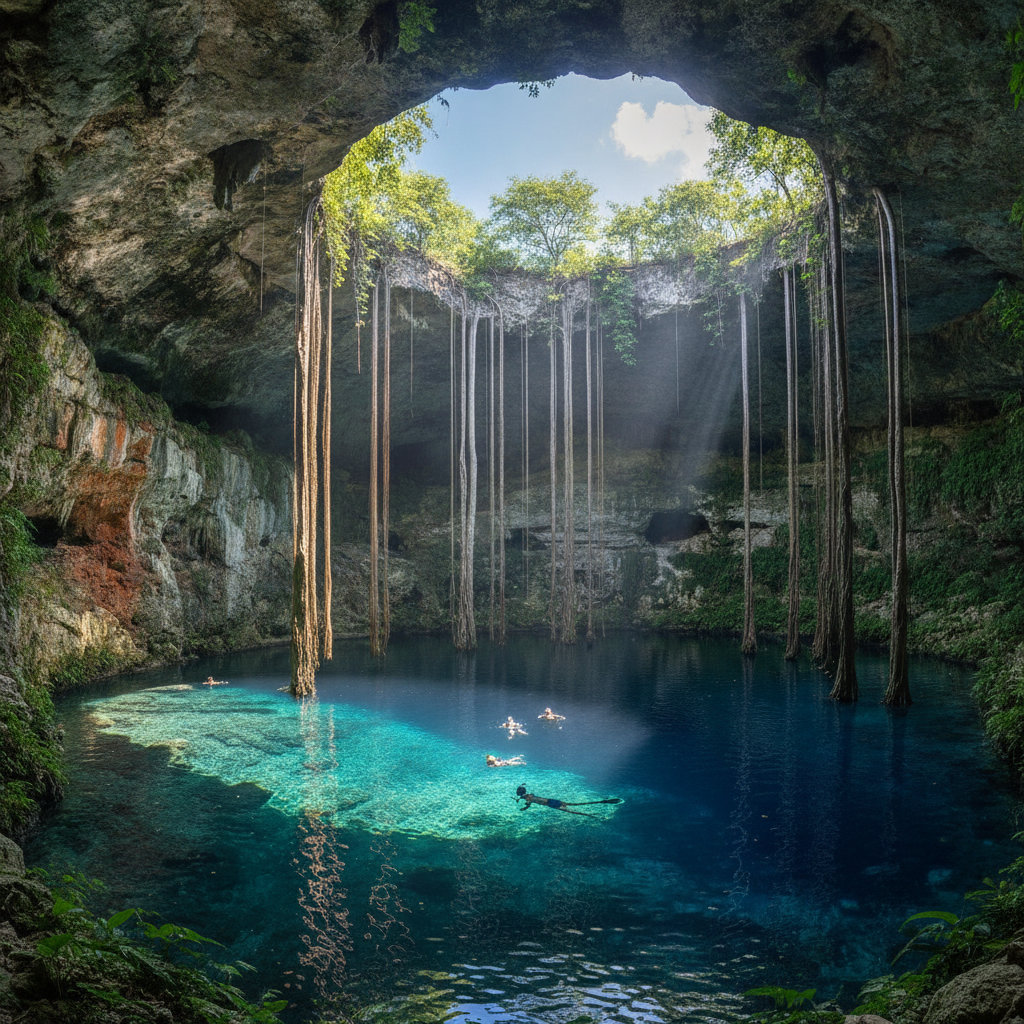
The cenotes (the 'ts'onot' — the natural freshwater sinkholes of the Yucatán limestone karst, ranging from small cave pools to vast open lagoons) and the Xel-Há natural water park (the natural inlet where the fresh water of the cenote system meets the Caribbean Sea — now operated as an all-inclusive snorkelling park on the Riviera Maya) represent the freshwater dimension of the Yucatán's extraordinary natural heritage, the complement to the saltwater reef experience of Cancún.
- 1
Xel-Há Natural Aquatic Park
Xel-Há (the 'Xel-Há' — 'where the water is born' in Maya, the natural inlet at km 240 of the Cancún-Chetumal highway, 120 km (75 miles) south of Cancún — now operated as an all-inclusive natural water park by the Experiencias Xcaret company): the natural inlet (the Xel-Há inlet — the natural phenomenon of the freshwater spring (the cenote water that flows from the limestone karst through underground channels to emerge at the coast) meeting the saltwater of the Caribbean Sea in the Xel-Há inlet, creating a halocline (the mixing zone of fresh and salt water) and the remarkable visibility conditions that make the inlet one of the most biodiverse and most photogenic snorkelling sites on the Riviera Maya): the park activities (the all-inclusive Xel-Há park activities — the snorkelling (the free-float snorkel through the 'río' (the main freshwater-to-saltwater channel of the Xel-Há inlet, floating downstream with the current while observing the fish (the tropical fish of the Caribbean, including the schoolmaster snapper (Lutjanus apodus), the French grunt (Haemulon flavolineatum), and the occasional nurse shark (Ginglymostoma cirratum) resting on the sandy bottom)), the cliff jumping (the small platforms above the inlet from which visitors jump into the water below), the zip-lines over the water, and the bike rental for the mangrove paths of the surrounding park): the fish feeding (the fish feeding at Xel-Há — the schools of fish that have been habituated to the presence of snorkellers in the inlet and that surround the snorkellers in large numbers, creating the sensation of swimming in an aquarium).
- 2
Gran Cenote & the Tulum Cenote Trail
The Gran Cenote (the 'Grand Cenote' — the most popular open cenote on the Tulum Cenote Trail, located 3 km (2 miles) west of the Tulum beach area on the road from the Tulum town centre to the Cobá ruins): the Gran Cenote experience (the Gran Cenote — the semi-open cenote (partially roofed with the stalactite-hung limestone cave ceiling, partially open to the sky) with the turquoise freshwater pool, the stalactites and stalagmites (the calcium carbonate formations that take thousands of years to grow in the cave environment), and the cave passages leading into the larger Sistema Sac Actun cave system): the cenote types (the four types of Yucatán cenote — the 'joya' (the pit cenote — the cylindrical or conical pit open to the sky, the deepest type, exemplified by the Cenote Ik Kil near Chichén Itzá), the 'gruta' (the cave cenote — the fully enclosed cenote inside a limestone cave, requiring diving equipment to access), the 'semiabierta' (the semi-open cenote — the most common and most visited type, with the partial cave ceiling and the partial open sky, exemplified by the Gran Cenote and the Cenote Dos Ojos), and the 'aguada' (the lake cenote — the cenote where the water table is at or near the surface, creating the appearance of a small lake)): the Cenote Dos Ojos (the 'Two Eyes' cenote — the cenote named for the two adjacent open pools that appear as two eyes when viewed from the air, 18 km (11 miles) north of Tulum on the highway — one of the most popular cave diving and snorkelling sites in the Yucatán, part of the Sistema Dos Ojos which is one of the world's longest known underwater cave systems (82 km / 51 miles of mapped passages)).
- 3
Puerto Morelos & Cancún's Quieter Alternative
Puerto Morelos (the small fishing town 36 km (22 miles) south of Cancún — the closest settlement to the Cancún International Airport and the primary 'quiet alternative to Cancún' destination for the traveller who wants the Caribbean beach experience without the mass-market resort atmosphere of the Hotel Zone): the town (Puerto Morelos — the small, largely pedestrianized town centre (the 'pueblo') around the central plaza, the leaning lighthouse (the 'faro inclinado' — the lighthouse that was struck and partially toppled by Hurricane Beulah in 1967 and that has been left in its tilted position as a local landmark), and the small boat harbour where the local fishing fleet and the whale shark tour boats dock): the Puerto Morelos reef (the Parque Nacional Arrecife de Puerto Morelos — the section of the Mesoamerican Barrier Reef immediately offshore of Puerto Morelos, one of the most accessible and least-visited reef snorkelling sites in the Mexican Caribbean, accessible by kayak from the beach or by the 'lancha' (the small boat tour) from the Puerto Morelos harbour): the book town (the 'pueblo mágico' atmosphere of Puerto Morelos — the town known for the independent bookshop ('Alma Libre Bookstore' — the legendary used bookshop on the Puerto Morelos central plaza, a favourite of the North American expats who have settled in Puerto Morelos)), the artisan market (the weekend artisan market on the Puerto Morelos central plaza, with the Mexican handicrafts and the local food), and the slow pace of life that contrasts sharply with the relentless activity of the Cancún Hotel Zone 36 km to the north.
- 4
Akumal — Swimming with Sea Turtles
Akumal (the 'Place of the Turtle' in Maya — the small village on the Riviera Maya, 97 km (60 miles) south of Cancún, named for the sea turtles that nest on its beaches and that feed in the seagrass beds of the 'Bahía de Akumal' (the 'Bay of Akumal')): the sea turtle snorkelling (the most popular activity in Akumal — the snorkelling in the shallow (1-4 metre / 3-13 foot) seagrass beds of the Bahía de Akumal to observe the green sea turtles (Chelonia mydas) feeding on the turtlegrass (Thalassia testudinum)): the turtles (the Akumal sea turtles — the green sea turtles that have been feeding in the Bahía de Akumal for decades, habituated to the presence of snorkellers (the snorkellers are required to maintain a minimum distance of 1 metre from the turtles and not to touch them), the turtles present year-round in the bay (the seagrass beds of Akumal are one of the most important green sea turtle feeding habitats in the Mexican Caribbean)): the nesting season (the sea turtle nesting season at Akumal — from May to October, when the female green sea turtles and the loggerhead sea turtles (Caretta caretta) come ashore to nest on the Akumal beach and the adjacent beaches): the Centro Ecológico Akumal (the 'CEA' — the marine conservation organization in Akumal that monitors the sea turtle population of the bay, manages the snorkelling activity to minimize disturbance to the turtles, and operates the turtle conservation programme (the nest monitoring and protection, the hatchling release ceremonies) that has protected the Akumal sea turtle population since 1993).
- 5
Riviera Maya Boutique Hotels & Eco-Resorts
The Riviera Maya boutique hotel scene (the alternative to the all-inclusive mega-resort of the Cancún Hotel Zone — the collection of boutique hotels, eco-resorts, and design hotels that has developed along the Riviera Maya coast from Puerto Morelos to Tulum since the 1990s): the Tulum hotel zone (the Tulum 'Zona Hotelera' — the stretch of boutique eco-resorts and design hotels on the beach road south of the Tulum ruins, the destination that has become the most fashionable and most Instagram-photographed resort destination in Mexico in the 2010s-2020s, the 'Tulum style' (the design aesthetic of the open-air thatched-roof palapa structures, the hand-crafted wood and wicker furniture, the outdoor showers, the natural pools, and the yoga platforms that define the Tulum boutique hotel aesthetic)): the Papaya Playa Project (the Papaya Playa Project — the most famous boutique eco-resort in Tulum, on the beach road 4 km south of the Tulum ruins, the resort that became the defining example of the Tulum design aesthetic and that hosts the monthly Full Moon Party (the outdoor electronic music party on the beach)): the Azulik (the Azulik resort — the most photogenic and most architecturally ambitious of the Tulum boutique hotels, the resort of treehouse-style villas built in the jungle on the cliff above the Caribbean Sea, with the 'nests' (the individual villa structures built from the living wood of the trees), the 'Muluk Studio' (the contemporary art gallery within the resort), and the 'Mia' restaurant (the fine dining restaurant serving the Tulum cuisine — the plant-based, locally sourced food that has made Tulum the most important destination for health and wellness food culture in Mexico)).
- 6
Tulum Town & Wellness Culture
Tulum town (the 'pueblo' of Tulum — the small Mexican town 2 km inland from the Tulum beach hotel zone, accessible from the hotel zone by bicycle or taxi): the Tulum town character (the rapidly growing Mexican town of approximately 40,000 permanent inhabitants (2020) that has transformed from a quiet market town serving the local Maya and mestizo population into the service centre for the Tulum tourism industry, with the restaurants, the supermarkets, the bicycle rental shops, the yoga studios, the holistic health centres, and the 'alternative' spiritual practices (the temazcal (the pre-Hispanic sweat lodge ceremony), the cacao ceremony, the ayahuasca retreats) that have made Tulum the most important wellness tourism destination in Mexico): the Tulum wellness economy (the wellness tourism industry in Tulum — the yoga retreats, the meditation centres, the holistic health programmes, the plant medicine ceremonies, and the raw food and vegan restaurants that have attracted a global community of wellness tourists (predominantly North American and European) to Tulum since the mid-2010s and that have made Tulum the fastest-growing small city in Mexico): the gentrification (the gentrification of Tulum — the tension between the rapidly rising property prices (driven by the international wellness tourism and property investment), the displacement of the local Maya and mestizo residents from the areas of highest tourism value, and the extraordinary ecological pressure on the Tulum ecosystem (the overloaded sewage system that is contaminating the cenotes and the Sian Ka'an lagoon system, the construction on the beach dunes that is destroying the sea turtle nesting habitat, and the well-documented cocaine trade that has brought cartel violence to the town in the late 2010s-2020s).
Walk this route with audio
Stories play automatically as you reach each stop — no tapping needed.
More in cancun
Cancún Spring Break, Music Festivals & Beach Party Culture
Downtown Cancún, Mexican Street Food & Local Life
Sian Ka'an Biosphere Reserve & Mayan Jungle Wilderness
Cancún's Hotel Zone, Caribbean Beaches & Turquoise Waters
The Mesoamerican Reef, Snorkelling & Cancún's Marine World