The Largest Urban Hiking Trail Network in South Korea, the World's Largest Department Store by Floor Area & the Ssiat Hotteok Queue That Defines Busan Street Food
The Taejongdae lighthouse view toward Tsushima Island 50 km south; the Gwangan Bridge Friday drone show as the best free spectacle in Busan; the 278-km Busan Dulle-gil as the most extensive urban trail network in South Korea; the Oryukdo Islands whose count changes with the tide; the Choryang Milmyeon Street's 1953 Gaya Milmyeon as the oldest operating milmyeon restaurant; and the Shinsegae Centum City as the Guinness-certified world's largest department store since 2009.
- 1
Taejongdae Park – Busan's Dramatic Cliffs
Taejongdae (태종대—the rocky peninsula at the southern tip of Yeongdo Island, connected to the Busan mainland by the Busan Bridge): the most dramatic natural landscape within Busan city limits and the most historically important park in the city. The Taejongdae geology (the park is built on the exposed metamorphic and volcanic rock of the Yeongdo headland—the rock formations at the cliff edge show horizontal sedimentary banding indicating ancient seabed uplift; the coastal erosion has produced the characteristic wave-cut platforms and sea caves at the cliff base): the park's signature landform (the Sinseon Rock—the large flat boulder at the cliff's edge where legend says the Silla King Taejong (654–661 CE) performed archery practice): the park's name derives from this royal archery legend. The Danubi Train (the internal circulating train within Taejongdae Park—the small open-sided tourist train that circles the 4.3-km park road and stops at the key viewpoints): the most practical way to navigate the hilly park for visitors who prefer not to walk the entire circuit. The lighthouse (the Yeongdo Lighthouse at the southernmost point of Taejongdae—the active lighthouse marking the shipping lane into Busan Port from the south; the lighthouse observation deck provides the view of the open sea south toward Japan with the Tsushima Island visible on clear days at 50 km distance).
- 2
Nampo-dong & Busan Tower – The City Center
The Nampo-dong district (남포동—the traditional commercial and entertainment center of Busan, located in the Jung-gu district surrounding Busan Station and the Jagalchi waterfront): the historic core of Busan that predates the resort development of Haeundae and the port expansion of the modern city. The Yongdusan Park (the hilltop park in the center of Nampo-dong, approached by a steep stairway from the Nampo-dong shopping street): the location of the Busan Tower (the 120-metre observation tower built in 1973—the landmark silhouette of central Busan visible from the sea; the observation deck at 102 metres provides the best panoramic view of the Busan Port and the Nampo-dong city center, the cargo cranes of the Busan North Port, and the Geumjeong Mountain to the north). The Gukje Market (국제시장—International Market, the large traditional market covering 8 blocks in the Nampo-dong area, established during the Korean War when traders set up stalls around the port area): the market's Korean War origin (the name 'International Market' derives from the post-war black market trading of US military goods, imported goods, and Japanese items that characterized the market in the 1950s). The Bupyeong Kkangtong Market (the night market adjacent to Gukje Market—the 'can market' (깡통 시장) that operates from 18:00 to midnight with the highest concentration of street food vendors in central Busan): the most authentic Busan evening food experience in the city center.
- 3
Busan's Beaches Beyond Haeundae
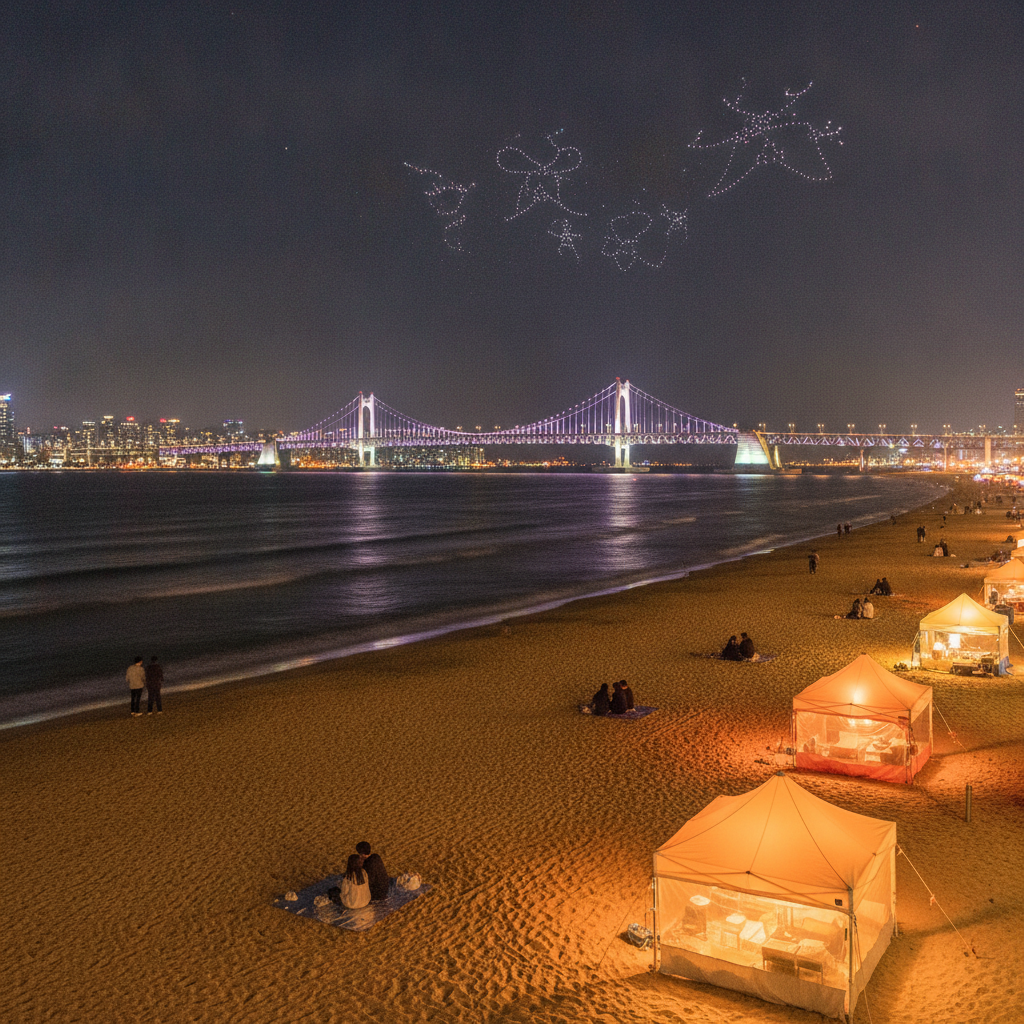
The Busan beach landscape (the city has 7 publicly accessible beaches within its city limits—the most concentrated beach resource of any major city in Northeast Asia): the guide to the beaches beyond the famous Haeundae for the visitor who wants less crowd and more character. Gwangalli Beach (광안리 해수욕장—the 1.4 km beach in the Suyeong district, 3 km west of Haeundae): the beach with the most dramatic night view in Busan (the Gwangan Bridge (Diamond Bridge)—the 7.4 km suspension bridge illuminated in coloured LED lights visible from the beach): the Friday night drone show over the Gwangan Bridge (the Busan Metropolitan City weekly drone light show—100 synchronized drones performing above the bridge and beach): the best free evening spectacle in Busan. Songjeong Beach (송정 해수욕장—the 1.2 km beach in the Gijang district, 5 km north of Haeundae on the coastal railway line): the least crowded quality beach accessible from central Busan by train and the primary surfing beach in Busan. Dadaepo Beach (다대포 해수욕장—the 900-metre beach at the southwestern tip of Busan near the Nakdong River estuary): the beach with the most important sunset view in Busan (faces due west over the Yellow Sea): the Dadaepo Sunset Fountain (the largest fountain in Asia when activated—operates nightly at sunset with music synchronization).
- 4
Busan's Hiking Culture – City Trails
The Busan hiking culture (the most developed urban hiking culture in South Korea—Busan's dramatic topography of multiple mountain ridges running through the city creates a network of trails accessible directly from residential neighbourhoods without requiring transport out of the city): the Busan Dulle-gil (the 278-km circular hiking trail system encircling the entire Busan city limit—the most extensive urban trail network in South Korea, divided into 21 sections). The Igidae Coastal Trail (the 5.5 km cliff-top trail along the southern coast of Busan from Oryukdo Island to Namcheon-dong): the most visually rewarding single trail section in Busan (the trail alternates between sea cliff viewpoints looking south toward the open ocean and the forest ridge), with the Oryukdo Islands (the 5–6 small rocky islands at the eastern entry to Busan Harbour—'oryukdo' means '5-6 islands' because the count changes with the tide) as the starting landmark. The Hwangnyeongsan Trail (the central city mountain (427m) connecting the Yeonje-gu and Dongnae districts—the trail accessible from Banyeo Station (Metro Line 3) and reaching the summit with a 360-degree city view in 45 minutes from the trailhead): the most efficient high-altitude city view in Busan. The Dalmaji Hill walk (the coastal ridge walk above the eastern end of Haeundae Beach—the hill road with cherry blossoms in spring (late March) and the highest concentration of cafes and art galleries on a walking path in Busan): the most pleasant afternoon walk in the Haeundae area.
- 5
Busan's Korean Food Deep Dive
The complete Busan food guide beyond dwaeji gukbap and milmyeon (the broader Busan culinary landscape that reflects the port city's fishing heritage, its Japanese colonial influence, and its Korean War food innovation): the framework for eating through Busan systematically. The seafood (Busan's fishing port heritage means the city has Korea's most competitive raw seafood (hoe) culture—the flatfish (광어, gwangeo) sashimi at the Haeundae raw fish center (the 40-restaurant hoe complex in the alley behind Haeundae Beach where a live flatfish is killed tableside and served as sashimi with the skeleton deep-fried as a second course): the most complete Korean seafood dining experience in the city. The ssiat hotteok (씨앗 호떡—the seed hotteok): the Busan version of the Korean street pancake filled with brown sugar, honey, and mixed seeds (sunflower, pumpkin, sesame) rather than the plain brown-sugar filling of the Seoul version: the Nampo-dong ssiat hotteok vendors (the queuing vendor stalls on the BIFF Square side street) are the most iconic Busan street food experience. The Choryang Milmyeon Street (the block of milmyeon restaurants in the Choryang district near Busan Station that has been the traditional milmyeon center since the 1950s when North Korean refugees established the first wheat noodle restaurants here): the Gaya Milmyeon restaurant is the oldest continuously operating milmyeon restaurant in Busan (est. 1953). The Dongnae pajeon (동래 파전—the Dongnae district's green onion seafood pancake): the Busan variant of the seafood pancake that uses the entire spring onion rather than chopped pieces and adds shellfish and squid: Dongnae-style pajeon is rated the best version in Korea.
- 6
Busan 4-Day Itinerary – The Complete First Visit
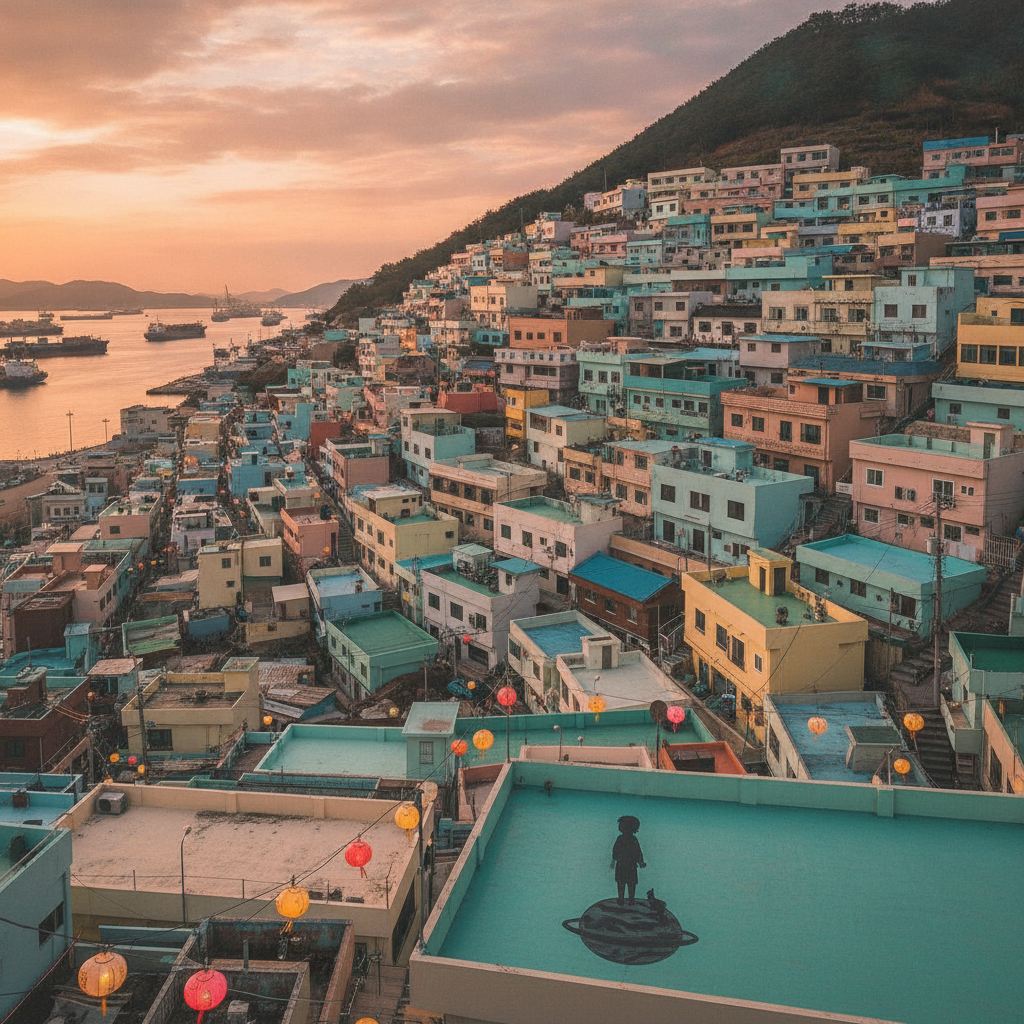
The complete Busan 4-day first visit itinerary (the schedule that covers the essential sites in a logical geographic sequence, minimizing backtracking and building from the historical center outward to the beaches): Day 1 (Central Busan): arrive at Busan Station by KTX from Seoul → walk to Nampo-dong (20 minutes) → Jagalchi Market lunch (the 2nd-floor restaurant for live fish—order the gwangeo hoe set) → BIFF Square handprint walk → Gukje Market → Gamcheon Culture Village (sunset—the village in late afternoon light is the most photogenic moment) → return to Nampo-dong for dwaeji gukbap dinner at the Odeng Sikdang (the most consistently recommended old-school dwaeji gukbap restaurant near Nampo station). Day 2 (Southern Busan): Taejongdae Park morning (9:00 arrival before the weekend tour buses) → Danubi Train circuit → lighthouse viewpoint → Haedong Yonggungsa Temple afternoon (the temple in afternoon light with the tide in is the most photogenic condition) → Haeundae Beach evening walk. Day 3 (Northern Busan): Beomeosa Temple morning (the 5:40 bus from Beomeosa Station (Metro Line 1) reaches the temple before the tour groups) → Geumjeong Mountain Fortress ridge walk to North Gate (3 hours) → Seomyeon for late lunch and Seomyeon underground shopping. Day 4 (Haeundae & departure): Gwangalli Beach morning (the beach at 9:00 before the swimmers arrive, with the Gwangan Bridge in morning light) → Centum City shopping (the Shinsegae Centum City—the world's largest department store by floor area, Guinness certified since 2009) → Gimhae Airport for international departure or KTX back to Seoul.
Walk this route with audio
Stories play automatically as you reach each stop — no tapping needed.
More in Busan
The Only UN Cemetery in the World, the 1,348-Year-Old Monastery Where Morning Prayer Starts at 04:00 & the Film Festival That Introduced Korean Cinema to the World