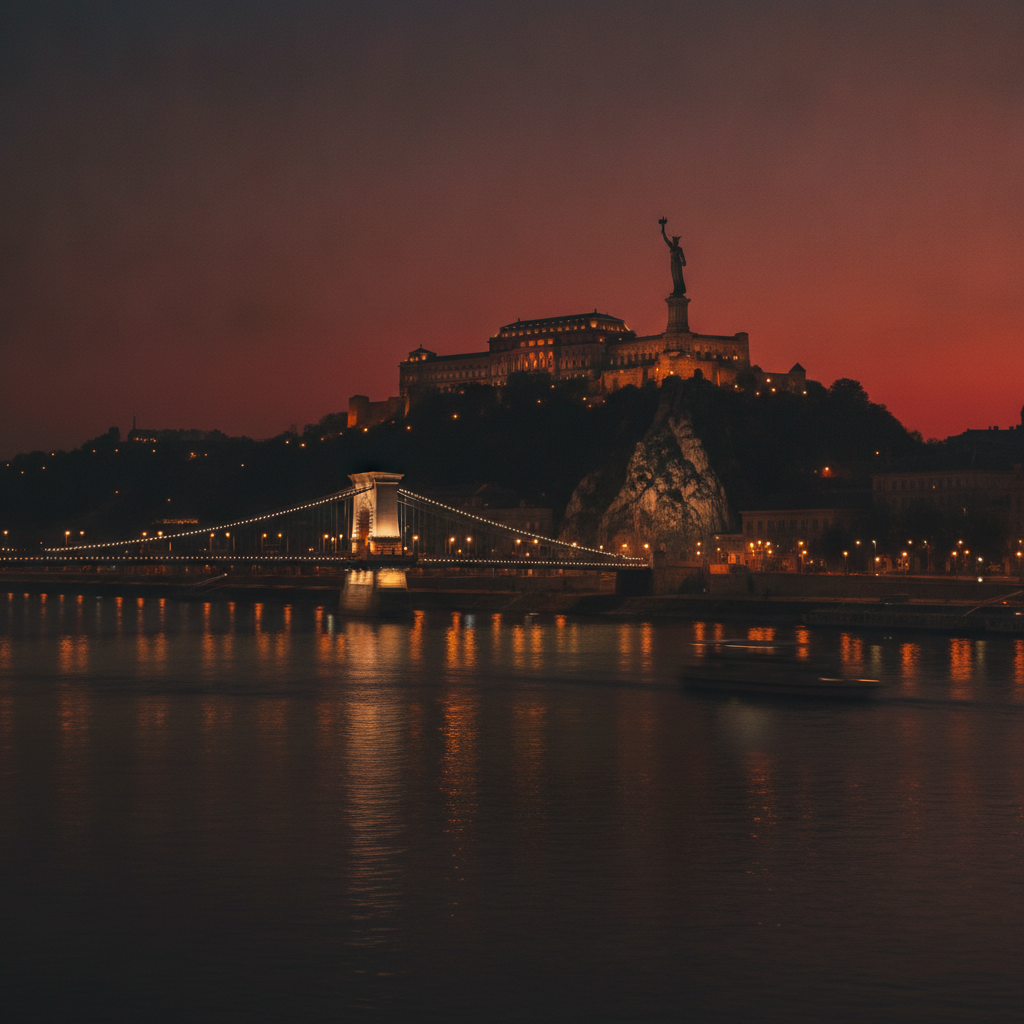
Green Island in the River: Margaret Island
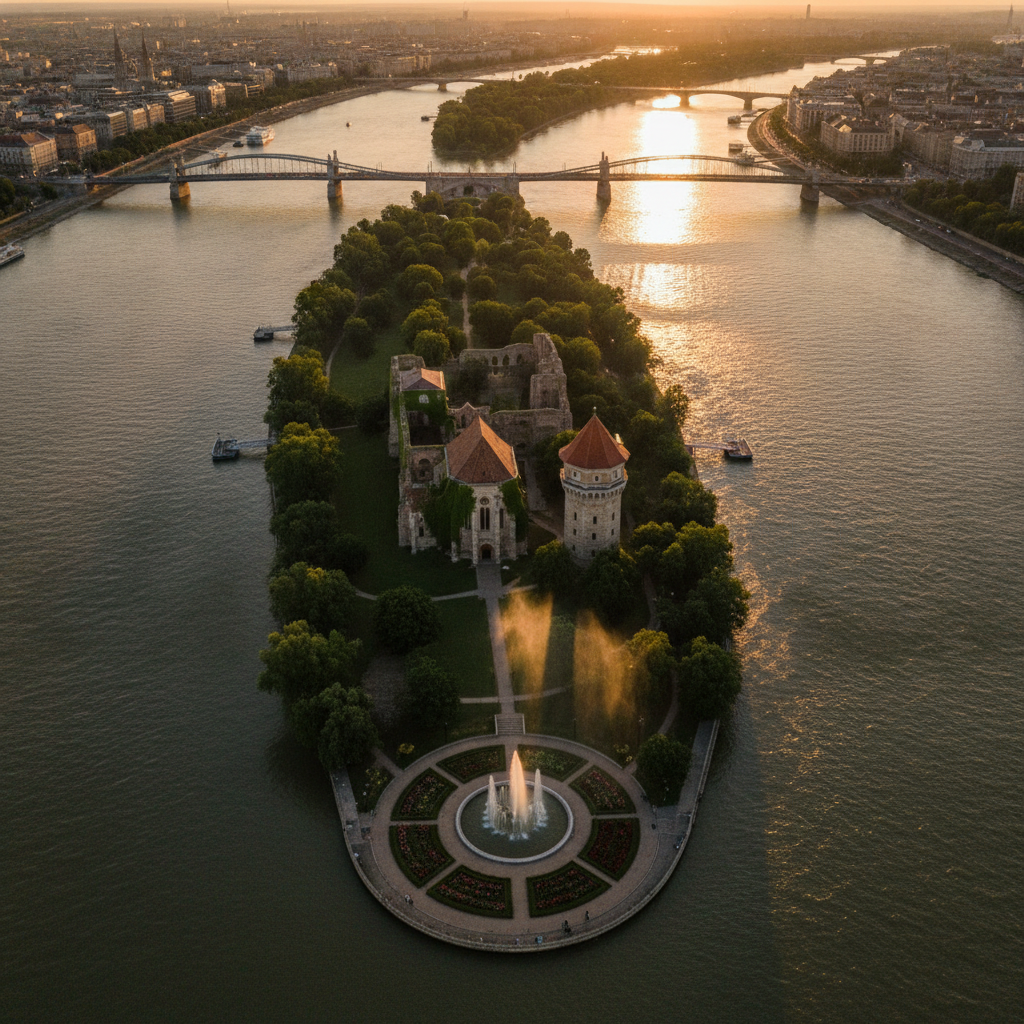
Margaret Island (Margit-sziget), a 2.5-kilometer-long island in the middle of the Danube between the Margaret and Árpád bridges, is Budapest's most beloved public park — a car-free green space containing medieval ruins, thermal springs, a musical fountain, rose gardens, and an open-air theatre, used daily by Budapestians for running, cycling, swimming, and picnicking.
- 1
Margaret Bridge (Margit híd) & Island Approach
Margaret Bridge (Margit híd), built between 1872 and 1876 by the French engineer Ernest Goüin, is unusual in being a Y-shaped bridge with a separate arm descending to Margaret Island — the only bridge in the world with this configuration. The bridge's distinctive feature is the obtuse angle at which its two main spans meet above the island arm, necessitated by the island's position; this gives it an elegant, quirky geometry visible from both riverbanks. The bridge was catastrophically destroyed by a German mine in November 1944 during afternoon rush hour — with nearly 40 trams, buses, and hundreds of pedestrians on it; the current bridge was rebuilt by 1948.
- 2
Japanese Garden & Centenary Monument
The Japanese Garden at the northern end of the Margaret Island approach (near the Centenary Monument fountain) is a small but carefully maintained traditional Japanese garden with a pond, stone lanterns, azaleas, and a wooden bridge. It was created in the 1960s as a gift from the Japanese government. The Centenary Monument (1973) — a musical fountain near the southern entrance to the island — was built to commemorate the centenary of the unification of Buda, Óbuda, and Pest into Budapest in 1873; it plays musical performances synchronized with water choreography every hour in summer.
- 3
Dominican Convent Ruins & Princess Margaret's Chapel
The ruins at the center of Margaret Island are those of a Dominican convent founded in 1252 by King Béla IV, who vowed to the Virgin Mary that if Hungary survived the Mongol invasion of 1241-42, he would give his daughter to God. He kept his vow: Princess Margaret lived as a Dominican nun on this island from age 9 until her death in 1271, and was canonized in 1943. The convent's Gothic church and cloister were destroyed in the Ottoman period; the ruins were excavated in the 19th century. The Water Tower (1911), the island's most visible landmark, rises directly above the ruins and is now an open-air theatre and gallery space.
- 4
Palatinus Thermal Bath
The Palatinus Strand, the largest outdoor thermal bath complex in Europe with a capacity for 10,000 bathers simultaneously, was built in 1919 and extended in the 1930s on the site of a natural thermal spring discovered on the island in 1866. Its multiple pools — including a wave pool, a covered thermal pool, water slides, and children's areas — use water from the island's underground thermal sources. The complex is particularly popular with families from all over the city; during peak summer weekends it is one of the liveliest places in Budapest.
- 5
Rose Garden & Premonstratensian Chapel
The rose garden at the southern end of Margaret Island, containing thousands of rose varieties in formal beds, is the most fragrant and visually elaborate section of the island's park. Adjacent to it stand the ruins of the Premonstratensian Chapel — a 12th-century Romanesque church that is the oldest surviving building remains on the island. The chapel's 15th-century bell, recovered from the Danube in 1914 (having fallen in during the Ottoman period), was found still capable of producing its original tone; it now hangs in the reconstructed chapel.
- 6
Sports Complex & Northern Tip
The northern half of Margaret Island is occupied primarily by sports facilities — the National Athletics Centre, tennis courts, a running track used by thousands of Budapestians daily, and a cycling circuit rented by bicycle for the car-free island. The northern tip of the island, accessible by foot or bicycle, approaches the Árpád Bridge (1950) and offers a different perspective on the Danube — upstream toward the Buda hills and the industrial reaches of the river north of the city. The island's northern end is quieter than the tourist-heavy southern section and favored by locals for undisturbed recreation.
Walk this route with audio
Stories play automatically as you reach each stop — no tapping needed.
More in budapest
The Jewish Quarter: Dohány Synagogue, Memorial & Ruin Bars
Inner City Markets: Great Market Hall, Váci Street & the Danube Embankment
Roman Budapest: Aquincum, Óbuda & the Ancient City Beneath the Modern
The Grand Boulevard: Andrássy Avenue from Opera to Heroes' Square
Parliament & the Danube: Lipótváros, Chain Bridge & St. Stephen's Basilica