The Jewish Quarter: Dohány Synagogue, Memorial & Ruin Bars
Budapest's 7th district — the Erzsébetváros (Elizabeth Town) — contains the largest surviving Jewish quarter in Central Europe, centered on the Dohány Street Synagogue, the largest in Europe and second largest in the world. The same streets that bore the weight of the 1944-45 Budapest Ghetto now host the ruin bar scene that has made Budapest a global destination for urban nightlife.
- 1
Dohány Street Synagogue (Dohány utcai zsinagóga)
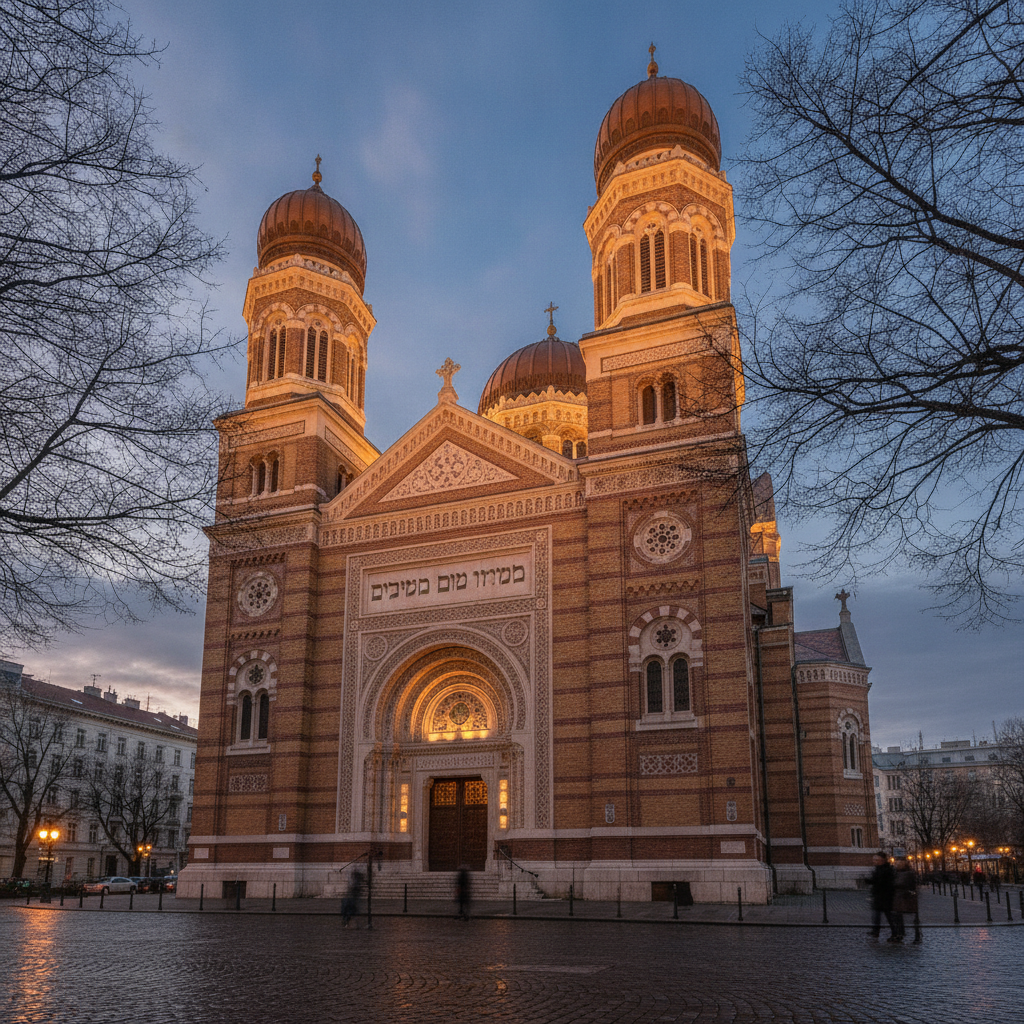
The Dohány Street Synagogue (completed 1859, architect Ludwig Förster), the largest synagogue in Europe with 3,000 seats, is one of the defining monuments of 19th-century Budapest. Its twin copper-domed Moorish towers — inspired by the Great Mosque of Córdoba and the Alhambra — rise 43 meters and are among the most distinctive silhouettes in the city. The synagogue was built at a moment of Jewish emancipation and cultural confidence; its design deliberately incorporated elements of Viennese Historicism and Islamic architecture to create a monumental synthesis that was at once Jewish and Central European. Beside the main building, the Heroes' Temple (1931) was added as a memorial to the 10,000 Hungarian Jews who died in World War I — fighting on the side of Austria-Hungary.
- 2
Hungarian Jewish Museum & Memorial
The Hungarian Jewish Museum, in the wing attached to the Dohány Synagogue, houses one of the most important collections of Judaica in Europe — religious objects, Torah scrolls, community records, and art documenting eight centuries of Jewish life in Hungary. Behind the synagogue, in the courtyard that was inside the Budapest Ghetto wall in 1944-45, the Tree of Life Memorial (1991) by sculptor Imre Varga marks the mass grave of over 2,000 Jews who died of disease and starvation during the Ghetto — its metal weeping willow leaves each engraved with a victim's name. Theodor Herzl, the founder of modern Zionism, was born in a house adjacent to the synagogue site in 1860.
- 3
Kazinczy Street Synagogue & Orthodox Quarter
One block north of the Dohány Synagogue, the Kazinczy Street Synagogue (1913) is the main synagogue of the Orthodox Jewish community of Budapest — a beautiful Hungarian Secession building designed by the brothers Löffler with a facade of polychrome ceramics. The streets around Kazinczy utca preserve the densest concentration of pre-war Jewish institutional buildings in Budapest: kosher restaurants, the Jewish Community offices, the Bethlen Square synagogue, and the preserved houses of the former Ghetto that once housed the entire Jewish population of Budapest within its walls from November 1944 to liberation in January 1945.
- 4
Szimpla Kert (Ruin Bar)
Szimpla Kert, opened in 2002 in a derelict apartment building on Kazinczy utca, is the founding institution of Budapest's ruin bar culture — a globally influential concept in which abandoned, deteriorating urban buildings are turned into multi-room bars and cultural spaces with deliberately unfinished decor: exposed concrete, salvaged furniture, graffiti, plants growing through the ruins. Szimpla now fills an entire courtyard complex and has become one of the most visited bars in the world; its Sunday farmers' market, film screenings, and art events have made it as much a cultural institution as a bar. The ruin bar concept has since spread to dozens of venues in the 7th district.
- 5
Gozsdu Udvar (Courtyard)
The Gozsdu Udvar (Gozsdu Courtyard), a 200-meter-long passage connecting Király utca and Dob utca through a series of seven interconnected courtyards, was built in 1901 as a commercial passage and residence complex for the Jewish community. Named after Manó Gozsdu, a Romanian-Hungarian philanthropist of Greek descent who funded its construction, it was the social spine of the Jewish Quarter — its courtyards containing workshops, small businesses, and community life. After decades of dereliction following the war, it has been restored and is now lined with restaurants and bars that operate primarily at night.
- 6
Király Street (Király utca)
Király utca (King Street), the main commercial artery of the Jewish Quarter running parallel to Andrássy Avenue, is the neighborhood's most dynamic street today — a continuous stretch of independent restaurants, bars, coffee shops, and fashion boutiques that has made the 7th district the gastronomic and nightlife heart of Budapest. The street's mix of pre-war architecture (Art Nouveau, Secession, and Historicist apartment blocks) and contemporary fit-outs in former commercial spaces gives it a character that self-consciously plays the tension between preservation and renewal. The 7th district has been described as one of the few urban quarters in Europe where gentrification has proceeded alongside genuine community preservation.
Walk this route with audio
Stories play automatically as you reach each stop — no tapping needed.
More in budapest
Inner City Markets: Great Market Hall, Váci Street & the Danube Embankment
Green Island in the River: Margaret Island
Roman Budapest: Aquincum, Óbuda & the Ancient City Beneath the Modern
The Grand Boulevard: Andrássy Avenue from Opera to Heroes' Square
Parliament & the Danube: Lipótváros, Chain Bridge & St. Stephen's Basilica