Brisbane: South Bank Artificial Beach and Arts Precinct, Lone Pine World Largest Koala Sanctuary, Story Bridge Climb and CityCat Ferry, Mount Coot-tha Lookout, and Complete Gateway City Practical Guide
Brisbane: South Bank parklands (Streets Beach, GOMA, Queensland Art Gallery), Lone Pine Koala Sanctuary (world largest, 130+ koalas, koala holding), Story Bridge and Howard Smith Wharves, Mount Coot-tha panoramic views and Botanic Gardens, and the complete Brisbane practical guide as Queensland gateway city.
- 1
Brisbane - the Sunshine Capital of Queensland
Brisbane (population approximately 2.5 million metropolitan area): the capital city of Queensland and the third-largest city in Australia. Brisbane (Meanjin in the Turrbal and Jagera languages: the place of the Melaleuca spike rush) sits on the Brisbane River, 16 km from Moreton Bay on the Pacific coast. Brisbane was established in 1824 as a penal colony for the most hardened convicts from Sydney; the free settlement of Queensland began in 1842 when transportation ended and the Moreton Bay district opened to free settlers. Brisbane climate: subtropical, with warm winters (average July maximum 21 degrees C) and hot, humid summers (average January maximum 29 degrees C). Brisbane receives approximately 2,800 sunshine hours per year, one of the sunniest major cities in Australia. The 2032 Brisbane Olympics: Brisbane will host the Summer Olympic Games in 2032, the third Australian Olympic Games after Melbourne 1956 and Sydney 2000. The Brisbane city skyline: the Story Bridge (the heritage cantilever bridge, opened 1940) and the Brisbane River are the signature images of the city; the CBD sits on a bend of the river with the South Bank arts and leisure precinct on the south bank.
- 2
South Bank - Brisbane Artificial Beach and Arts Precinct
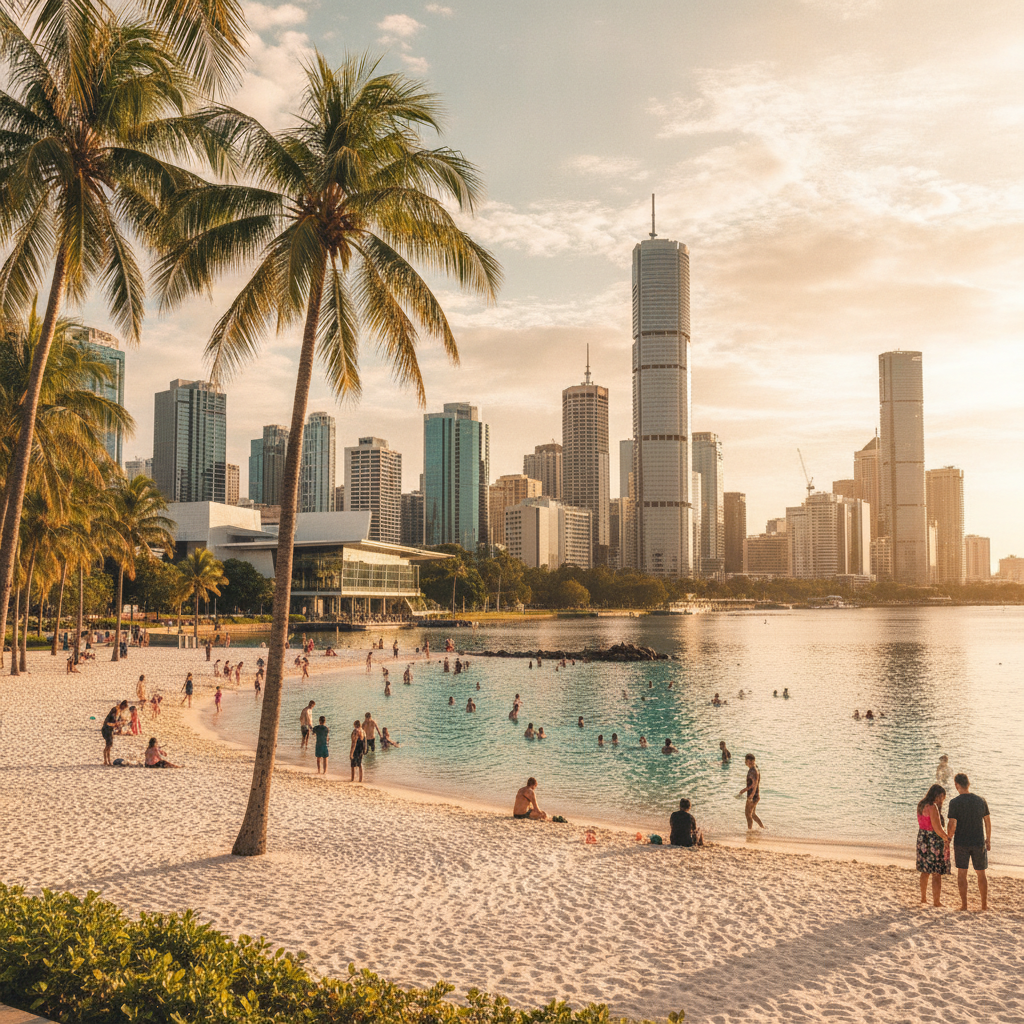
South Bank (the precinct on the south bank of the Brisbane River, directly opposite the CBD): the primary leisure and arts precinct of Brisbane, developed after the 1988 World Expo. South Bank Parklands: the 17-hectare riverfront parkland with streets beach (the artificial beach with a lagoon, open year-round with lifeguards), the rainforest walk, the markets, and the riverside promenade. Streets Beach: the man-made beach in the heart of Brisbane, with white sand, palm trees, and a safe swimming lagoon; the only city-center artificial beach in Australia. The Queensland Cultural Centre (at the north end of South Bank): the complex of Queensland museums and galleries including the Queensland Museum (the natural history, science, and social history museum), the Queensland Art Gallery (opened 1982, focusing on Australian and Asian-Pacific art), the Gallery of Modern Art (GOMA, opened 2006, the largest gallery of modern and contemporary art in Australia), the Queensland Performing Arts Centre (QPAC), and the State Library of Queensland. The GOMA: the Gallery of Modern Art has one of the finest contemporary art collections in the southern hemisphere, with particular strength in Asia-Pacific contemporary art. The South Bank weekend markets: the collective of markets including the Collective Markets (Friday, Saturday, and Sunday evenings) and the Lifestyle Markets (Saturday and Sunday).
- 3
Lone Pine Koala Sanctuary - the World Largest Koala Sanctuary
Lone Pine Koala Sanctuary (approximately 11 km southwest of Brisbane CBD, on the banks of the Brisbane River at Fig Tree Pocket): the world largest koala sanctuary (over 130 koalas) and one of the oldest (established 1927). The koala holding experience at Lone Pine: Australia only allows koala holding for paying visitors in Queensland (and South Australia, under limited conditions); holding a koala at Lone Pine is one of the most popular visitor activities in Australia. Koala biology: the koala (Phascolarctos cinereus) sleeps 18-22 hours per day (the high-fiber, low-nutrition eucalyptus diet requires minimal energy expenditure); the average koala weighs 4-15 kg; their fingerprints are nearly identical to human fingerprints. Lone Pine other species: kangaroo and wallaby feeding (visitors can buy kangaroo food and hand-feed the mob in the open enclosures), platypus (the shy monotreme in its indoor pool habitat), Tasmanian devil, wombat, echidna, and a large collection of Australian birds. The Brisbane River Cruise to Lone Pine: the Mirimar cruise from South Bank to Lone Pine (1 hour) provides a scenic river journey through the Brisbane suburbs. The koala conservation note: wild koala populations in southeast Queensland have declined dramatically due to habitat loss, dog attacks, and chlamydia disease.
- 4
Story Bridge and Brisbane River Activities
The Story Bridge (the cantilever bridge spanning the Brisbane River between the Kangaroo Point cliffs and the Fortitude Valley/New Farm area): the second-longest cantilever bridge in Australia (opened 1940, named for John Douglas Story, a senior Queensland public servant). The Story Bridge Adventure Climb: the guided climb of the Story Bridge arch structure (similar to the Sydney Harbour Bridge Climb concept), with panoramic views of the Brisbane CBD and the river from the summit. The Kangaroo Point Cliffs (the vertical basalt cliffs on the south bank of the Brisbane River, opposite the CBD): the rock climbing wall (the cliff face is a public climbing area), the Cliffs Bar (the bar at the base of the cliffs with CBD views), and the Kangaroo Point Green Bridge (the pedestrian bridge connecting Kangaroo Point to the CBD, one of the first new bridges in Brisbane in decades). The Brisbane River Ferry (the CityCat high-speed catamaran ferry service): the fastest public transport connection between New Farm, the CBD, South Bank, West End, and the University of Queensland; the CityCat is a practical commuter service that is also an excellent way to see the river from the water. The Howard Smith Wharves: the historic port warehouses under the Story Bridge, converted to a restaurant, bar, and hotel precinct (the Fantauzzo Hotel, the Greca restaurant, and the outdoor riverside bars).
- 5
Mt Coot-tha and Brisbane Lookout Points
Mount Coot-tha (the 287 m summit with the primary Brisbane lookout, approximately 8 km southwest of the CBD): the primary high point for panoramic Brisbane views, with the city skyline, Moreton Bay, the Glass House Mountains, and on clear days the Scenic Rim ranges visible from the summit. The Mount Coot-tha Botanic Gardens (at the base of the summit): the 52-hectare tropical and subtropical plant collection, with the Japanese Garden, the Tropical Display Dome, the Bonsai House, and the Planetarium. The Sir Thomas Brisbane Planetarium (at the Botanic Gardens): the largest public planetarium in Australia, with the Cosmic Skydome (the 18 m domed theatre with the Zeiss projector). The Brisbane Botanic Gardens (City Botanic Gardens, in the CBD near Alice Street): the original Brisbane Botanic Gardens (established 1855, preceding the Mt Coot-tha gardens) on the banks of the Brisbane River, with the mangrove boardwalk, the bamboo grove, and the riverside lawn used for events. Walkabout Creek Discovery Centre (in The Gap suburb, 10 km from the CBD): the wildlife discovery centre focusing on Queensland native species, particularly nocturnal animals, with a freshwater aquarium and echidna feeding demonstrations.
- 6
Brisbane Practical Guide - Climate, Transport, and Gateway City
Brisbane practical: Brisbane Airport (BNE, 16 km north of the CBD): the third-busiest airport in Australia, with direct flights to all major Australian cities, Asia (Tokyo, Singapore, Hong Kong, Kuala Lumpur, Jakarta), the United States (Los Angeles, San Francisco), Europe (via connection), and the Pacific Islands. The Airtrain (the rail link between Brisbane Airport and the CBD, 22 minutes, AUD 22): the most efficient airport transit in Australia. The TransLink bus and train network: the go card (the Opal-equivalent smartcard for Brisbane public transport) covers trains, buses, and ferries including the CityCat. Brisbane as gateway: the city is the primary gateway for Queensland north (Sunshine Coast 1 hour, Noosa 2 hours, Fraser Island 4 hours, Whitsundays 2 hours by air, Cairns 2.5 hours by air) and the Gold Coast (1 hour south). The Brisbane bar scene: Fortitude Valley (the Valley, the primary nightlife district, with the Chinatown, the fortitude Valley mall, and the club strip on Brunswick Street) and the New Farm/Newstead precinct (the gentrified restaurant and bar zone along the river, with the Howard Smith Wharves and the powerhouse). Best season to visit Brisbane: April to October (the dry season, with mild temperatures and low humidity). December to February is hot and humid, with afternoon thunderstorms.
Walk this route with audio
Stories play automatically as you reach each stop — no tapping needed.
More in brisbane
Brisbane: Byron Bay and Northern NSW, Toowoomba Garden City and Darling Downs, North Stradbroke Island Whales, Turrbal and Jagera Bunya Pine Country, Brisbane Arts (GOMA Asia Pacific Triennial, Brisbane Festival), Four-Route Complete Verdict
Brisbane: Noosa and Sunshine Coast Best Beach, Glass House Mountains Volcanic Plugs, Moreton Island Wild Dolphin Feeding and Tangalooma Wrecks, Fraser Island World Largest Sand Island, Brisbane Food Scene, and Queensland Gateway Assessment