Bologna's Porticoes, Medieval Towers & UNESCO Historic Centre
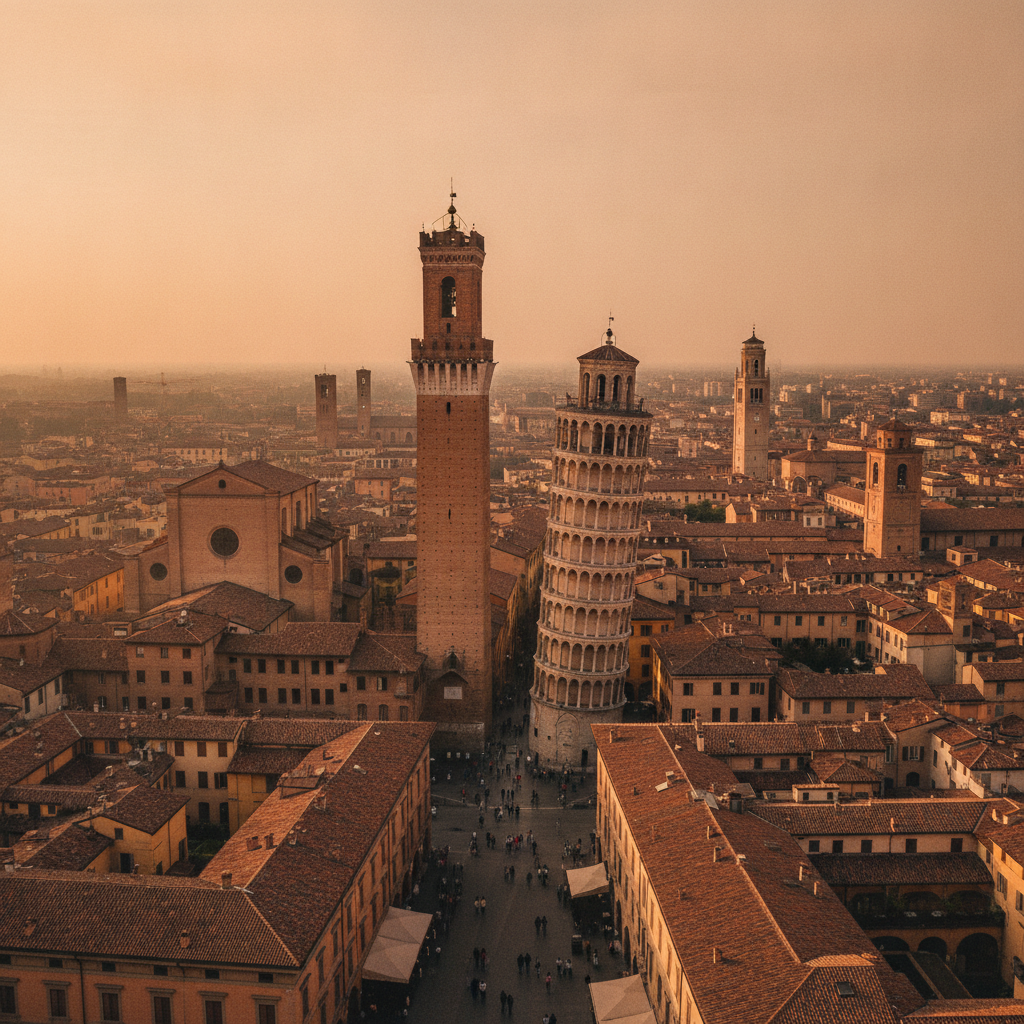
Bologna is 'La Rossa' (the 'Red One' — the city of the red brick buildings and the terracotta tile roofs that give the entire city its distinctive warm reddish-brown colour) and the home of the 'portici' (the porticoes — the UNESCO World Heritage Site covered walkways, 62 km of them in the historic centre alone, that make Bologna the city with the most extensive portico system in the world and the only Italian city where you can walk for kilometres under cover): the Two Towers (the medieval towers of Asinelli and Garisenda, the most iconic landmarks of Bologna), and the Piazza Maggiore (the great central square with the Basilica di San Petronio and the Palazzo del Podestà).
- 1
The Due Torri — Two Medieval Towers of Bologna
The 'Due Torri' (the 'Two Towers' of Bologna — the Torre degli Asinelli and the Torre della Garisenda, the two surviving medieval towers that stand at the intersection of the Via Rizzoli and the Strada Maggiore at the eastern end of the Piazza di Porta Ravegnana, the most iconic landmarks of Bologna): the Torre degli Asinelli (the 'Asinelli Tower' — the taller of the two towers: the tower of 97.2 metres height (the tallest medieval tower in Italy still standing), the tower with the lean of 2.23 metres from the vertical (the lean caused by the subsidence of the unstable clay soil of the Reno River plain on which Bologna is built), the tower built 1109-1119 by the Asinelli family (one of the powerful magnate families of medieval Bologna) and subsequently taken over by the Comune of Bologna (the city government), the tower with the 498 steps to the summit (the climb to the summit of the Asinelli tower offering the most panoramic views of the Bologna historic centre, the Apennine hills to the south, and the Po plain to the north): the Torre della Garisenda (the 'Garisenda Tower' — the shorter and the more dramatically leaning of the two towers: the tower of 48 metres height (truncated from its original height of approximately 60 metres in the 14th century because the lean became so extreme as to threaten the structural stability), the tower with the extraordinary lean of 3.22 metres from the vertical (making the Garisenda visually the more dramatic of the two towers — the lean visible to the naked eye from across the city): the Dante citation (the Torre della Garisenda cited by the Florentine poet Dante Alighieri (1265-1321) in the 'Inferno' of the 'Divine Comedy' (the 'Commedia Divina' — written approximately 1308-1320): Canto XXXI, lines 136-141, in which Dante compares the giant Antaeus bending over him to the Garisenda tower seeming to lean over the observer): the medieval towers of Bologna (the medieval tower culture of Bologna — Bologna as the city of towers: at the height of the tower-building activity (the late 11th-early 12th century), it is estimated that Bologna had between 100 and 180 towers (the towers built by the wealthy families of Bologna as the symbols of family power, the taller the tower the greater the prestige of the family), the towers destroyed by fire, demolished for building material, or incorporated into the later buildings, leaving only the Due Torri and a handful of others surviving into the modern period).
- 2
The UNESCO Porticoes of Bologna
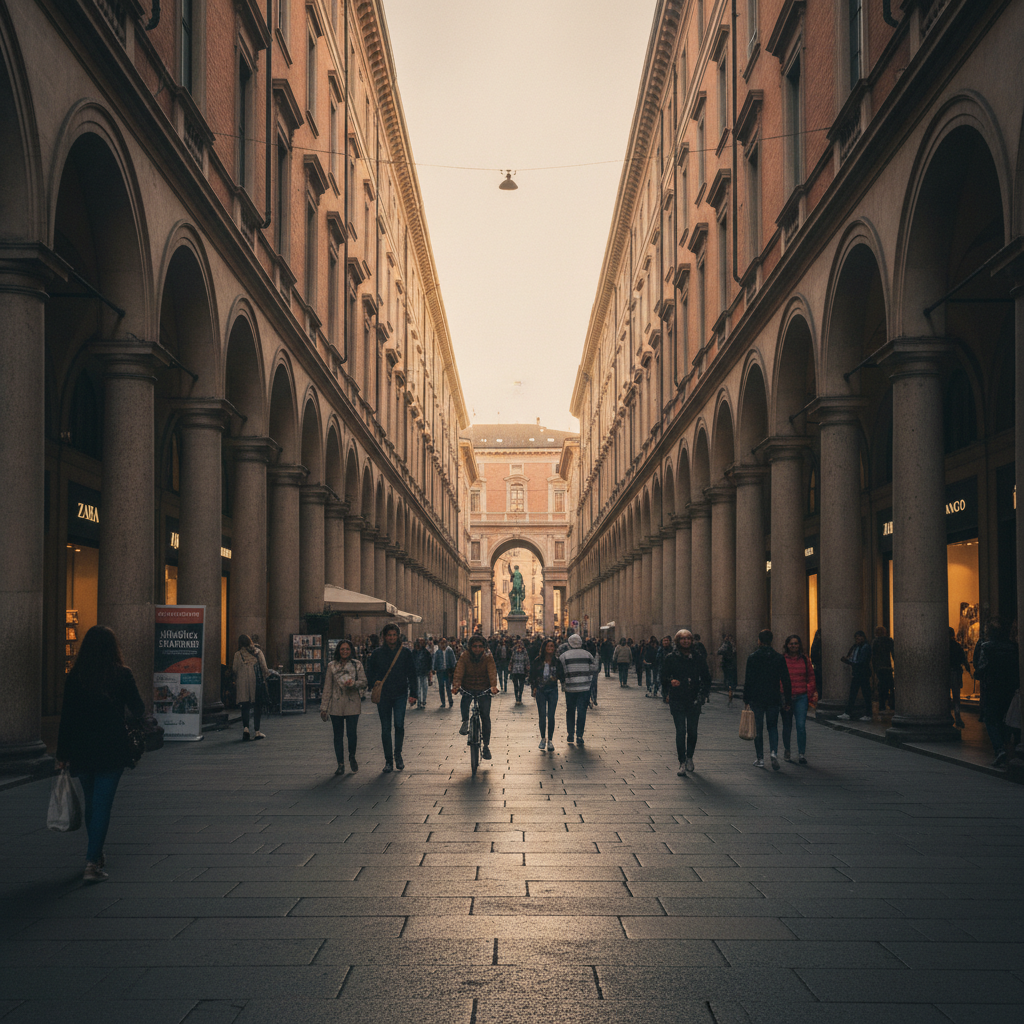
The 'portici di Bologna' (the 'porticoes of Bologna' — the UNESCO World Heritage Site (inscribed 2021 as the 'Porticoes of Bologna'): the covered walkways ('portici' — the colonnaded or arched passages at street level, set into the ground floor of the buildings above, allowing pedestrians to walk under cover along the streets) that are the defining architectural feature of Bologna and the most distinctive urban element of the city: the history (the porticoes of Bologna — the history of the Bologna portico: the first documented regulation of the Bologna porticoes dates to 1041 (the earliest documented portico regulation in Italy), the regulation requiring the landlords of the University of Bologna student accommodation to provide the covered porticos at a minimum height of 2.66 metres (the height needed to allow a person on horseback to pass underneath): the development (the development of the Bologna portico system: from the wooden porticoes of the medieval period (the first porticoes built from wood on the wooden structures projecting from the façades of the upper-storey additions to the ground-floor buildings) to the brick and stone porticoes of the Renaissance and the Baroque periods (the stone columns and the brick arches that replaced the wooden structures as the permanent architectural feature of the Bologna street): the extent (the extent of the Bologna portico system — the total length of porticoes in the City of Bologna: 62 km of porticoes within the historic centre (the area within the medieval walls), the total length of porticoes in the entire Bologna municipality (including the suburbs) of approximately 38 km: the Portico di San Luca (the single longest portico in the world — the 3.796 km covered portico that climbs from the Porta Saragozza in the historic centre to the Basilica di San Luca on the Colle della Guardia above Bologna, the portico with 666 arches (the 666 arches — the number evoking the 'Number of the Beast' was deliberate, reflecting the medieval pilgrimage tradition of building 666 arches as a penitential act))).
- 3
Piazza Maggiore & the Basilica di San Petronio
The Piazza Maggiore (the 'Major Square' — the main civic square of Bologna, the largest medieval-era civic square in Italy, the piazza that is the heart of the public life of Bologna): the piazza (the Piazza Maggiore — the great rectangular open space of approximately 115 × 60 metres, flanked by the Basilica di San Petronio (the largest unfinished Gothic church in the world), the Palazzo dei Notai, the Palazzo d'Accursio (the Bologna City Hall), and the Palazzo del Podestà: the Piazza del Nettuno (the 'Piazza of Neptune' — the small piazza adjacent to the Piazza Maggiore, connected at the northwest corner, containing the 'Fontana del Nettuno' (the 'Neptune Fountain' — the Renaissance bronze fountain by the Flemish sculptor Jean de Boulogne ('Giambologna') (1529-1608), the fountain commissioned by the papal legate Cardinal Charles Borromeo and completed in 1566, the bronze Neptune (the 'Nettuno': the standing 3.2-metre bronze figure of Neptune with the trident, the figure surrounded by the four putti ('puttini') each holding a dolphin spouting water, and the four female figures at the base (each woman squeezing the water from her breast in the 'fontana dell'acqua' gesture)): the Basilica di San Petronio (the 'Basilica of San Petronio' — the principal church of Bologna and the largest Gothic church in Italy by volume: the church begun in 1390 to the design of the architect Antonio di Vincenzo but never completed (the Gothic facade left half-finished with the lower section covered in the white and pink marble paneling and the upper section exposed as the plain brick): the church dedicated to the patron saint of Bologna (San Petronio — the 5th-century bishop of Bologna who is the patron saint of the city).
- 4
University of Bologna — The World's First University
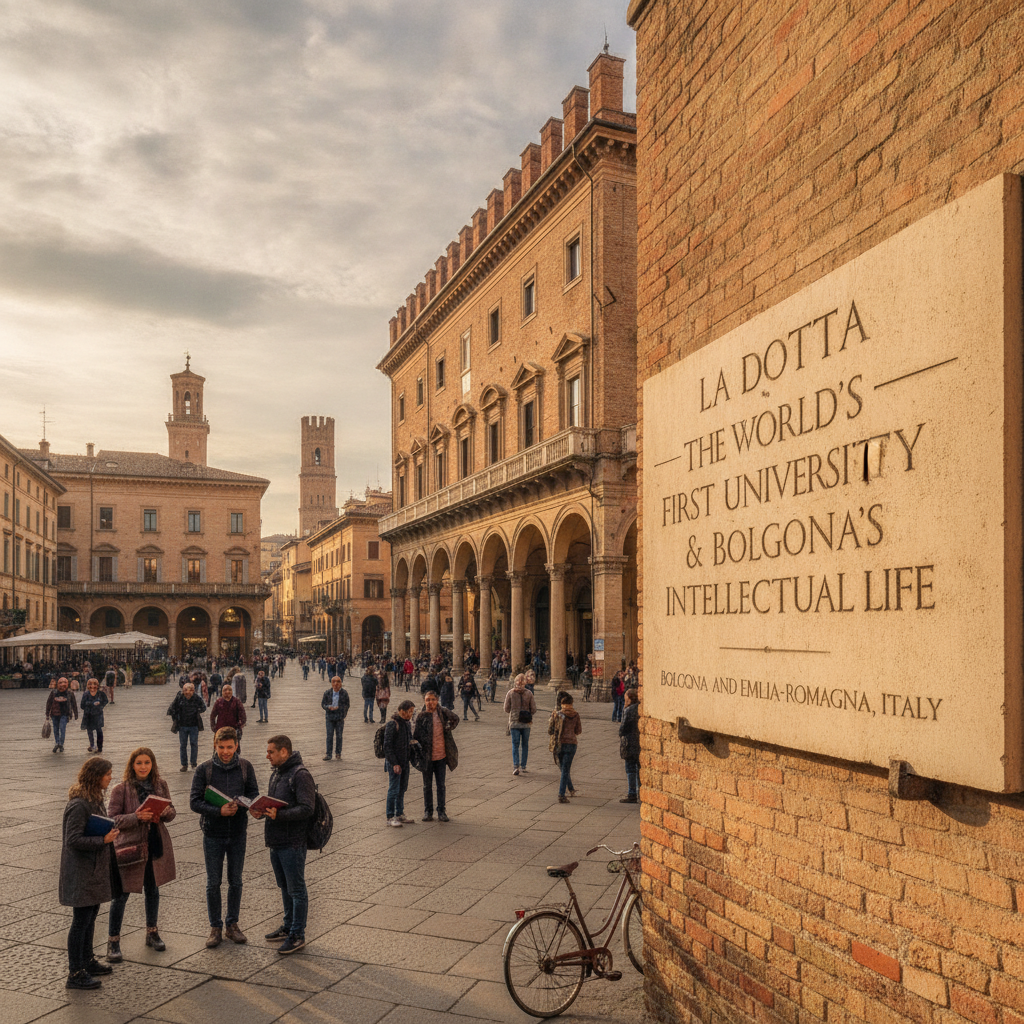
The Università di Bologna (the 'University of Bologna' — the 'Alma Mater Studiorum', the oldest university in the Western world, founded in Bologna in 1088 (the date of the founding of the university generally accepted as 1088, the year that the jurist Irnerius began the systematic teaching of Roman law in Bologna): the history (the University of Bologna — the university that established the model of the European university: the institution that from its foundation in 1088 to the present day has defined the European university tradition (the term 'university' (from the Latin 'universitas' — the 'whole' or the 'corporation') was coined in Bologna to describe the corporation of students and teachers that is the defining institutional form of the European university): the medieval university (the University of Bologna in the medieval period — the university that attracted students from across Europe (the 'nationes' of Bologna — the organized groups of students by nationality, the precursors of the modern university 'faculties'): the professors (the faculty of the medieval University of Bologna — the professors who taught at Bologna and who established the intellectual foundations of the European university tradition: Irnerius (c. 1050-c. 1130) (the founder of the Bologna law school and the systematizer of Roman law), Gratian (the 12th-century monk who wrote the 'Decretum Gratiani' (the foundational text of canon law), and Dante Alighieri (1265-1321) (who studied at Bologna): the contemporary university (the contemporary University of Bologna — the university with approximately 90,000 students (the largest university in Italy by student enrollment) and the faculties distributed across the Bologna historic centre (the university buildings in the historic centre including the 'Palazzo dell'Archiginnasio' (the 17th-century university palace, now housing the Municipal Library of Bologna with the famous 'Teatro Anatomico' — the 17th-century anatomical theatre used for the public anatomical dissections that were the foundation of the Bologna school of anatomy).
- 5
Piazza Santo Stefano & the Seven Churches
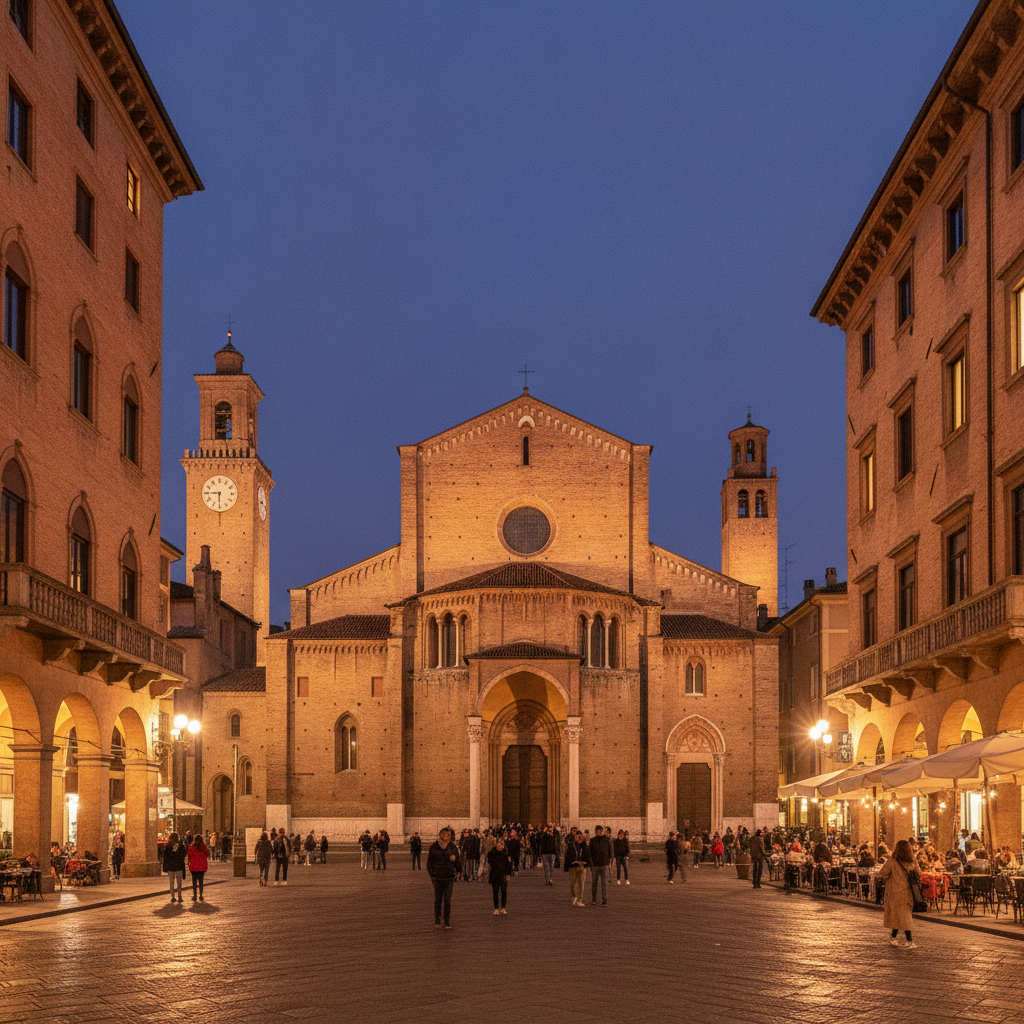
The Piazza Santo Stefano (the 'Square of Santo Stefano' — the piazza at the eastern end of the 'Via Santo Stefano' in the Bologna historic centre, the most atmospheric and the most medieval of the public spaces in Bologna): the piazza (the Piazza Santo Stefano — the irregular triangular piazza formed by the convergence of the Via Santo Stefano and the Via Castiglione, the piazza lined with the medieval palazzi and the medieval porticoes that create the most complete surviving medieval streetscape in Bologna): the Basilica di Santo Stefano (the 'Basilica di Santo Stefano' — the complex of medieval religious buildings known as the 'Sette Chiese' (the 'Seven Churches'): the church complex assembled from the 4th century to the 13th century on the site of the ancient Roman temple of Isis and Serapis, the complex incorporating the remains of the Roman buildings into the medieval Christian structures: the seven churches of Santo Stefano (the 'Sette Chiese' — the seven churches/buildings of the Santo Stefano complex: the 'Chiesa del Crocifisso' (the 8th-century church), the 'Basilica dei Santi Vitale e Agricola' (the oldest church in Bologna, the 5th-century basilica incorporating the column drums from the Roman temple), the 'Cortile di Pilato' (the 'Courtyard of Pilate' — the Romanesque courtyard with the 8th-century marble 'Vasca di Pilato' (the 'Basin of Pilate' — the large marble basin traditionally identified as the vessel in which Pontius Pilate washed his hands after the trial of Jesus), the 'Santo Sepolcro' (the 12th-century octagonal church modelled on the Church of the Holy Sepulchre in Jerusalem — the most important of the Sette Chiese and the original focus of the pilgrimage to Santo Stefano), the 'Cappella della Benda' and the 'Cappella degli Innocenti', and the 'Cortile dei Romiti').
- 6
Archiginnasio, Anatomical Theatre & Bologna's Academic Legacy
The Palazzo dell'Archiginnasio (the 'Palace of the Archiginnasio' — the former palace of the University of Bologna, built 1562-1563, the building that served as the seat of the entire University of Bologna from its completion in 1563 until the relocation of the university to the Palazzo Poggi in 1803): the building (the Palazzo dell'Archiginnasio — the U-shaped Renaissance palace at the southwestern edge of the Piazza Maggiore, the palace with the extraordinary collection of approximately 6,000 'stemmi' (the coats of arms) of the students, professors, and rectors of the University of Bologna carved in the stone and painted on the wall surfaces of the building's courtyard and corridors: the most complete and the most visually overwhelming collection of academic heraldry in the world): the Teatro Anatomico (the 'Anatomical Theatre' of the Archiginnasio — the 17th-century anatomical theatre inside the Palazzo dell'Archiginnasio: the theatre built in 1637 to the design of Antonio Paolucci, the theatre used for the public anatomical dissections ('notomie') that were the foundation of the Bologna school of anatomy (the Bologna anatomical tradition that produced the first systematic anatomical illustrations — the 'De humani corporis fabrica' of Andreas Vesalius (1543), the foundational text of modern anatomy, based on the Bologna anatomical tradition): the wooden theatre (the extraordinary carved wooden interior of the Teatro Anatomico — the carved walnut wood paneling of the walls and the ceiling, the two rows of wooden benches rising steeply around the central dissection table, the wooden statues of the famous Bologna anatomists (the 'spellati' — the flayed male figures, their muscles and tendons exposed, flanking the professor's chair) and the canopy above the professor's chair supported by the figures of the 'svagati' (the 'distracted ones' — the two figures looking away from the dissection): the theatre destroyed in the Allied bombing of 1944 and reconstructed from the original fragments after the war.
Walk this route with audio
Stories play automatically as you reach each stop — no tapping needed.
More in bologna
Santo Stefano Basilica, Medieval Palazzi & Bologna After Dark
Parma Day Trip — Prosciutto, Duomo & Verdi's Homeland
Via dell'Indipendenza, Shopping & Bologna's Artisan Culture
Ravenna Mosaics Day Trip — UNESCO Byzantine Art Capital
La Dotta — The World's First University & Bologna's Intellectual Life