Boise: Salmon River of No Return, Stanley and Sawtooths, Julia Davis Park, Idaho Politics, Eastern Idaho, and Yellowstone
Boise: Salmon River (692km longest undammed single-state US river no dams entire main stem, Middle Fork 145km most acclaimed US multi-day rafting 100+ Class III-IV rapids hot springs petroglyphs floatplane only or Boundary Creek dirt road, 6-day permit lottery Recreation.gov February, Lewis and Clark called impassable turned back to Lolo Trail), Stanley (170km NE 1,905m population 60 smallest county seat US, coldest continental US regular station -40C January below-freezing every month, SNRA 756,000 acres 217,000 wilderness 40 peaks 3,000m+ 300 alpine lakes 700km trails, Redfish Lake 8km long 1,983m named red sockeye salmon, Redfish sockeye world most inland 1,450km Pacific to 1,983m ESA listed 1991 4 adults 1992 recovered 200-400 by 2020), Julia Davis Park (90 acres Boise Art Museum Idaho State Historical Museum Idaho Black History Museum only Idaho Black history museum Buffalo Soldiers 1870s Fort Boise, Discovery Center, Zoo Boise 1916 350,000 visitors/year snow leopard Amur tiger, Ann Morrison 153 acres Esther Simplot fountain Alive After Five, 3km Greenbelt most walked segment), Idaho politics (Republican every presidential since 1968 except LBJ 1964, federal owns 63% Idaho land, Bonner Boundary counties highest antigovernment militia Pacific NW, Aryan Nations Hayden Lake 1973-2000 civil lawsuit, Ruby Ridge 1992 triggered militia movement nationally, City of Trees 24% canopy USD 10M environmental services, Mayor McLean 2019 first woman mayor re-elected 2023 majority Democratic city in Republican state), eastern Idaho (Pocatello 56,000 340km Oregon Short Line Railroad 1881-1884 railroad company town 1882, Idaho Falls 67,000 430km, INL established 1949 5,600 employees USD 2.9B 52 reactor experiments, first nuclear-powered city December 20 1951 BORAX IV, Mesa Falls Upper 33m Henry Fork last intact major Snake falls), Yellowstone (550km West Yellowstone entrance US-20, Grand Teton 520km, Greater Yellowstone 72,800 sqkm largest intact temperate ecosystem Northern Hemisphere outside Russia 67 mammals all pre-contact megafauna, Snake River originates Yellowstone 2,438m same river as Boise Greenbelt Hells Canyon Shoshone Falls, Jackson WY median home USD 3M+ highest small town US 7,500-11,000 elk National Elk Refuge).
- 1
The Salmon River and the River of No Return
The Salmon River (the 692-km river originating in the Sawtooth Mountains near Galena Summit, 200 km northeast of Boise, flowing north and then west through the Frank Church-River of No Return Wilderness to join the Snake River near Riggins, ID): the longest free-flowing river within a single US state (the Salmon has no dams on its main stem for its entire 692-km length, making it one of the last undammed major rivers in the lower 48 states). The Middle Fork of the Salmon River (the 145-km wilderness tributary joining the main Salmon at the confluence known as the Mouth, near North Fork, ID): the most acclaimed multi-day whitewater rafting river in the United States, with 100+ Class III-IV rapids, wilderness hot springs (Sunflower Hot Springs, Hospital Bar Hot Springs), Bighorn Crags scenery, and Sheepeater Cliff petroglyphs -- all accessible only by river or floatplane from the airstrip at Indian Creek or Corn Creek. The typical Middle Fork float: 6 days, 145 km, starting at the Boundary Creek put-in (accessible by dirt road from Stanley, ID) or the Indian Creek put-in (floatplane only), ending at the Cache Bar take-out. Permits are required June-July (the high season) and are allocated by lottery managed by Recreation.gov each February for the following season. The Main Salmon (the Salmon River main stem from North Fork to Riggins, the River of No Return section, 135 km, Class III whitewater, 4-5 days): the accessible alternative to the Middle Fork, permitted but with a less complex permit system. Lewis and Clark called the Salmon impassable and turned back -- a decision that led them north over the Lolo Trail to the Clearwater instead.
- 2
Stanley, Idaho and the Sawtooth Valley
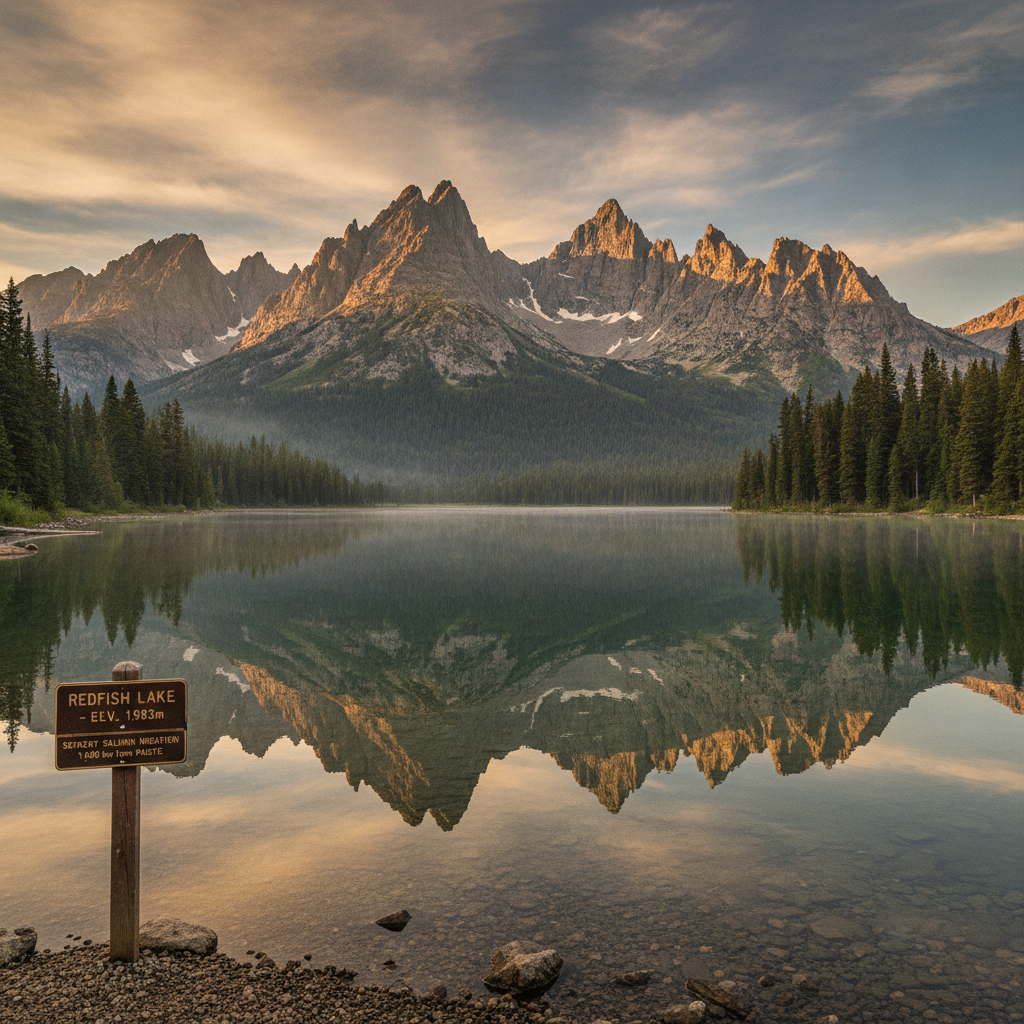
Stanley, Idaho (at 1 Ace of Diamonds Street, Stanley, ID, 170 km northeast of Boise via SH-21 or US-20 and SH-75, elevation 1,905 m, population approximately 60 permanent residents -- the smallest incorporated city that is the county seat of any county in the United States, as the seat of Custer County): the remote mountain town at the confluence of the Salmon River and Valley Creek, surrounded on all sides by mountains (the Sawtooths, the White Clouds, the Boulders, and the Lemhi Range), and the service hub for Middle Fork rafting and Sawtooth recreation. Stanley is famous for having the coldest temperatures of any regularly reporting weather station in the continental United States -- temperatures below -40C (-40F) have been recorded in January, and the town experiences below-freezing temperatures in every month of the year at least once. The Sawtooth National Recreation Area (managed from Stanley, 756,000 acres including the 217,000-acre Sawtooth Wilderness): the recreation area with 40 peaks exceeding 3,000 m, 300+ alpine lakes, and 700 km of trails from Stanley. Redfish Lake (9 km south of Stanley via SH-75, 8 km long, 1,983 m elevation, named for the sockeye salmon -- Oncorhynchus nerka -- that turned red on the spawning run and once filled the lake): the most photographed mountain lake in Idaho, with the Sawtooth peaks reflected in the water. The sockeye salmon: the Redfish Lake sockeye salmon (the world's most inland sockeye salmon, migrating 1,450 km from the Pacific Ocean through the Columbia and Snake Rivers to spawn at 1,983 m altitude) was listed under the Endangered Species Act in 1991 after the population crashed to 1-4 returning adults per year in 1992 -- the most extreme salmon population collapse in the United States. Recovery programs have restored returns to 200-400 per year by 2020.
- 3
Boise's Parks, Zoo, and Julia Davis Park Complex
Julia Davis Park (at 700 South Capitol Boulevard, Boise, at the bend of the Boise River in central Boise, the primary urban park of Boise, covering 90 acres): the park containing the most significant concentration of Boise cultural institutions, including the Boise Art Museum, the Idaho State Historical Museum, the Idaho Black History Museum (at 508 West Julia Davis Drive, the only museum dedicated to the Black history of Idaho in existence), the Discovery Center of Idaho (the hands-on science museum at 131 Myrtle Street), and Zoo Boise. Zoo Boise (at 355 Julia Davis Drive, established 1916 as a Boise City zoo with two deer, now with 250+ animals in 11 acres): the most visited paid attraction in Idaho, with approximately 350,000 visitors per year, notable for its snow leopard exhibit, its Amur tiger pair, and the African savanna habitat. The Idaho Black History Museum (at 508 West Julia Davis Drive): the museum documenting the history of Black Idahoans from the Buffalo Soldiers stationed at Fort Boise in the 1870s through the civil rights era -- a largely unknown history in a state that is 96% white but has maintained a small, significant Black community since the 1880s. The Ann Morrison Park (at 1000 West Americana Boulevard, across the Boise River from Julia Davis Park, 153 acres): the park with the Esther Simplot Memorial Fountain (the fountain at the park entrance, named for the wife of J.R. Simplot), the extensive turf fields used for sports and the music festivals (including the Alive After Five summer concert series). The Boise River Greenbelt connection between the two parks: the paved trail connecting Julia Davis Park and Ann Morrison Park by following the Boise River for 3 km through the heart of the city -- the most walked segment of the entire 35-km Greenbelt.
- 4
Idaho's Political Identity and the Libertarian West
Idaho's political character: Idaho is one of the most reliably Republican states in the United States (voting Republican in every presidential election since 1968, with the exception of Lyndon Johnson's 1964 landslide victory), with a political culture that reflects the Intermountain West's historical suspicion of federal government (the federal government owns 63% of all Idaho land), strong individual property rights, gun ownership culture, and small government philosophy. The Bundy standoff connection: Idaho's Bonner and Boundary counties in the panhandle are home to the highest concentration of antigovernment militia groups, sovereign citizen adherents, and Christian Identity movement members of any region in the Pacific Northwest -- the legacy of the 1990s far-right community building in northern Idaho (including the Aryan Nations compound in Hayden Lake, which operated 1973-2000 until a civil lawsuit forced its closure, and the Ruby Ridge incident of 1992 in which the accidental shooting of Randy Weaver's son and wife by U.S. Marshals sparked the militia movement nationally). The City of Trees: Boise earned the City of Trees nickname for its canopy of deciduous trees (primarily elm, maple, and locust) planted by early settlers along the city grid to create shade in the high desert -- a tree canopy that now covers approximately 24% of the city land area and provides USD 10M+ per year in environmental services (air quality, stormwater management, urban cooling). The Boise political contrast: the city of Boise itself votes majority Democratic (Mayor Lauren McLean, elected 2019, the first woman mayor of Boise, re-elected 2023) in contrast to the surrounding Ada County and Idaho state government -- the political divergence between the urban core and the rural state is one of the sharpest in any inland American state.
- 5
Idaho Falls, Pocatello, and Eastern Idaho
Eastern Idaho day trips from Boise: the 400-km corridor east from Boise via I-84 and I-86 to Idaho Falls passes through the historic Oregon Trail corridor, the Craters of the Moon (described in Route 1), and the Snake River Plain agricultural heartland before reaching the cities of Pocatello and Idaho Falls at the foot of the Rocky Mountains. Pocatello (population 56,000, 340 km east of Boise, at 1,356 m at the confluence of the Portneuf River and the Snake River): the railroad junction city that was the construction headquarters of the Oregon Short Line Railroad (the Union Pacific branch line built 1881-1884 through Idaho to connect the Pacific Northwest to the transcontinental railroad at Ogden, Utah) -- Pocatello was literally a railroad company town built in 1882, and the distinctive downtown architecture reflects the late 19th century railroad prosperity. Idaho Falls (population 67,000, 430 km east of Boise, at 1,429 m on the Snake River): the commercial hub of eastern Idaho, the home of the Idaho National Laboratory (the nuclear research laboratory at US-20, 80 km west of Idaho Falls, established 1949, operated by Battelle Energy Alliance for the U.S. Department of Energy, with 5,600 employees and an annual budget of USD 2.9B -- the primary center for nuclear reactor development in the United States, with 52 reactor experiments completed since 1951, more than any other site in the world, and the first city in the world to be powered by nuclear electricity on December 20, 1951, with the BORAX IV reactor). The Mesa Falls Scenic Byway (north of Idaho Falls via US-20 to Ashton and Island Park, 130 km): the scenic route to the Upper and Lower Mesa Falls (the two waterfalls on the Henry's Fork of the Snake River, the last intact major waterfalls on the Snake River system, Upper Mesa Falls at 33 m and 67 m wide).
- 6
Yellowstone from Boise - The Greater Yellowstone Ecosystem
Yellowstone National Park from Boise: the western and southern entrances to Yellowstone National Park are approximately 550-650 km from Boise via US-20 (through Idaho Falls and Island Park to the West Yellowstone entrance -- the nearest at 550 km) -- a challenging but feasible 2-night road trip from Boise, passing through Grand Teton National Park (at Moose, WY, the park entrance, 520 km from Boise) en route. The Greater Yellowstone Ecosystem (the 72,800-square-km ecosystem centered on Yellowstone National Park, extending into Grand Teton NP, the surrounding national forests, the John D. Rockefeller Jr. Memorial Parkway, and the national wildlife refuges of the Snake River Plain): the largest nearly intact temperate ecosystem in the Northern Hemisphere outside of Russia, with 67 mammal species (including all of the megafauna that inhabited the area before European contact -- bison, grizzly bear, black bear, wolf, mountain lion, moose, elk, pronghorn, bighorn sheep, wolverine, lynx, and river otter), 330 bird species, and 16 fish species. The Snake River connection: the Snake River originates in Yellowstone National Park (at the South Boundary of Yellowstone, at elevation 2,438 m), flows south through the Jackson Hole valley and Grand Teton National Park, then west through the Snake River Plain to its confluence with the Columbia River near Pasco, Washington -- the same river that forms the Boise River Greenbelt, the Hells Canyon, and the Shoshone Falls. Jackson, Wyoming (40 km south of Grand Teton, at 1,899 m): the luxury resort town and gateway to Grand Teton, with median home prices exceeding USD 3M (the highest of any small town in the United States), the National Museum of Wildlife Art (at 2820 Rungius Road, Jackson Hole), and the Elk Refuge (the National Elk Refuge, with 7,500-11,000 elk wintering within 10 minutes of downtown Jackson).
Walk this route with audio
Stories play automatically as you reach each stop — no tapping needed.
More in boise
Boise: Egyptian Theatre, Sagebrush Trails and the Semiconductor City
Boise: Treasure Valley Food Scene, Nez Perce War, Lewis and Clark, BSU Blue Turf, Idaho Potatoes, and Basque Heritage
Boise: Greenbelt, Basque Block, Oregon Trail, Outdoor Recreation, Craters of the Moon, and the Tech Economy
Boise: Astronaut Training Lava Fields, Blue Football Turf and a Food Scene on the Rise
Boise: Snake River Raptors, Sun Valley, Arts Scene, Owyhee Mountains, River Floating, and Practical Info