The Kyrgyz Tunduk Roof Ring on the National Flag, the Osh Bazaar Kumys Fermented Mare's Milk & Ala-Archa Glacier 45 km from Central Bishkek
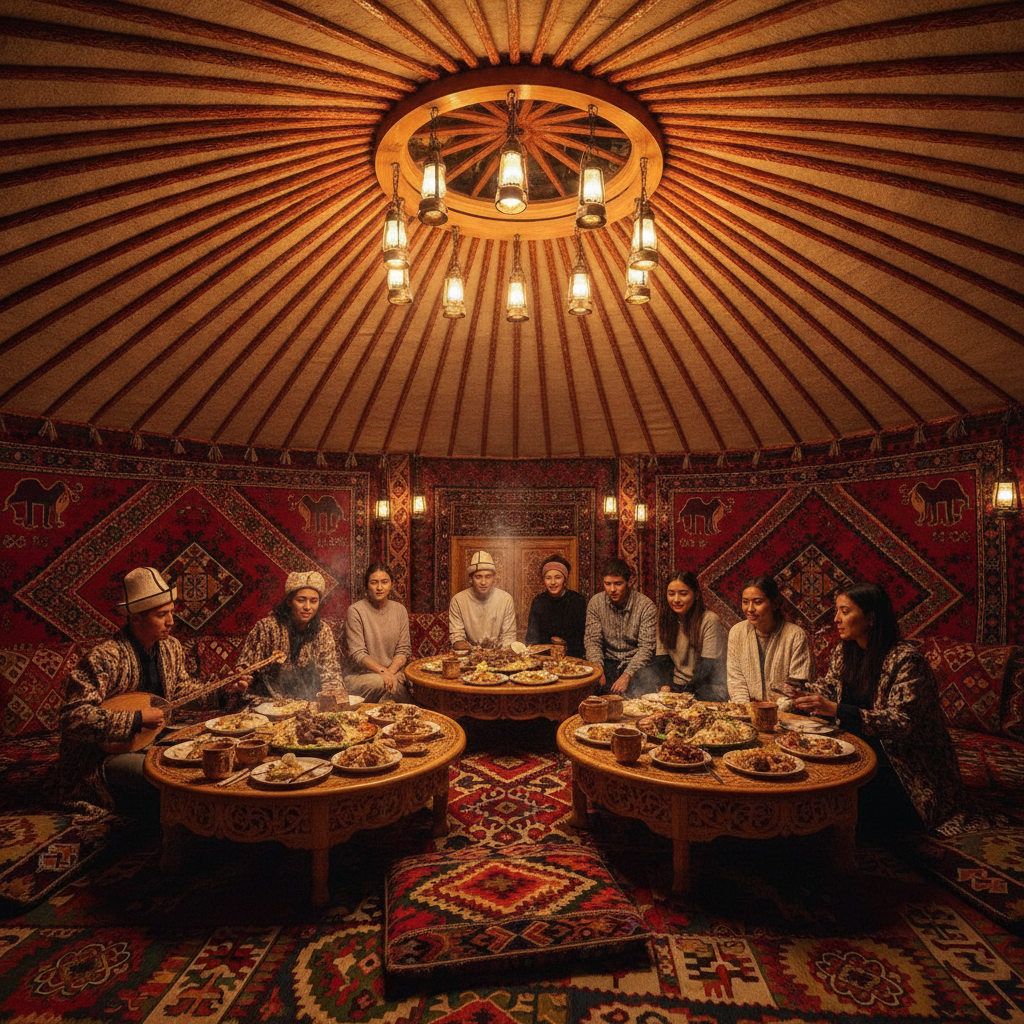
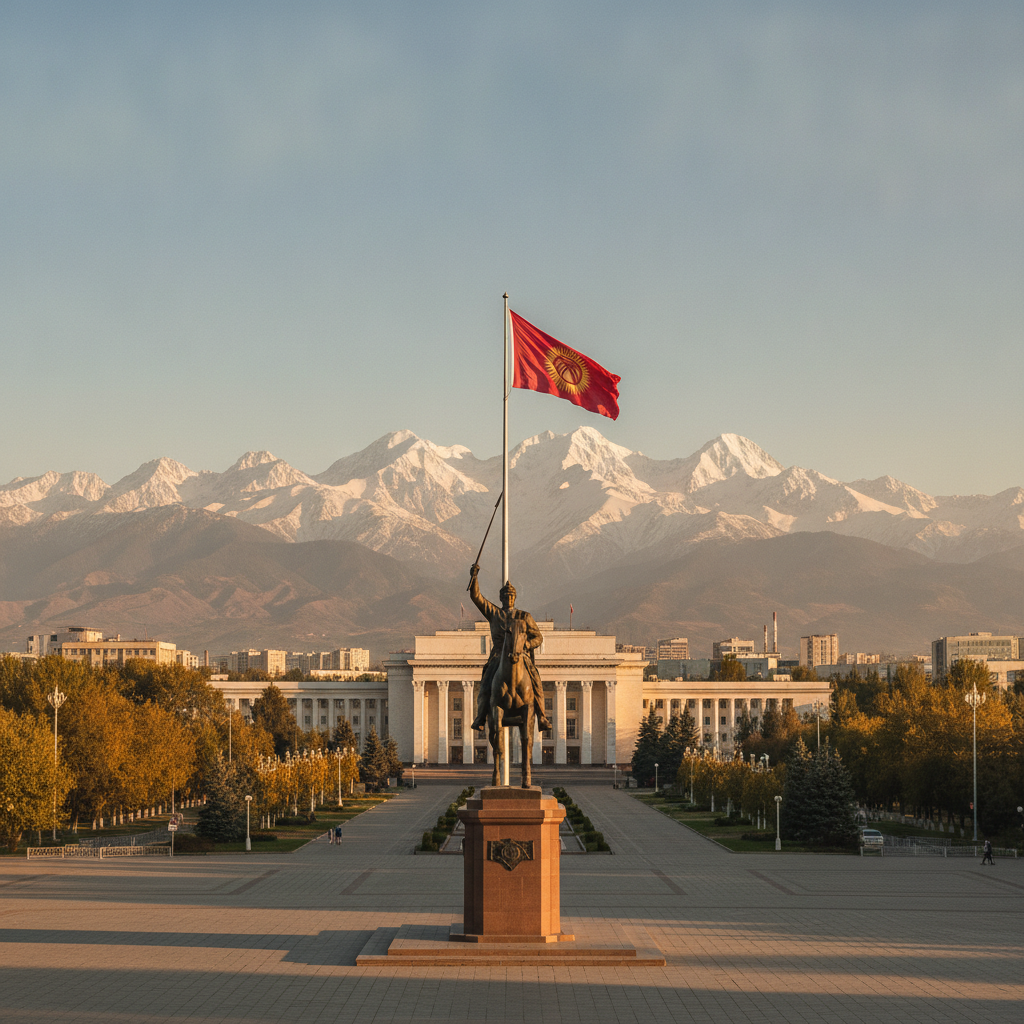
Ala-Too Square with Manas statue replacing the 1984 Lenin statue removed in 1991; the Osh Bazaar dried kurut sour milk balls as the primary Kyrgyz portable food; the tunduk central yurt ring ring on the Kyrgyz flag representing the 40-ray celestial vault; the Berkutchi eagle hunters training golden eagles for fox and wolf hunting (UNESCO 2016); Soviet Bishkek renamed Frunze 1926–1991 after the Red Army conqueror of Central Asia; and Ala-Archa National Park with the Ak-Sai glacier accessible by a 4-hour hike from 45 km south of the city center.
- 1
Ala-Too Square – The Heart of Bishkek
Ala-Too Square (Ala-Too Aydyni — the central public square of Bishkek and the primary civic space of Kyrgyzstan): the square heritage guide. The square (Ala-Too Square (named for the Ala-Too mountain range — the Ala-Too (the Spotted Mountains, from Kyrgyz Ala (spotted or piebald) and Too (mountain) — the Kyrgyz name for the range of the Tian Shan mountains visible to the south of Bishkek): the square was laid out in the Soviet era as Lenin Square and redesigned after independence (1991) as the primary post-Soviet national public space: the Manas statue (the central monument on Ala-Too Square is the figure of the legendary Kyrgyz hero Manas (Манас) — the 7m bronze equestrian statue of Manas by the sculptor Tursunaly Sadykov (installed 2011, replacing the 1984 Lenin statue that was removed in 1991) — Manas rides a horse and holds a spear, looking toward the Tian Shan mountains to the south: the National Museum (the State Historical Museum (Мамлекеттик тарых музейи) on the northern edge of Ala-Too Square — the primary museum of Kyrgyz history from the Bronze Age through the present: the museum contains the definitive collection of Kyrgyz artifacts including: the ancient Saka and Scythian goldwork (7th–3rd century BCE); the Sogdian silver coins; and the Soviet-era collection including the Lenin bust that stood in the square until 1991): the Manas flag ceremony (the changing of the Kyrgyz honor guard at the national flagpole on Ala-Too Square occurs every hour from 09:00 to 18:00 — the ceremony includes a mounted horseback guard in traditional Kyrgyz costume).
- 2
The Osh Bazaar – Central Asia's Largest Covered Market
The Osh Bazaar (Ош Базары — the primary market of Bishkek and one of the largest covered markets in Central Asia): the bazaar heritage guide. The Osh Bazaar (the Osh Bazaar of Bishkek is named for the Osh bazaar tradition originating in Osh (the second city of Kyrgyzstan, 750 km south of Bishkek in the Fergana Valley) — the Osh Bazaar has been the primary commercial center of Bishkek since the Soviet era: the market (the bazaar covers approximately 15 hectares in the Leninskoye district of Bishkek — the market is organized into specialized sections: the kumys section (the kumys (fermented mare's milk — the most important traditional beverage of Kyrgyz nomadic culture — the Osh Bazaar kumys vendors sell both fresh kumys (within 24 hours of fermentation) and aged kumys (up to 3 days of fermentation, significantly more alcoholic): the dried foods section (the kurut section — kurut (dried sour milk balls — the primary preserved food product of Kyrgyz nomadic culture: the small hard spheres of dried fermented milk are the most important portable food for the Kyrgyz nomadic economy — they are reconstituted with water or eaten dry as a snack: they contain all essential amino acids and significant calcium): the spice market (the combination of Kyrgyz, Uzbek, and Chinese spice merchants creates the most diverse spice market in the eastern part of Central Asia): the fabric section (the traditional Kyrgyz felt and fabric section — the primary source for shyrdak felt carpets (the most celebrated Kyrgyz craft product) and kalpak hats (the white felt hat worn by Kyrgyz men)).
- 3
Tian Shan Mountains – Bishkek's Dramatic Backdrop
The Tian Shan mountains visible from Bishkek (the Ala-Too range of the Tian Shan system rising immediately south of Bishkek to 4,895m at Peak Uchitel — the most dramatic urban mountain backdrop in the former Soviet Union): the mountain heritage guide. The Tian Shan (the Tian Shan (Chinese: Tian Shan — Celestial Mountains or Heavenly Mountains): the Tian Shan is one of the world's great mountain systems — a 2,900 km east-west arc from western China through Kyrgyzstan to Tajikistan and Kazakhstan: the highest peak (Khan Tengri (Khan-Tengri — Lord of the Spirits — 6,995m) on the Kazakhstan-Kyrgyzstan border: Peak Pobedy (Peak of Victory — 7,439m, the highest point of the Tian Shan) on the China-Kyrgyzstan border: Bishkek geography (Bishkek sits on the northern Tian Shan piedmont at 760m altitude — the Ala-Too range rises immediately to the south reaching 4,895m at Peak Uchitel within 25 km of the city center — the mountains are visible on clear days from the city center as a wall of snow and rock: the Ala-Archa National Park (Ала-Арча Улуттук Паркы — the most accessible alpine wilderness area from Bishkek: the park is 45 km south of central Bishkek, accessible by marshrutka (shared minibus) from the Osh Bazaar: the primary trail (the trail to the Ak-Sai glacier (4-hour hike from the park entrance) passes through alpine meadows with the endemic Tian Shan spruce (Picea schrenkiana) and reaches the glacier tongue at 3,800m).
- 4
Kyrgyz Nomadic Culture – Yurt, Horse & Eagle
The Kyrgyz nomadic heritage (the living nomadic pastoral culture of Kyrgyzstan — the most intact nomadic tradition in the former Soviet Union): the nomadic culture guide. The yurt (the boz ui (the Kyrgyz yurt — the portable circular felt-covered dwelling of the Kyrgyz pastoral nomads — the primary architectural achievement of the Kyrgyz culture: the yurt structure (the Kyrgyz yurt consists of: the kerege (the expandable lattice wall framework made of willow rods — typically 6 sections for a standard family yurt); the uuk (the roof poles — 60–80 straight rods that radiate from the central ring to the top of the kerege wall); the tunduk (the central roof ring — the most sacred element of the Kyrgyz yurt — the tunduk is the symbol of the Kyrgyz national identity and appears on the Kyrgyz flag: the white circle with a 40-ray sun pattern on the Kyrgyz flag represents the tunduk of a yurt): the horse culture (the horse is the central symbol of Kyrgyz identity — the Kyrgyz are among the world's most accomplished traditional horsemen: the primary Kyrgyz horse games: kok-boru (the team sport of carrying a goat carcass on horseback — the most popular spectator sport in Kyrgyzstan): ulak tartish (individual competition variant of kok-boru): at-chabysh (long-distance horse racing of up to 50 km): the Kyrgyz eagle hunters (the Berkutchi — the Kyrgyz eagle hunters who train golden eagles (Aquila chrysaetos) to hunt foxes and wolves on horseback — the tradition is protected by the Kyrgyz government and was added to the UNESCO Intangible Cultural Heritage list in 2016).
- 5
Soviet Bishkek – Frunze & the Architecture of the Kirghiz SSR
The Soviet Bishkek heritage (the architectural and historical legacy of Bishkek as the capital of the Kirghiz SSR (1936–1991) — one of the most completely Soviet-planned cities in Central Asia): the Soviet heritage guide. The Frunze period (Bishkek was renamed Frunze (Фрунзе) in 1926 after the Soviet military commander Mikhail Frunze (1885–1925) who directed the Red Army conquest of Central Asia (1919–1920): the city remained Frunze until 1991 when independence was declared and the original Kyrgyz name Bishkek (Бишкек) was restored: the Frunze Museum (the Mikhail Frunze House-Museum — the small house in central Bishkek where Frunze was born — now a museum of the Soviet conquest of Central Asia): the Soviet planning (Bishkek was entirely planned and built as a Soviet city from 1878 onwards — there is no pre-Russian historic urban fabric in central Bishkek (unlike Osh, which has a traditional bazaar district): the tree-lined boulevards (the most distinctive Soviet feature of Bishkek's urban fabric is the extensive tree planting — Soviet planners systematically planted tree-lined avenues throughout the city as part of the greening policy): the primary Soviet monuments (the Victory Square (Жеңиш Аянты — the Soviet war memorial in western Bishkek: the 45m Victory Arch (built 1984 for the 40th anniversary of the Soviet victory in World War II) surrounded by an eternal flame: the Bishkek Philharmonic (Kyrgyz State Philharmonic — the primary concert hall of Bishkek, built in 1980 in the Soviet neoclassical style): the Erkindik Boulevard (the main Soviet-era promenade of Bishkek — the 2 km tree-lined central boulevard running from the Philharmonic to the White House).
- 6
Bishkek Practical Guide – Budget, Transport & Trekking Base
The Bishkek practical travel guide (the logistics and planning information for independent travel to Bishkek — particularly as a base for trekking and Silk Road travel in Kyrgyzstan): the comprehensive practical guide. The airport (the Manas International Airport (FRU) is 25 km northwest of central Bishkek — the airport shuttle bus (Bus 380) runs to the Osh Bazaar area for KGS 40 (USD 0.45) — the journey takes 45–60 minutes: the shared taxi from the airport to central Bishkek costs KGS 300–500 (USD 3.50–6): the primary entry (most nationalities can enter Kyrgyzstan visa-free for 30–60 days — the Kyrgyz visa-free regime covers citizens of 60+ countries including all EU citizens, Americans, Australians, and most Asian nationalities): the currency (the Kyrgyzstan Som (KGS) — the exchange rate is approximately 1 USD = 88 KGS (2025): the currency is non-convertible outside Kyrgyzstan — exchange US dollars or euros before arrival at Bishkek exchange offices (the best rates are at the Osh Bazaar exchange kiosks): the transport to Son Kul and Issyk-Kul (the primary natural destinations from Bishkek: Issyk-Kul Lake (the world's second-largest alpine lake at 1,608m altitude) is 280 km east of Bishkek — shared taxis from the Bishkek West Bus Station depart when full: Son Kul Lake (the high-altitude summer pasture lake at 3,016m) is accessible by 4x4 from Kochkor (150 km south of Bishkek)): the trekking season (the optimal trekking season in the Tian Shan is July–August — the passes above 4,000m are snow-free from late June to early September).
Walk this route with audio
Stories play automatically as you reach each stop — no tapping needed.
More in Bishkek
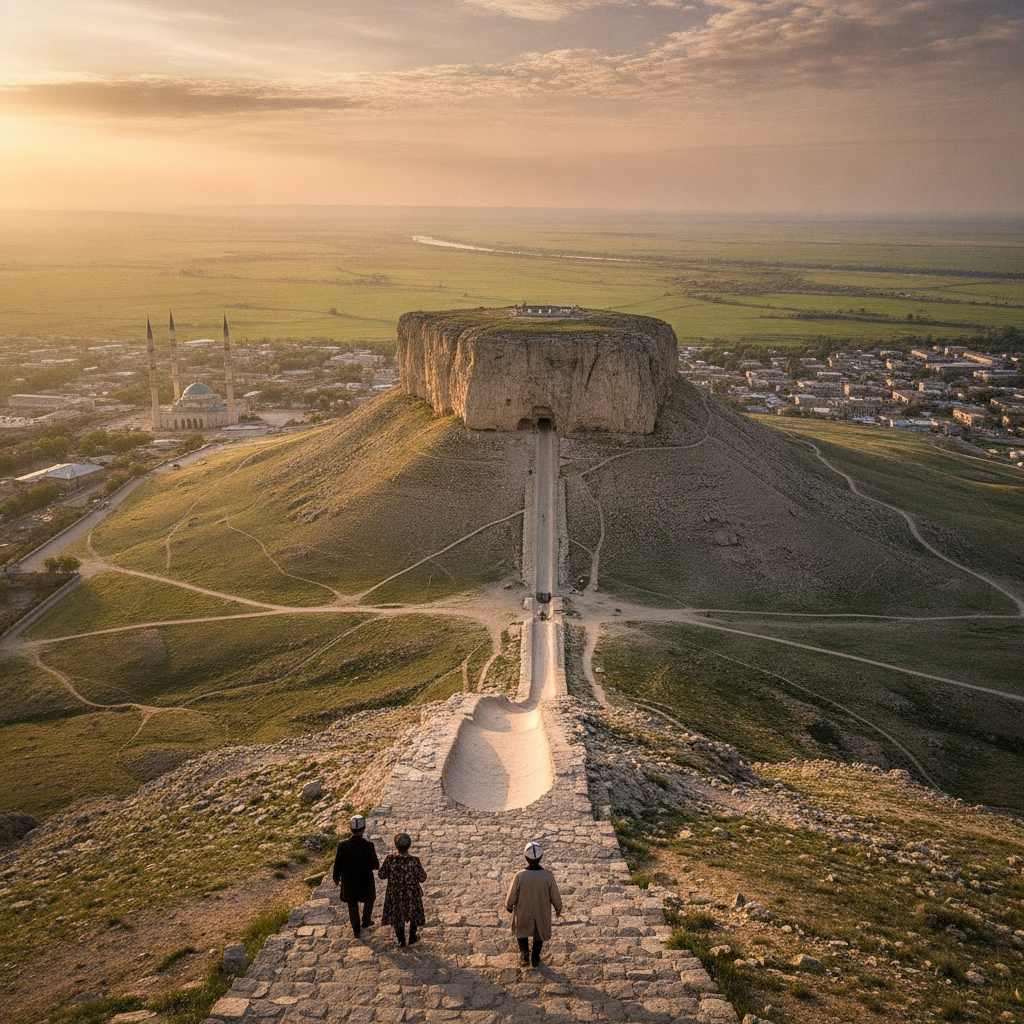
Babur Founded the Mughal Empire After Ruling Osh and Leaving His Mark on the Suleiman-Too Cave Mosque, the Kyrgyz Horse Surviving -40°C by Digging Through Snow (Tebineu) for Frozen Grass & the Burana Tower Oldest Monument in Kyrgyzstan
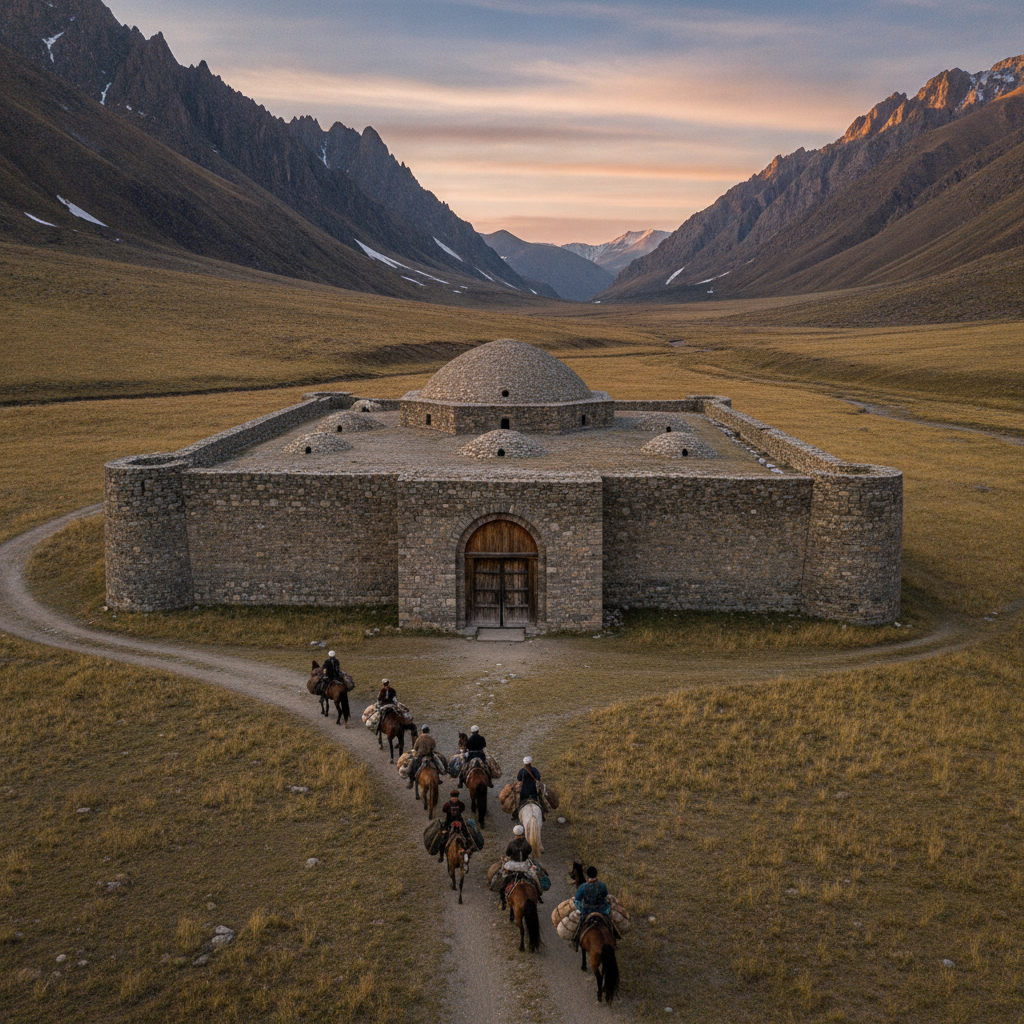
The Battle of Talas 751 CE Where Captured Chinese Papermakers Transferred Paper-Making Technology to the Islamic World, the Tash-Rabat Caravanserai Built at 3,200m Without Mortar & Kyrgyzstan's 700,000 Migrant Workers Sending 35% of GDP Home from Russia
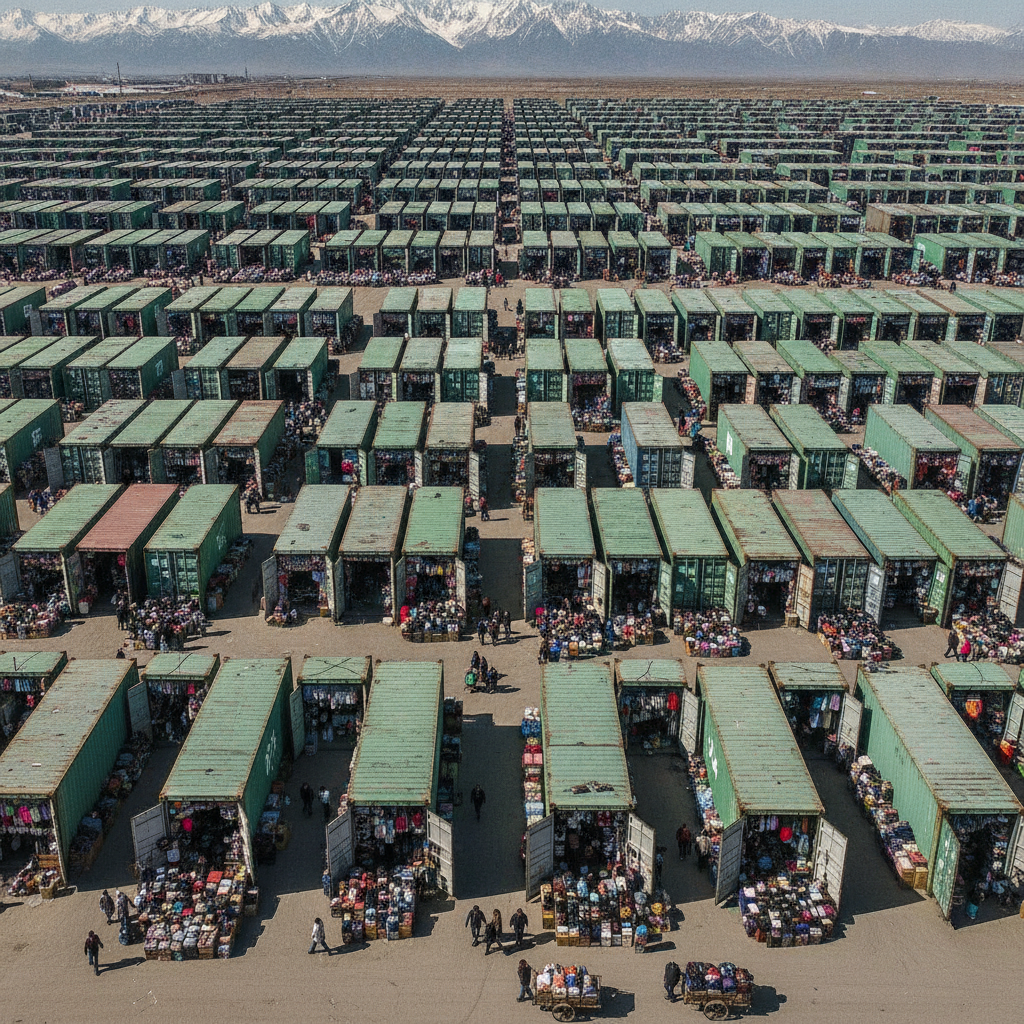
The Dordoi Bazaar 30,000 Container Stalls Handling USD 3-5 Billion Annually, Kyrgyz Yenisei Khaganate Briefly the Largest Turkic State in 840 CE & the CKU Railway Planned Since the 1990s Still Unbuilt

The Manas Epic at 500,000+ Lines Longer Than the Iliad and Mahabharata Combined, Issyk-Kul Never Freezes at 1,608m Due to Its 668m Depth & Son-Kul Summer Yurt Camps at 3,016m