Schöneberg, Steglitz & South Berlin: Kennedy's Stage, Bowie's Flat
South Berlin — the bourgeois residential districts stretching from Schöneberg through Steglitz to Lichterfelde — is quieter and less visited than the tourist center but contains some of the most significant sites in the city's modern history: the Rathaus Schöneberg where Kennedy declared himself a Berliner, David Bowie's apartment, the Wittenbergplatz market hall, and the peaceful Botanical Garden.
- 1
Wittenbergplatz & KaDeWe Area
Wittenbergplatz — the square at the western end of the Tauentzienstraße, anchored by the neo-Baroque Wittenbergplatz U-Bahn station (1913, Alfred Grenander, one of the most important Art Nouveau transit stations in Germany, carefully restored 1981) — is the commercial hub of West Berlin's main shopping district. The station's wooden interior fittings, ceramic tile decorations, and original street-level pavilion are intact; a sign outside the station lists the names of the Nazi concentration camps (a memorial installed in the 1980s by local citizens). KaDeWe's main entrance faces the square. The Wittenbergplatz market (weekly, Saturdays) and the surrounding streets of Schöneberg — Goltzstraße, Akazienstraße — contain some of the most established independent restaurants and cafes in the city: the Paris Bar (1952, Kantstraße, the most famous Berlin restaurant associated with artists and writers), the Café Einstein (1978, Kurfürstenstraße, in the villa of the silent-film star Henny Porten, the most aristocratic of Berlin's traditional coffeehouses), and the Neues Ufer bar (Hauptstraße 157, frequented by David Bowie during his Berlin years, 1976-1978).
- 2
Rathaus Schöneberg & John-F.-Kennedy-Platz
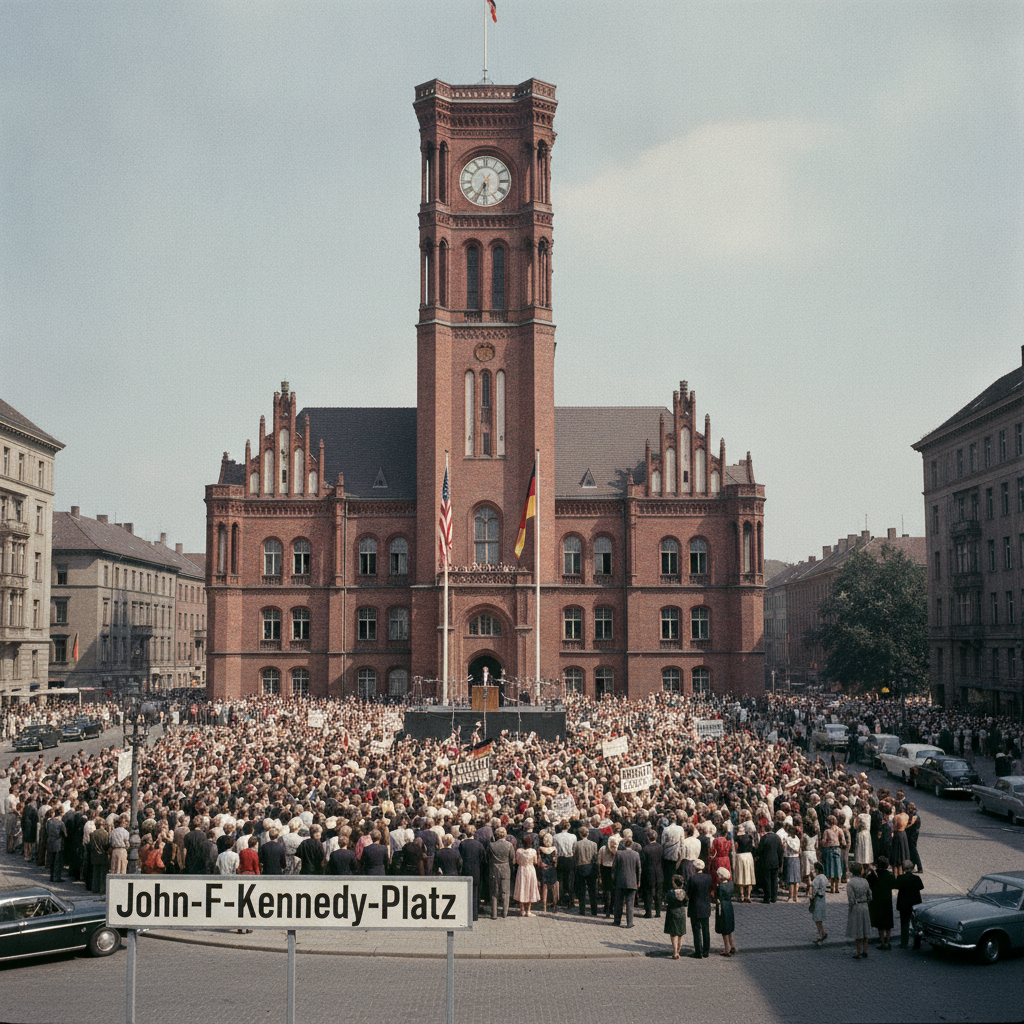
The Rathaus Schöneberg (Schöneberg Town Hall, 1914) — the red-brick neo-Romanesque building with its distinctive 60-meter tower, the seat of West Berlin's city government from 1948 to 1990 — is the site of the most famous speech delivered in Berlin during the Cold War: John F. Kennedy's 'Ich bin ein Berliner' address on June 26, 1963. Kennedy stood on the balcony of the Rathaus before an estimated 450,000 Berliners — the largest crowd ever gathered in the city — and delivered a passionate defense of the free world, ending with the declaration 'All free men, wherever they may live, are citizens of Berlin, and therefore, as a free man, I take pride in the words: Ich bin ein Berliner!' (a sentence Kennedy had written in phonetic German on a notecard minutes before). The square in front of the Rathaus was named John-F.-Kennedy-Platz in 1963; a replica of the Liberty Bell (given by the US government to West Berlin in 1950, a symbol of American commitment to the city's freedom) hangs in the tower. The Rathaus now serves as an events venue (the Freedom Bell is still rung on special occasions) and the John F. Kennedy Museum is nearby.
- 3
David Bowie's Berlin (Hauptstraße 155, 1976-1978)
The apartment at Hauptstraße 155 in Schöneberg — the first-floor flat (shared with Iggy Pop, who took the ground floor) where David Bowie lived from late 1976 to early 1978, the most creatively fertile period of his career — is a pilgrimage site for music fans and one of Berlin's most important sites of cultural history. Bowie came to Berlin to escape drug addiction and the Los Angeles rock star lifestyle; the city's anonymity and cheapness (Schöneberg rents in 1976 were among the lowest in Western Europe) allowed him to work freely. During these Berlin years, Bowie (with Brian Eno and Tony Visconti) recorded the 'Berlin Trilogy': 'Low' (January 1977), 'Heroes' (September 1977, the title song recorded in the studio overlooking the Berlin Wall at the Hansa By the Wall studio on Köthener Straße), and 'Lodger' (1979, partially recorded in Berlin). The albums redefined art rock and remain among the most influential recordings in rock music history. The Hansa Tonstudio (Köthener Straße 38) where the albums were recorded is still an active recording studio and the exterior is marked with a plaque.
- 4
Botanischer Garten & Botanical Museum (1897-1910)
The Botanischer Garten Berlin (Berlin Botanical Garden) — established at its current location in Dahlem/Lichterfelde 1897-1910 (the original botanical garden was in Schöneberg, on the site of the current Kleistpark), designed by Adolf Engler (director of the garden) and the landscape architect Karl Koopmann — is the third-largest botanical garden in the world (by plant collection) and the largest in Germany: 43 hectares containing 22,000 plant species from all over the world. The garden's 16 greenhouses (the Great Tropical House, 25 meters high, 60 meters long, with tropical trees reaching the ceiling) are the most important surviving examples of late 19th-century greenhouse architecture in Germany; the Great Tropical House was built using the largest glass-and-iron construction technology of its time. The Botanical Museum adjacent to the main entrance contains permanent exhibitions on plant taxonomy, ethnobotany, and the history of the garden; it houses the largest collection of botanical models in the world (the Brendel collection of wax plant models, 19th century, technically unparalleled).
- 5
Domäne Dahlem & Freie Universität
Dahlem — the village-within-the-city district in southwestern Berlin, absorbed into Berlin in 1920 — retains its rural character in the Domäne Dahlem (a working farm museum on the site of a medieval manor, with agricultural exhibitions, historic farm buildings, and weekend farmers' market) and the Freie Universität Berlin (Free University of Berlin, founded 1948 by West Berlin faculty and students who left the Humboldt University under Soviet control — itself a Cold War founding story — now one of Germany's leading research universities and home to 9 Nobel laureates). The FU campus was designed by the American-German architecture firm Candilis-Josic-Woods (1963-1973) in a 'mat building' style (connected clusters of low buildings in a grid, inspired by Team X's critique of CIAM modernism) and is itself a significant work of architectural history. The Henry Ford Building (1952, Franz Heinrich Sobotka and Gustav Müller, the main auditorium) contains the Philologische Bibliothek (the 'Berlin Brain', 2005, Norman Foster, a glass-covered courtyard library that looks like a velvet-covered brain).
- 6
Lichterfelde & Villa Colony
Lichterfelde — the former satellite town south of Berlin, incorporated in 1920, now the wealthiest residential district in the city — contains the most intact concentration of late 19th-century and early 20th-century villa architecture in Berlin: the villas of successful Wilhelmine merchants, factory owners, and military officers lining the streets between the S-Bahn station and the old town hall. The district also contains the former Prussian Military Cadet Academy (the Kadettenanstalt, now the campus of the Bundesarchiv, Germany's national archive) and the Stubenrauchstraße, where the poet and satirist Kurt Tucholsky (1890-1935) was born. The Lichterfelde tram (1881, Berlin's first horse-drawn tram line, converted to electric in 1891 — the world's first electric tram) ran through the district; the route is now served by the S25 S-Bahn. The Lichterfelde cemetery (Südwestfriedhof Stahnsdorf, 1907-1909, 200 hectares, the largest English landscape cemetery on the European continent) is 5 km further south, worth visiting for its extraordinary collection of Wilhelmine and Weimar-era sculpture and funerary architecture.
Walk this route with audio
Stories play automatically as you reach each stop — no tapping needed.
More in berlin
Kreuzberg: Turkish Market, Landwehrkanal & Urban Culture
Hackescher Markt, Scheunenviertel & Prenzlauer Berg: Berlin's Bohemian Heart
Charlottenburg Palace & Kurfürstendamm: West Berlin's Royal Mile
Brandenburg Gate, Reichstag & Tiergarten: The Heart of Reunified Berlin
Museum Island & Unter den Linden: Berlin's UNESCO Cultural Heart