Potsdamer Platz, Sony Center & Kulturforum: The New Berlin
Potsdamer Platz — once the busiest traffic intersection in Europe (1920s), then the emptiest wasteland in the divided city (1961-1989, the death strip of the Berlin Wall), now the most ambitious urban redevelopment project in post-war European history — is a case study in the transformation of Berlin after reunification. The adjacent Kulturforum (West Berlin's cultural campus) contains the Philharmonie and the Neue Nationalgalerie.
- 1
Potsdamer Platz (1920s/1990s)
Potsdamer Platz — named for the gate in the city wall (destroyed 1867) facing toward Potsdam — was in the 1920s the busiest traffic intersection in Europe (the first traffic light in continental Europe was installed here in 1924, a replica stands on the square today) and the symbolic heart of Weimar-era Berlin: cafes, department stores (Wertheim, the largest in Europe), hotels (the Esplanade), theaters, and the UFA film studios nearby in Tempelhof. After the war, the area was devastated (80% destroyed by bombing and street fighting); the Berlin Wall bisected the square entirely in 1961, with the Death Strip running through the middle. After the Wall fell, the empty Potsdamer Platz was the largest urban development site in Europe: from 1993 to 1998, a consortium led by Daimler-Benz (later DaimlerChrysler), Sony, and others invested €4 billion to build a new quarter of offices, apartments, shops, and the giant Cinemax multiplex. The masterplan was developed by Renzo Piano and Christoph Kohlbecker; the Daimler sector (by Piano) and the Sony Center (by Helmut Jahn) remain the dominant structures.
- 2
Sony Center (2000, Helmut Jahn)
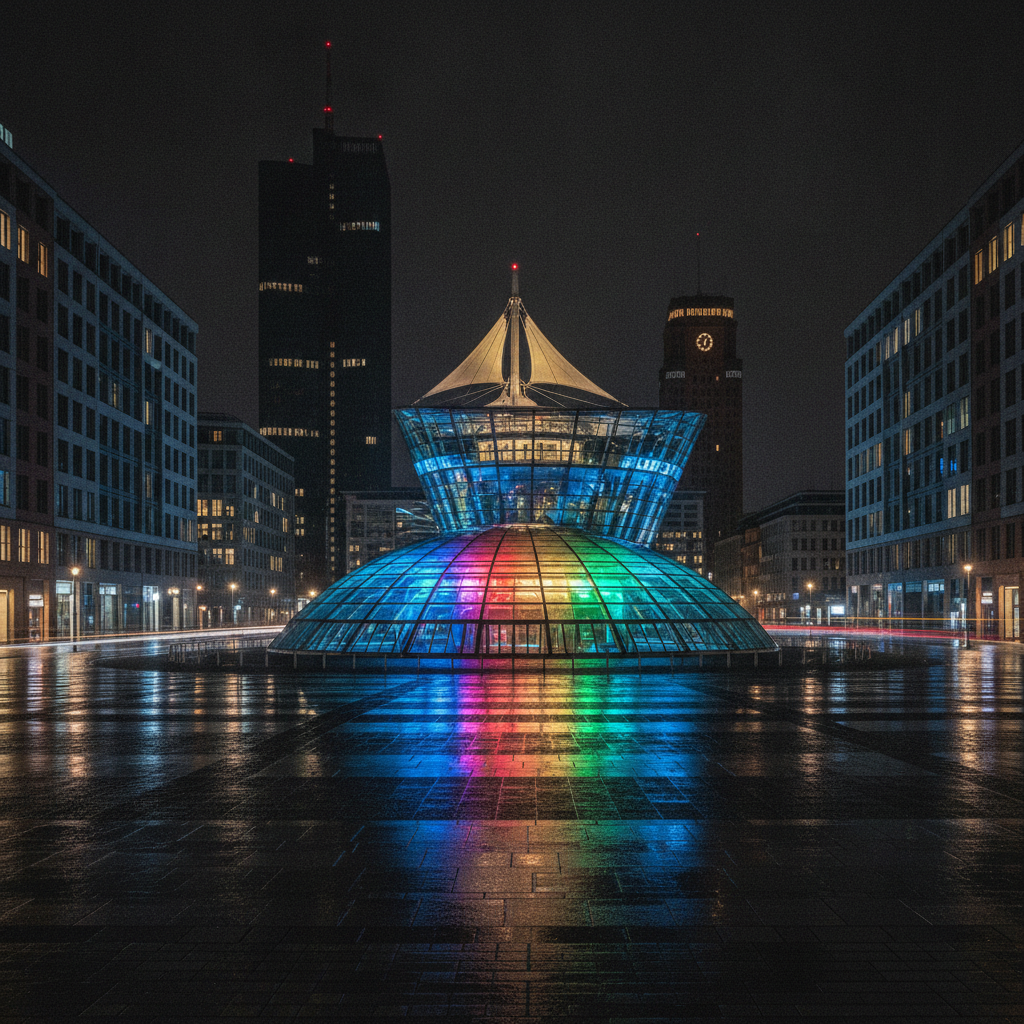
The Sony Center — seven buildings arranged around a glass-roofed elliptical forum, designed by Chicago architect Helmut Jahn (1999-2000) — is the most architecturally striking complex at Potsdamer Platz and one of the most impressive urban spaces in Europe. The forum's tensile roof (a 4,000 m² combination of glass and fabric canopy supported by steel cables) is based on the form of Mount Fuji in Japan (Sony's corporate symbolism) and changes color via LED lighting at night. The complex contains the original ballroom of the Hotel Esplanade (the 'Kaisersaal', 1908, the only surviving fragment of the pre-war Potsdamer Platz, which was moved 75 meters in one piece in 1996 during construction — the largest building-moving operation in Berlin's history), the Museum of Film and Television (Deutsche Kinemathek, Germany's most comprehensive film archive and museum), the IMAX theater, and multiple restaurants. The Sony corporation sold the complex to a Korean investment fund in 2017.
- 3
Kollhoff Tower & Historic Traffic Light
The Kollhoff Tower (1999, Hans Kollhoff) — the 103-meter brown brick neo-expressionist skyscraper at the eastern end of Potsdamer Platz, the dominant vertical element in the square — deliberately recalls the brick towers of 1920s New York and the expressionist architecture of Erich Mendelsohn in its warm color and tapered form. The tower's panorama point (Panoramapunkt, top floor at 96 m, reached by Europe's fastest elevator) offers the best views of the new Berlin. At the base of the Kollhoff Tower stands the replica of the 1924 Potsdamer Platz traffic light (the original traffic light tower, a yellow octagonal column that rotated 90 degrees on a 90-second cycle, was the first in continental Europe) — an attempt to acknowledge the square's pre-war history in the entirely new built environment. The Daimler quarter (by Renzo Piano and others, including Giorgio Grassi, Richard Rogers, Rafael Moneo, and Hans Scharoun) extends south from Potsdamer Platz to the Landwehrkanal.
- 4
Philharmonie (1963, Hans Scharoun)
The Berliner Philharmonie — designed by Hans Scharoun, completed 1963 (the chamber music hall added 1987 by Edgar Wisniewski), seat of the Berlin Philharmonic Orchestra — is one of the most architecturally significant concert halls in the world and the first to use the 'vineyard' seating arrangement (the stage surrounded by blocks of seating on terraced levels on all sides, now the standard model for concert hall design worldwide). Scharoun's design was radical for its time: the irregular exterior form was driven entirely by interior acoustic considerations, the terra-cotta-yellow facade and asymmetric tent-like roof making it immediately identifiable in the West Berlin cityscape. The Philharmonic under Herbert von Karajan (chief conductor 1955-1989) became under Scharoun's building one of the most recorded orchestras in history; subsequent chief conductors Claudio Abbado (1989-2002) and Simon Rattle (2002-2018) maintained the ensemble's position at the apex of the orchestral world. The hall's acoustic (designed with the physicist Lothar Cremer) is widely considered the finest in the world.
- 5
Neue Nationalgalerie (1968, Mies van der Rohe)
The Neue Nationalgalerie — designed by Ludwig Mies van der Rohe (his last completed building, 1968) as the home of the National Gallery's 20th-century collection — is one of the supreme achievements of 20th-century architecture: an 8-column steel-and-glass temple (the roof is a single 65×65 meter steel plate, weighing 1,200 tons, supported on just 8 columns) that represents the ultimate realization of Mies's lifelong pursuit of universal space. The building was closed for renovation in 2015 (architect: David Chipperfield) and reopened in 2021 after six years of work. The permanent collection includes major works by Picasso (the 1960 'Crouching Woman'), Ernst Ludwig Kirchner, Max Beckmann, Paul Klee, Max Ernst, and Alexander Calder; the most significant piece is Willi Baumeister's studio. The open ground-floor gallery (entirely glass, with no fixed walls) is used for temporary exhibitions; the permanent collection is in the basement below.
- 6
Gemäldegalerie & Kunstgewerbemuseum
The Gemäldegalerie (Picture Gallery) — opened 1998 in the Kulturforum, designed by Heinz Hilmer and Christoph Sattler — contains one of the world's greatest collections of European paintings from the 13th to 18th centuries: 1,500 paintings on display (from a collection of 3,000) spanning Flemish and Dutch masters (the world's largest collection of Rembrandt paintings outside the Netherlands: 'Man in the Golden Helmet', 16 works), Italian masters (Botticelli, Raphael, Titian, Caravaggio), Spanish masters (Velázquez, Murillo), and German masters (Dürer, Cranach, Holbein). The adjacent Kunstgewerbemuseum (Museum of Decorative Arts, 1985, Rolf Gutbrod) contains the most comprehensive collection of European decorative arts in Germany, spanning the Middle Ages to Art Deco: the Guelph Treasure (Brunswick, 12th century, one of the most important medieval treasures), the Lüneburg town hall silver (15th-16th century), and complete 18th-century room installations.
Walk this route with audio
Stories play automatically as you reach each stop — no tapping needed.
More in berlin
Kreuzberg: Turkish Market, Landwehrkanal & Urban Culture
Hackescher Markt, Scheunenviertel & Prenzlauer Berg: Berlin's Bohemian Heart
Schöneberg, Steglitz & South Berlin: Kennedy's Stage, Bowie's Flat
Charlottenburg Palace & Kurfürstendamm: West Berlin's Royal Mile
Brandenburg Gate, Reichstag & Tiergarten: The Heart of Reunified Berlin