Potsdam & Sanssouci: Frederick the Great's Palace Paradise
Potsdam — 30 minutes by S-Bahn from central Berlin, the former Prussian royal residence and the most important ensemble of palaces and parks in northern Europe — is a UNESCO World Heritage Site (1990) containing 500 years of Hohenzollern history. Sanssouci ('without care' in French, the motto of Frederick the Great) is the intimate summer palace he designed himself and considered his true home, in contrast to the formal Berlin Palace.
- 1
Berlin Hauptbahnhof → Potsdam Hbf (S-Bahn)
The journey from Berlin to Potsdam by S-Bahn (S7, approximately 30-40 minutes from Hauptbahnhof or Zoologischer Garten) crosses the Havel River via the Glienicke Bridge (the famous 'Bridge of Spies' — the border between West Berlin and the GDR across the Havel at Glienicke, used for prisoner exchanges during the Cold War, most famously Francis Gary Powers for Rudolf Abel in 1962, made famous by Steven Spielberg's 2015 film). Potsdam Hauptbahnhof stands at the southern edge of the city; the palace park of Sanssouci is a 20-minute walk or 10-minute bus ride to the northwest. Potsdam itself (population 180,000) was the garrison city of the Hohenzollerns and retains its Dutch Quarter (Holländisches Viertel, 134 brick houses built 1733-1740 for Dutch craftsmen), the Russian Colony Alexandrowka (12 log houses built 1826 for the Russian choir singers of Friedrich Wilhelm III, UNESCO listed), and the Potsdam Conference Site (Cecilienhof Palace, 1916-1917, where Truman, Stalin, and Attlee signed the Potsdam Agreement dividing post-war Europe in August 1945).
- 2
Sanssouci Palace (1747, Knobelsdorff/Frederick the Great)
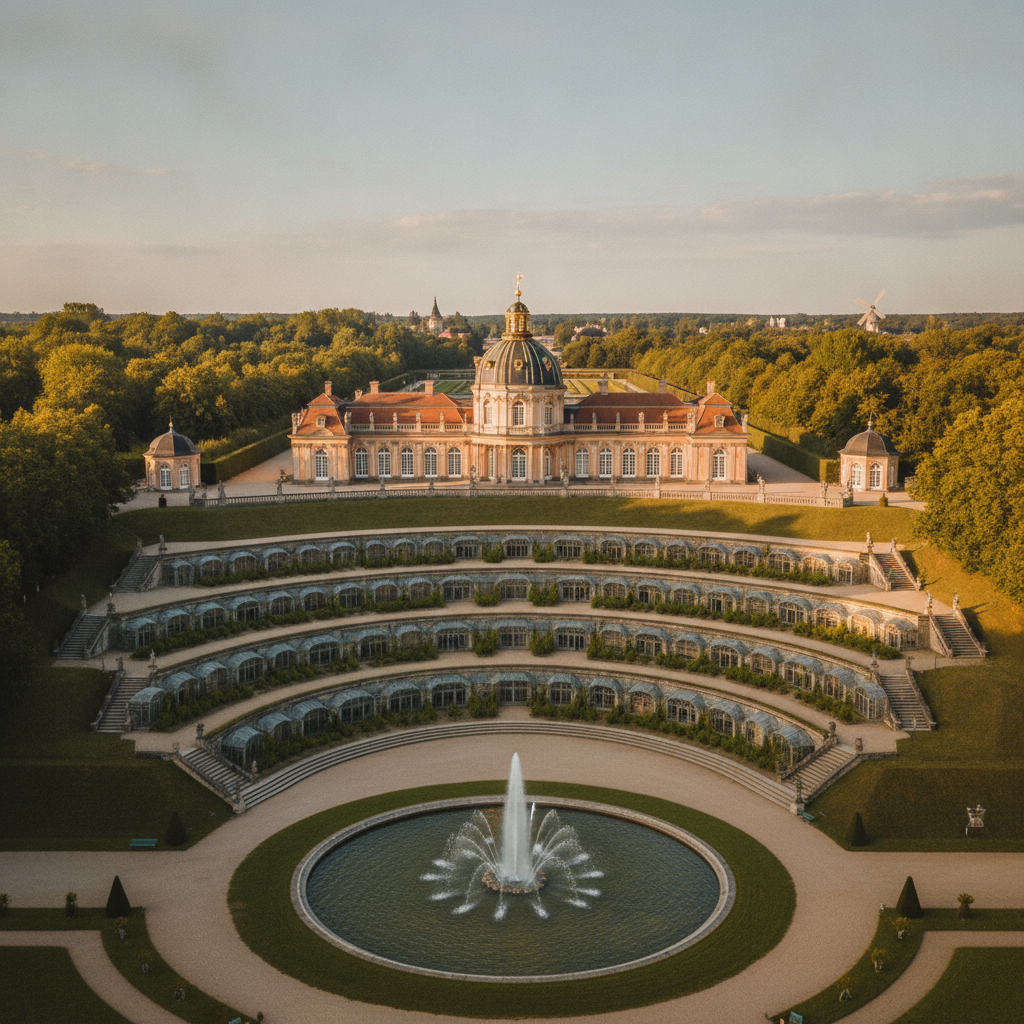
Sanssouci — built 1745-1747 by Georg Wenzeslaus von Knobelsdorff to the personal sketches of Frederick the Great (Friedrich II, King of Prussia 1740-1786, the 'Philosopher King', friend of Voltaire, military genius, and flute-player) — is an intimate 10-room rococo summer palace perched atop six terraced vineyard steps (the terraces, carved into the hillside, contain glass-fronted niches warming figs and grapevines, a technique introduced by Frederick who wanted to grow Mediterranean fruits in Brandenburg's cold climate). The palace is emphatically private (the word 'sans-souci' — French for 'without care' — was Frederick's description of his escape from the burdens of kingship) and architecturally modest by the standards of 18th-century royal residences: the facade is single-story, the rooms (including the marble hall, library, music room, study, and bedroom) are richly decorated in the Frederician Rococo style but intimate in scale. Frederick died here on August 17, 1786, in an armchair in his study; his wish to be buried next to his dogs on the terrace was denied until 1991 (German reunification), when his remains were finally interred here.
- 3
Sanssouci Park & Neue Kammern (1747)
The Sanssouci Park — 290 hectares extending from the New Palace in the west to the Charlottenhof in the southeast, organized around the central east-west axis of the main avenue — contains more historic buildings than any other palace garden in Germany: Sanssouci Palace (1747), the Neue Kammern (New Chambers, 1747, originally a greenhouse, converted into guest apartments 1771-1774), the Roman Baths (1829, Schinkel and Ludwig Persius, a romantic landscape feature), the Chinese Tea House (Chinesisches Teehaus, 1757, Büring, a gilded rococo fantasy of Chinese pavilion surrounded by gilded figures of Chinese courtiers under parasols), the Orangery (1851-1860, Persius, 300-meter-long Italian Renaissance palazzo), and the Dragon House (Drachenhaus, 1770, a Chinese-style tea house on the vineyard hill). The park's current extent reflects 250 years of additions by successive Hohenzollern kings, organized in the English landscape style by Peter Joseph Lenné (1816-1840).
- 4
Neue Palais (1763-1769)
The Neue Palais (New Palace) — built by Frederick the Great 1763-1769 immediately after the end of the Seven Years' War as a demonstration that Prussia was financially unbroken by the devastating conflict — is the largest palace in the Sanssouci Park (240 meters wide, with three floors and 322 rooms) and the most pompous Prussian Baroque/Rococo building. Frederick himself despised the building (he called it a 'fanfaronade', a boast) and rarely used it; it was the official guest palace of the Hohenzollerns and later the principal residence of Kaiser Wilhelm II (who abdicated here on November 9, 1918, the same day the Berlin Wall fell 71 years later). The Grotto Hall (the ground floor shell-mosaic room, containing 40,000 embedded shells, crystals, fossils, and minerals in elaborate patterns) and the Marble Hall (with ceiling fresco) are the two most spectacular interior spaces. The Communs — the two curved colonnaded wings flanking the palace court — are now the University of Potsdam campus.
- 5
Schloss Charlottenhof (1826-1829, Schinkel)
Schloss Charlottenhof — designed by Karl Friedrich Schinkel for Crown Prince Friedrich Wilhelm (later Friedrich Wilhelm IV) 1826-1829 in a Pompeian neoclassical style — is the most architecturally refined building in the Sanssouci Park and Schinkel's masterpiece of domestic architecture. The building, set in a shallow depression surrounded by Lenné's designed English landscape, looks outward over a reflecting pool to the park rather than presenting a formal facade — an anti-monumental approach unique in Prussian palace architecture. The interiors (Tent Room, Bedroom in the style of Pompeii, the Crown Prince's Study with Schinkel's own furniture designs) are intact and show the extraordinary integration of art, architecture, and nature that defines the Charlottenhof ensemble. Adjacent, the Roman Baths (1829, by Schinkel and Ludwig Persius) — a romantic ensemble of a tea house, courtyard, garden hall, and bath house in an Italian vernacular style — complete the ensemble.
- 6
Cecilienhof & Potsdam City Center
Cecilienhof Palace (1914-1917, Paul Schultze-Naumburg, English neo-Tudor style, the last palace built by the Hohenzollerns) — in the Neuer Garten on the Heiliger See lake — is famous as the site of the Potsdam Conference (July 17-August 2, 1945), where the victorious Allied leaders (Truman, Stalin, Churchill/Attlee) signed the Potsdam Agreement dividing Germany into occupation zones and establishing the post-war order. The conference room is preserved exactly as it was in 1945. The Potsdam city center (reconstructed after massive WWII destruction) includes the Dutch Quarter (Holländisches Viertel, 134 red-brick houses built 1733-1742 by Dutch craftsmen for Friedrich Wilhelm I), the Nikolaikirche (1830-1837, Schinkel, the finest classicist church in Prussia), and the Brandenburger Tor (1770, Gontard and Unger, the Potsdam Brandenburg Gate, predating and inspiring the Berlin one — the more modest of the two Prussian triumph arches).
Walk this route with audio
Stories play automatically as you reach each stop — no tapping needed.
More in berlin
Kreuzberg: Turkish Market, Landwehrkanal & Urban Culture
Hackescher Markt, Scheunenviertel & Prenzlauer Berg: Berlin's Bohemian Heart
Schöneberg, Steglitz & South Berlin: Kennedy's Stage, Bowie's Flat
Charlottenburg Palace & Kurfürstendamm: West Berlin's Royal Mile
Brandenburg Gate, Reichstag & Tiergarten: The Heart of Reunified Berlin