Museum Island & Unter den Linden: Berlin's UNESCO Cultural Heart
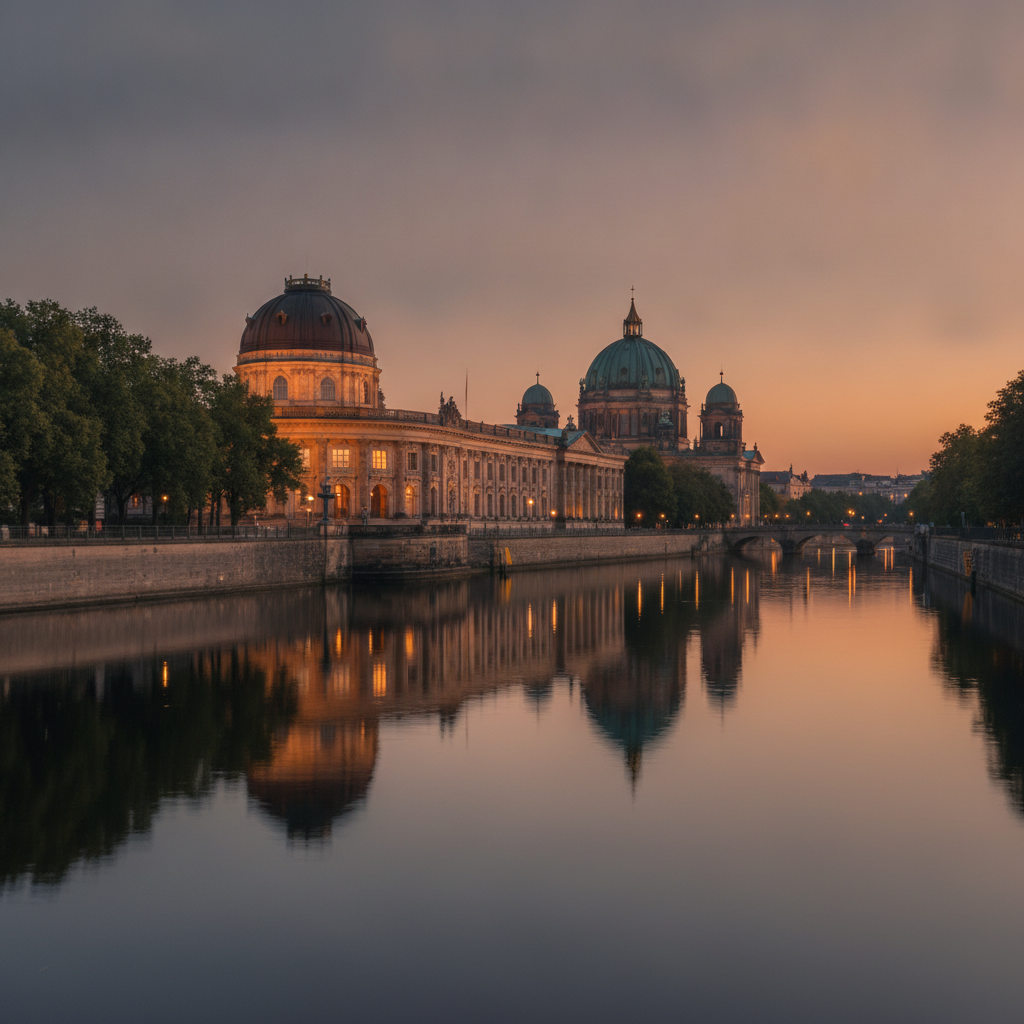
Museum Island (Museumsinsel) — a UNESCO World Heritage Site since 1999 — is a narrow island in the Spree river containing five of Berlin's greatest museums built between 1824 and 1930: the Pergamon Museum (ancient Babylon and Pergamon), the Neues Museum (Egyptian collection and the bust of Nefertiti), the Alte Nationalgalerie (19th-century art), the Bode Museum (Byzantine and medieval art), and the Altes Museum. Unter den Linden, the grand lime-tree-lined boulevard, runs west to the Brandenburg Gate.
- 1
Pergamon Museum (1930) & Ishtar Gate
The Pergamon Museum — the most-visited museum in Germany (1.1 million visitors annually) — was built 1910-1930 to house the oversized architectural reconstructions that could not fit in any existing Berlin museum: the Pergamon Altar (166-156 BC, a massive altar to Zeus from the ancient city of Pergamon in western Turkey, reconstructed at full scale, 36 × 34 meters, the most important surviving Hellenistic structure), the Market Gate of Miletus (2nd century AD Roman, 17 meters high), and the Ishtar Gate of Babylon (ca. 575 BC, the eighth gate of the inner city of Babylon built under Nebuchadnezzar II, its blue-glazed bricks and animal reliefs forming one of the most spectacular ancient architectural ensembles in existence). All were excavated by German archaeologists in the late 19th and early 20th centuries and reconstructed in Berlin — their ownership is a subject of ongoing restitution discussions with Turkey and Iraq. The Pergamon Museum is currently partially closed for renovations (2023-2027); the Pergamon Altar hall is closed while the Market Gate of Miletus and Ishtar Gate remain open.
- 2
Neues Museum & Bust of Nefertiti (1912 BC)
The Neues Museum (New Museum) — designed by Friedrich August Stüler 1843-1855, bombed into a shell in WWII, left to decay for 50 years in divided Berlin (it was in the GDR sector and politically impossible to restore), spectacularly restored by David Chipperfield Architects 2003-2009 (winning the European Union Prize for Contemporary Architecture) — houses the Egyptian Museum and Papyrus Collection and the Museum of Prehistory and Early History. The supreme icon of the collection is the Bust of Nefertiti (ca. 1345 BC, limestone core covered with painted stucco, 50 cm high, discovered at Amarna in 1912 by Ludwig Borchardt and controversially transported to Germany) — the most reproduced artwork in the world after the Mona Lisa. Also significant: the Berlin Gold Hat (a cone-shaped sheet gold object of the Late Bronze Age, ca. 1000-800 BC), the Xanten Youth (a Roman bronze of exceptional quality, 1st century BC), and the Trojan antiquities excavated by Heinrich Schliemann. The Chipperfield restoration is itself a masterpiece: rather than recreating the destroyed rooms, he preserved the war-damaged surfaces and integrated new construction — a brilliant meditation on preservation, memory, and ruin.
- 3
Berliner Dom (Berlin Cathedral, 1905)
The Berliner Dom (Protestant Cathedral of Berlin) — built 1893-1905 by Julius Raschdorff for Kaiser Wilhelm II as the central court church and burial place of the Hohenzollern dynasty, replacing an earlier structure on the same site — is the largest Protestant church in Germany (114 meters dome height, capacity 1,500). The cathedral is not an Anglican/Catholic cathedral but a parish church with imperial ambitions: the four side chapels (the Denkmalskirche, the Taufkirche, the Trauungskirche, and the Predigtkirche) constitute a complete ceremonial apparatus for the Hohenzollern court. The imperial Hohenzollern sarcophagi in the crypt (95 sarcophagi from the 15th through 20th centuries, including the elaborate zinc-and-silver sarcophagi of the Great Elector Friedrich Wilhelm and his wife Luise Henriette) are one of the most comprehensive royal burial collections in existence. The dome offers an exceptional view of Museum Island and the Spree. The cathedral was severely damaged in WWII and not fully restored until 1993.
- 4
Humboldt Forum / Berlin Palace (Berliner Schloss, 2021)
The Humboldt Forum — opened 2021 in a reconstruction of the Berliner Stadtschloss (Berlin City Palace) on the site where the former East German Palace of the Republic (1976) stood until its demolition in 2008 — is Berlin's most controversial cultural project. The baroque palace (original built 1443-1713, reconstructed 2012-2021 at a cost of €680 million) houses non-European collections from the Ethnological Museum and Museum of Asian Art (previously in Dahlem), a Berlin history museum, the Humboldt University, and a digital hub. The reconstruction of the palace's three baroque facades (north, south, and east) while using a modernist glass curtain wall on the west side is a politically charged decision: the palace was the royal residence of the Prussian monarchy and has complex associations with German imperialism and colonialism. The non-European collections contain approximately 500,000 objects from Africa, the Americas, Oceania, and Asia, many acquired under colonial conditions — their deaccessioning and repatriation is one of the defining cultural-political debates in contemporary Germany.
- 5
Bebelplatz & Book Burning Memorial (1933)
Bebelplatz (formerly Opernplatz) — the large paved square west of the Berliner Dom, surrounded by the State Opera (Staatsoper Unter den Linden, originally built 1741-1743 by Georg Wenzeslaus von Knobelsdorff for Frederick the Great as the first opera house to open on a public square in Germany, rebuilt after WWII bomb damage), the St. Hedwig's Cathedral (1773, the first Catholic church built in Berlin after the Reformation), and the former Royal Library (now Humboldt University Law Faculty) — was the site of the Nazi book burning on May 10, 1933, when members of the German Student Union burned approximately 20,000 books by Jewish, Marxist, pacifist, and other 'un-German' authors. The square contains a striking underground memorial by Israeli artist Micha Ullman (1995): looking through a glass panel set into the paving, you see an underground white room lined with empty bookshelves — capacity sufficient for the 20,000 burned books. A plaque beside it quotes Heinrich Heine's 1820 prophecy: 'Dort wo man Bücher verbrennt, verbrennt man am Ende auch Menschen' ('Where books are burned, ultimately people will be burned too').
- 6
Unter den Linden & Staatliche Museen
Unter den Linden (Under the Lime Trees) — the 1.5 km ceremonial boulevard running west from the Berliner Dom to the Brandenburg Gate, originally a riding path laid out by the Elector Joachim II through his hunting grounds (1573), formally planted with double rows of linden trees in 1647 under Friedrich Wilhelm I — was the principal street of royal and imperial Berlin, lined with the palaces, embassies, and public buildings of successive Prussian rulers. The boulevard's name derives from the linden trees: replanted multiple times (most recently after WWII devastation), approximately 280 trees line the central promenade. Today the street is a 1.9 km pedestrianized zone (vehicles are permitted on the outer lanes) containing the Humboldt University main building (1748, originally built as a palace for Prince Heinrich, given to the university in 1809; alma mater of Albert Einstein, Karl Marx, Arthur Schopenhauer, Heinrich Heine), the German History Museum (Deutsches Historisches Museum, in the Zeughaus/Arsenal, the oldest surviving building on Unter den Linden, 1695-1706), and the Russian Embassy (the largest embassy building in Berlin, built in Stalinist neoclassical style 1950-1952).
Walk this route with audio
Stories play automatically as you reach each stop — no tapping needed.
More in berlin
Kreuzberg: Turkish Market, Landwehrkanal & Urban Culture
Hackescher Markt, Scheunenviertel & Prenzlauer Berg: Berlin's Bohemian Heart
Schöneberg, Steglitz & South Berlin: Kennedy's Stage, Bowie's Flat
Charlottenburg Palace & Kurfürstendamm: West Berlin's Royal Mile
Brandenburg Gate, Reichstag & Tiergarten: The Heart of Reunified Berlin