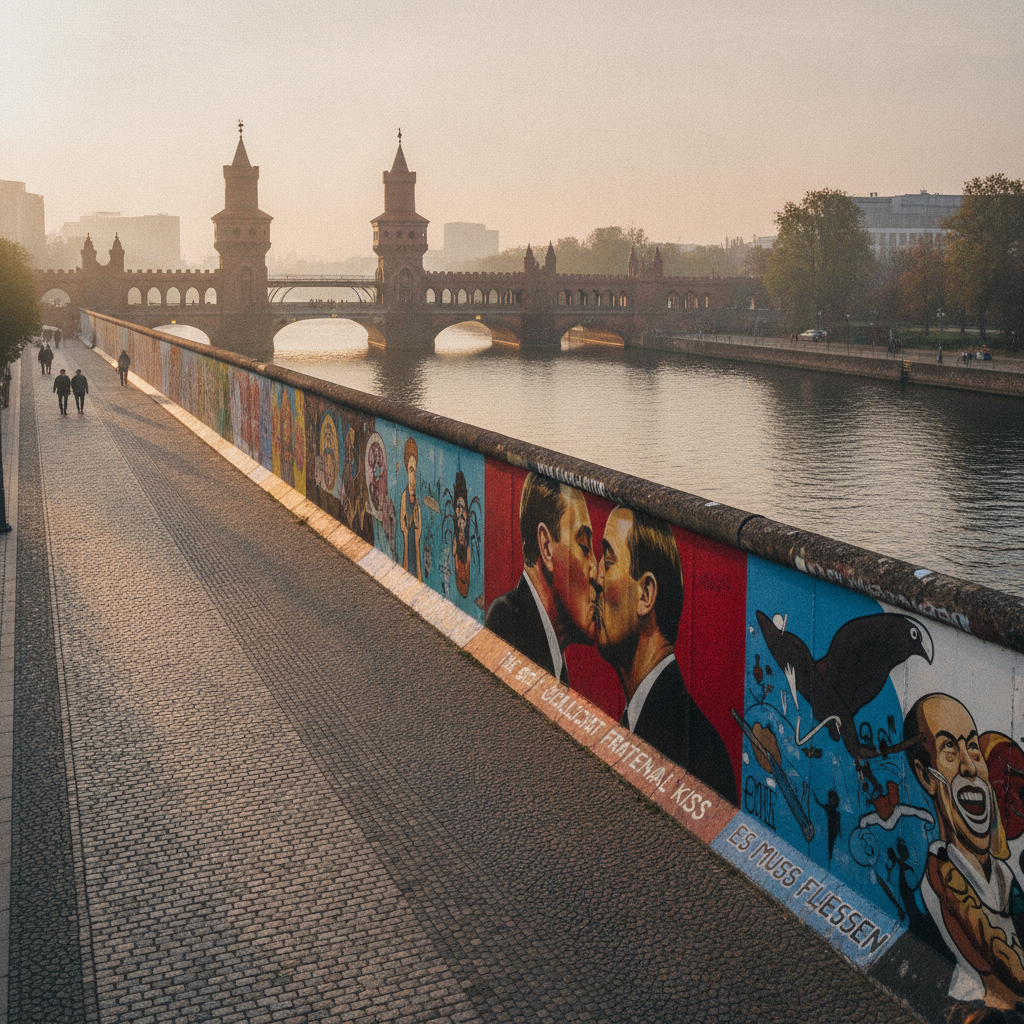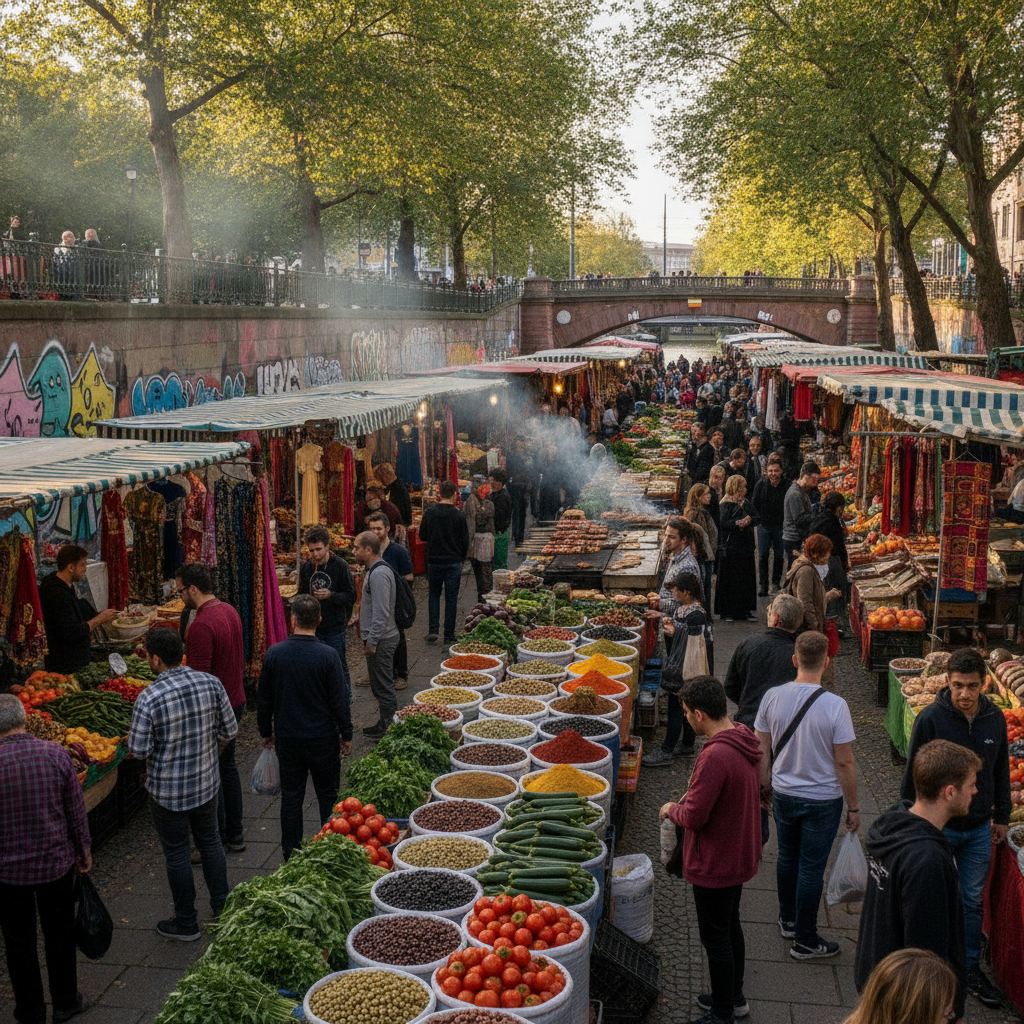
Kreuzberg: Turkish Market, Landwehrkanal & Urban Culture
Kreuzberg — the former West Berlin enclave that became the center of both the Turkish-German immigrant community and the alternative counterculture — is the most politically and culturally charged neighborhood in Berlin. From the Landwehrkanal's Turkish market to the street-art corridors of SO36, this route captures a neighborhood that has defined Berlin's reputation for radical diversity, creative resistance, and gentrification-era tension.
- 1
Oranienstraße & SO36 (Kreuzberg 36)
Oranienstraße — the main artery of Kreuzberg 36 (the SO36 postal district, a name that has come to define the entire alternative Kreuzberg culture) — is the historical center of West Berlin's squatter movement, punk scene, and Turkish immigrant community. During the 1970s and 1980s, Kreuzberg 36 — bordered by the Berlin Wall on three sides, cheap rents, and negligible city investment — became the gathering point for draft-dodgers (West Germany had no military service exemption for West Berlin residents, making it a haven for conscientious objectors), punk bands (the SO36 club, named after the postal code, was the venue for the Einstürzende Neubauten, Nina Hagen, and the first wave of German punk), and political squatters (the 'May 1st riots' in Kreuzberg have been an annual event since 1987, the last major confrontation between police and anti-gentrification protesters occurring in 2018). The Türkenmarkt (Tuesday and Friday, along Maybachufer canal) — established in the 1970s by Turkish guestworkers who had arrived under Germany's Gastarbeiter program since the 1960s — is the largest Turkish street market in Germany outside of Istanbul.
- 2
Landwehrkanal & Admiralbrücke
The Landwehrkanal — a 10.7 km canal cut 1845-1850 to relieve flooding on the Spree, running roughly parallel to the river between the Tiergarten in the north and Neukölln in the south — is the social spine of Kreuzberg and the setting of one of Berlin's most important unsolved historical crimes: the murder of Rosa Luxemburg (co-founder of the Communist Party of Germany, assassinated January 15, 1919, her body thrown into the Landwehrkanal from the Lichtenstein Bridge by Freikorps soldiers — not recovered until May 1919). The Admiralbrücke (Admirals' Bridge, 1902) — the iron bridge over the canal at Urbanstraße — has been an informal summer gathering spot since the 1990s, crowded nightly with young Berliners playing music, drinking, and socializing on the bridge parapet (the city's attempts to regulate this 'street partying' have been unsuccessful). The canal towpaths (Ufer) are lined with plane trees, houseboats, and the outdoor tables of cafes that remain open until late.
- 3
Viktoriapark & Kreuzberg Monument (1821)
Viktoriapark — the 13-hectare hilltop park at the summit of the Kreuzberg (the 66-meter glacial hill that gives the neighborhood its name) — contains the National Monument for the Liberation Wars (Nationaldenkmal für die Befreiungskriege, 1821, Karl Friedrich Schinkel, cast iron, neo-Gothic), commemorating the Prussian victories in the Napoleonic Wars (1813-1815). The monument — Schinkel's first major work, a 19-meter cast-iron cross atop the hill — is the origin of the Iron Cross military decoration (the cross-form was adopted directly from Schinkel's design by Friedrich Wilhelm III). The park also contains an artificial waterfall (the only natural-style cascade in inner-city Berlin, running down from the monument to a pool at the park's edge) and the Golgatha beer garden, Berlin's most atmospheric outdoor restaurant. The Tempodrom concert tent (the largest concert venue in Berlin after the Waldbühne) is at the park's base on the Anhalter Bahnhof former rail yard.
- 4
Bergmannstraße & Marheinekeplatz
Bergmannstraße — running east-west through the center of Kreuzberg 61 (the other sub-district, formerly more bourgeois, now the most expensive part of Kreuzberg) — is the most pleasant commercial street in Berlin: lined with independent food shops, bakeries, vintage furniture stores, independent cinemas (the Filmkunst 66 and the Odeon), and the Marheinekeplatz market hall (the Markthalle, 1891, now a covered food market with artisanal producers). Kreuzberg 61 — separated from the wilder SO36 by the Paul-Linke-Ufer canal — developed a distinct character as the home of Berlin's alternative intelligentsia: writers (Günter Grass lived in Friedenau, immediately adjacent), publishers, and the Südblock bar/Mehringhof cultural center complex. The Bergmannkiez (the residential blocks around Bergmannstraße) are among the most desirable in Berlin and have experienced the most intense gentrification pressure since 2010.
- 5
Tempelhof Airport Park (1923-2008)
Tempelhof Field (Tempelhofer Feld) — the former Tempelhof Airport (one of the world's first commercial airports, opened 1923, the site of the 1948-49 Berlin Airlift, closed 2008, the terminal building is the largest pre-war building by floor area in Germany at 300,000 m²) — was converted into a public park in 2010 after Berlin voters rejected a development plan in a 2014 referendum (the first successful citywide referendum in Berlin history, explicitly rejecting city government plans). The 386-hectare grassland — the largest inner-city park in Europe — is used for cycling, kite-flying, urban gardening, and community events. The runway remains intact, used for inline skating and cycling; the abandoned runways and aprons retain the atmosphere of an operating airport, with the massive curved terminal (designed by Ernst Sagebiel, 1936-1941, begun during the Nazi period, never fully completed) visible across the entire field. The field also serves as refugee accommodation (containers have been installed in the former air hangars since 2015).
- 6
Görlitzer Park & Urban Gardening
Görlitzer Park (Görli) — the former Görlitz Station rail yard (built 1866, bombed 1945, demolished 1961), converted into a park 1977-1991 — is the most controversial and vital public space in Kreuzberg. The park (14 hectares, with a small petting zoo, beach volleyball courts, a Turkish swimming pool, and community gardens) is the hub of Kreuzberg's outdoor social life and simultaneously the focal point of debates about drug dealing, policing, and gentrification in Berlin. The park has been the site of open drug sales (primarily cannabis, which is legally available in Germany since April 2024 but the park's informal economy predates legalization) for decades, and the city's attempts to police it have generated intense political controversy. The adjacent Spree canal section (Paul-Linke-Ufer, Kottbusser Damm bridge area) includes the most painted walls in Kreuzberg, with legal and illegal street art murals going back to the 1980s.
Walk this route with audio
Stories play automatically as you reach each stop — no tapping needed.
More in berlin
Hackescher Markt, Scheunenviertel & Prenzlauer Berg: Berlin's Bohemian Heart
Schöneberg, Steglitz & South Berlin: Kennedy's Stage, Bowie's Flat
Charlottenburg Palace & Kurfürstendamm: West Berlin's Royal Mile
Brandenburg Gate, Reichstag & Tiergarten: The Heart of Reunified Berlin
Museum Island & Unter den Linden: Berlin's UNESCO Cultural Heart