Bengaluru After Dark: 1am Bars, India's Most Visible Queer Scene & Why Hyderabad Is Trying to Steal the Silicon Valley Crown
Close the Bengaluru story—Koshy's opening at 5:30am and Imperial Restaurant serving Mughlai biryani at 2am bookending a city that works and plays on its own schedule, UB City's Louis Vuitton and Burberry built on Vijay Mallya's collapsed Kingfisher Airlines debt, the kere tank cascade system that watered the Deccan Plateau for 1,500 years now being restored lake by lake by citizen movements, the Queer Azaadi March of 15,000 people celebrating the Section 377 Supreme Court ruling in a city that is India's most openly LGBTQ+-friendly, and the Hyderabad challenge to Bengaluru's technology dominance—and why the 40-year human capital compound makes it hard to dislodge.
- 1
Bengaluru's Nightlife in Full – The Late City
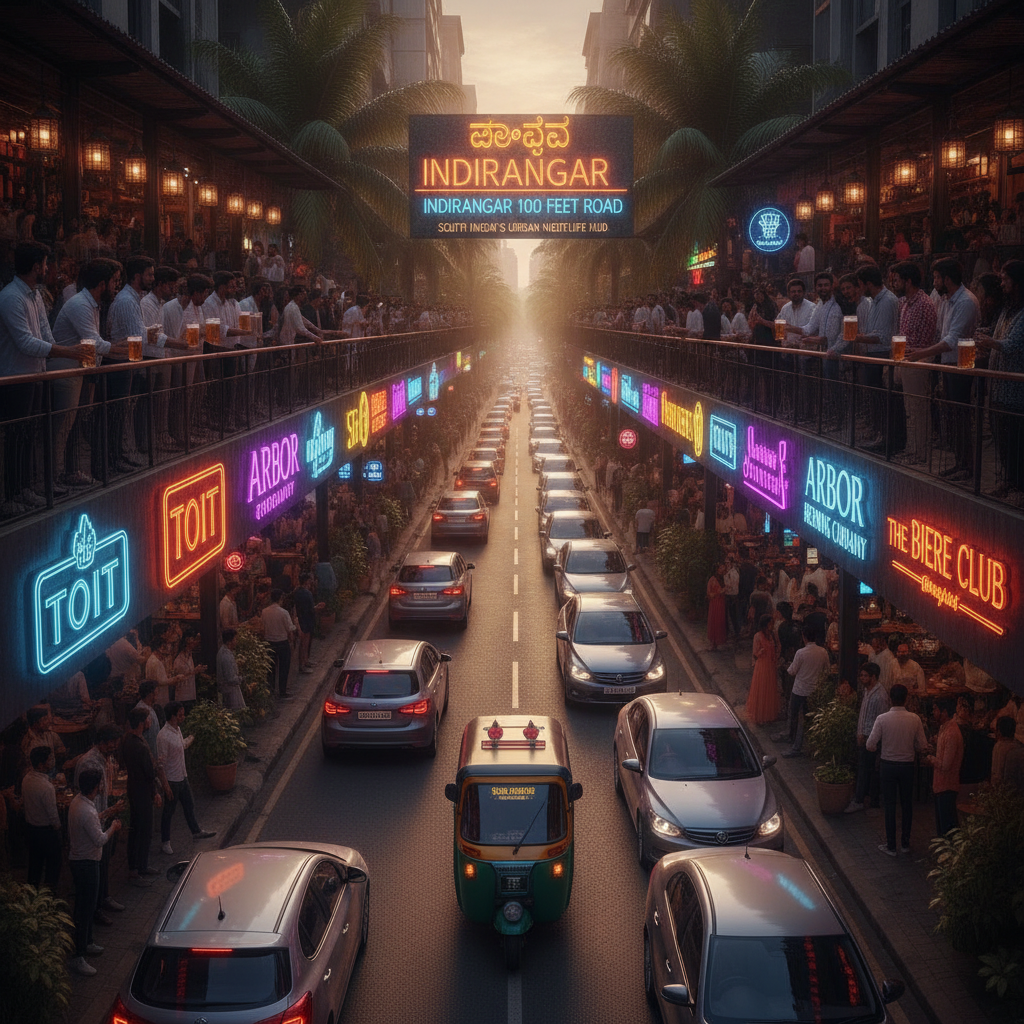
Bengaluru's nightlife operates later and more freely than any other Indian city outside Goa: bars and restaurants in Indiranagar, Koramangala, and Whitefield are active until 1am most nights (versus 11pm–midnight in Mumbai and Delhi). The reasons: Karnataka's more liberal excise regulations, the IT workforce's exposure to global nightlife norms, and the absence of the political culture that shuts down Mumbai and Delhi nightlife. The late-night food scene: Imperial Restaurant (Church Street—open 24 hours, Mughlai biryani and kebabs at 2am), Koshy's (St Mark's Road—Bengaluru's most beloved restaurant, established 1952, coffee house atmosphere, intellectuals and journalists, open since 5:30am). DJ culture: Skyye (UB City rooftop), Whisky Samba, and a network of Indiranagar warehouse venues that host international and Indian DJs weekly.
- 2
UB City & Bengaluru's Luxury Economy
UB City—the luxury mall and commercial development built on the former United Breweries headquarters site in Vittal Mallya Road, central Bengaluru—is the most concentrated luxury retail destination in South India: Louis Vuitton, Burberry, Armani, Prada, and a rooftop bar (Skyye) overlooking the city. The United Breweries Group (Kingfisher Beer, the most consumed beer in India) was built by the entrepreneur Vijay Mallya; his subsequent spectacular collapse (Kingfisher Airlines failed in 2012 with ₹9,000 crore in unpaid debt; Mallya fled India in 2016 and is subject to extradition proceedings by the UK) left UB City itself intact but gave it a complicated legacy. The Vittal Mallya Road area (Brigade Road, MG Road, and surrounding streets) constitutes central Bengaluru's commercial and hospitality core.
- 3
Bengaluru's Water Tanks – The Historic Kere System
The 'kere' (tank/lake in Kannada)—the thousands of interconnected water bodies engineered across Karnataka's Deccan plateau over 1,500 years by the Ganga, Hoysala, and Vijayanagara kingdoms to harvest monsoon runoff in a region with no perennial rivers—represent one of the world's most sophisticated pre-modern water management systems. Bengaluru's urban kere system (200+ tanks at independence, now reduced to 80) was designed so overflow from one tank fed the next in sequence—a gravity-fed cascade across the plateau. The Kempe Gowda (the feudal chief who founded Bengaluru city in 1537) is credited with building the original urban tank network. The 'Save Our Lakes' movement has achieved lake restoration at Puttenahalli (complete restoration, fish restocked, birds returned) and Jakkur—demonstrating that restoration is possible even in a densely developed urban context.
- 4
Bengaluru's LGBTQ+ Scene – India's Most Visible Queer Culture
Bengaluru has India's most visible and active LGBTQ+ community—a product of the city's cosmopolitan demographics, educated and internationally connected population, and relatively liberal social environment. The Bengaluru Queer Film Festival (BQFF, annual since 2009) is India's oldest LGBTQ+ film festival. The Queer Azaadi March (Bengaluru Pride Parade, annual in November) is one of India's largest, with 10,000–15,000 participants. India's Section 377 (which criminalised consensual same-sex relations) was struck down by the Supreme Court in September 2018—a ruling celebrated in Bengaluru with particular intensity. The same-sex marriage question (which reached the Supreme Court in 2023, which declined to rule—leaving the issue to Parliament) remains unresolved. Bengaluru's bar and restaurant scene is explicitly queer-friendly in a way that exceeds any other Indian city outside Mumbai.
- 5
Bengaluru's Education Complex – From IISc to Private Colleges
Karnataka's education sector—centred on Bengaluru—is one of the largest in India. Beyond IISc and IIMB (the premier institutions), Bengaluru has: Christ University, Manipal Academy, PESIT, RV College of Engineering, and dozens of other private universities and colleges that together enrol approximately 600,000 students. The private engineering college sector in Karnataka (400+ colleges) expanded dramatically from the 1990s to meet the IT sector's demand for software engineers; the resulting qualification inflation (engineering degrees now valued less per se; employers increasingly seek additional skills or IIT/IIIT-level credentials) is reshaping the employment market. The National Law School of India University (NLSIU, Bengaluru)—India's premier law school—and the Srishti Manipal Institute of Art, Design and Technology give the city a strong creative and legal professional base alongside its technical dominance.
- 6
Bengaluru vs Other Indian Tech Hubs – Hyderabad, Pune & Chennai
Bengaluru's dominance as India's technology capital is increasingly contested. Hyderabad ('Cyberabad'—the technology district centred on HITEC City) has attracted Microsoft, Google, Facebook, and Apple's India headquarters away from Bengaluru with cheaper real estate, better infrastructure (the Hyderabad metro is newer and better-designed than Bengaluru's), and the Telangana government's active investor-courting. Pune has attracted European and German automotive technology (Mercedes-Benz, Volkswagen, BMW tech centres), a strong manufacturing base, and lower living costs. Chennai has the automotive sector advantage. The primary counter-argument for Bengaluru: the quality of its talent pool (IISc, IIMB graduates; the self-selecting migration of India's most ambitious engineers to Bengaluru over 40 years has created a compound advantage in human capital density), and the ecosystem density (venture capital, angel investors, experienced second-time entrepreneurs) that cannot be relocated.
Walk this route with audio
Stories play automatically as you reach each stop — no tapping needed.
More in Bengaluru
Bengaluru Complete: Coorg Coffee Estates 5 Hours Away, the Standing-Only Darshini Breakfast & a City Without a Single Famous Monument
Bengaluru Insider: ISRO's $74m Mars Mission, Jacaranda Streets in March & the Indie Music Scene That Defined Indian Festivals
Bengaluru Essentials: India's Silicon Valley, the Garden City's Botanical Parks & the Country's Best Pub Scene
Bengaluru's Contrasts: Burning Lakes, ISRO's Moon Landing & the World's Most Traffic-Congested City