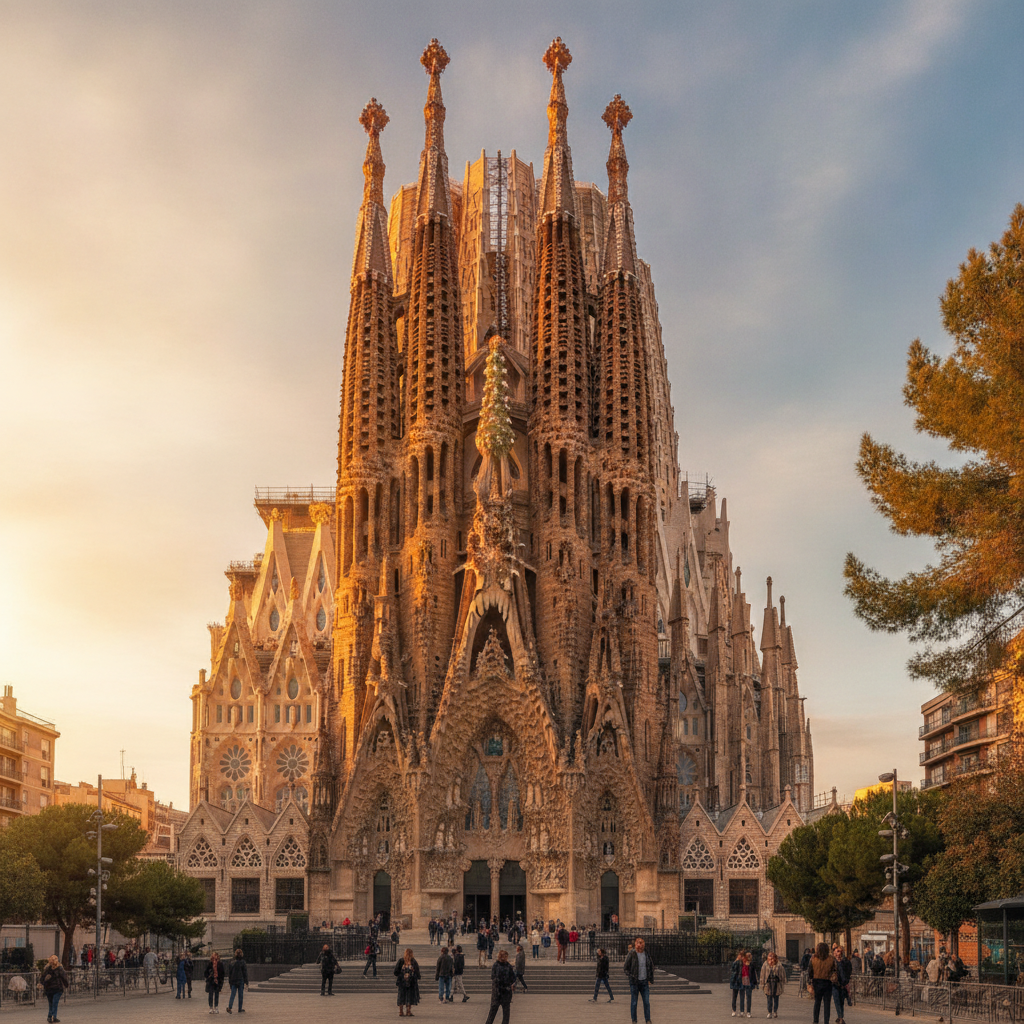
Tibidabo, Collserola & Pedralbes: Above the City, Beyond the Grid
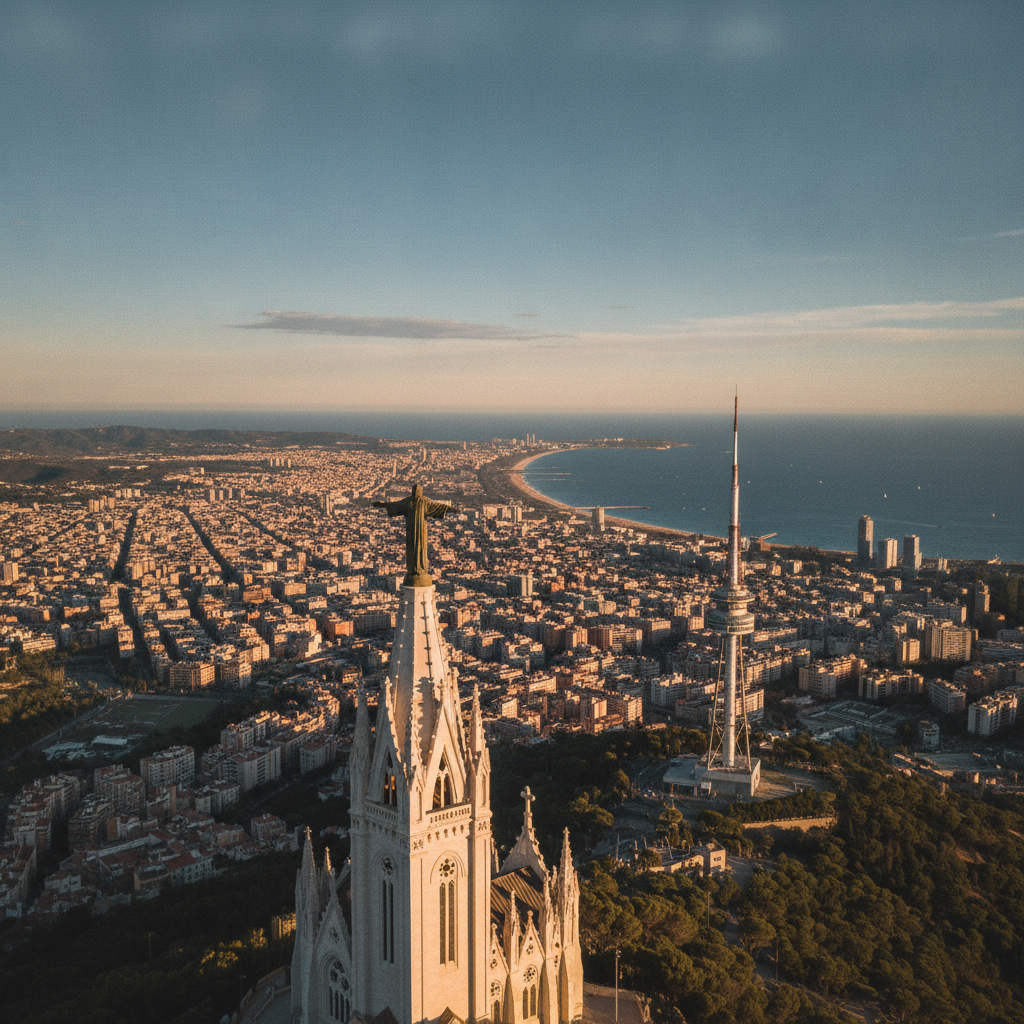
The Serra de Collserola — the range of forested hills immediately behind Barcelona, rising to 512 meters at Tibidabo — is one of the most remarkable features of Barcelona's geography: a vast natural park of 8,295 hectares entirely within the metropolitan area, visible from every street in the city and yet mostly wilderness. Tibidabo, the highest point, takes its name from the Latin temptation of Christ ('all this I will give you', the words of the devil showing Christ the kingdoms of the world from a high mountain) — a name that fits perfectly a summit from which the entire city, its harbor, and the Balearic Islands on a clear day are visible. This route ascends to Tibidabo, crosses the ridge to the Torre de Collserola, descends through the park to the medieval monastery of Pedralbes, and ends at the palatial gardens of Palau Reial.
1. Temple Expiatori del Sagrat Cor — Christ Above the City
- 1
Temple Expiatori del Sagrat Cor — Christ Above the City
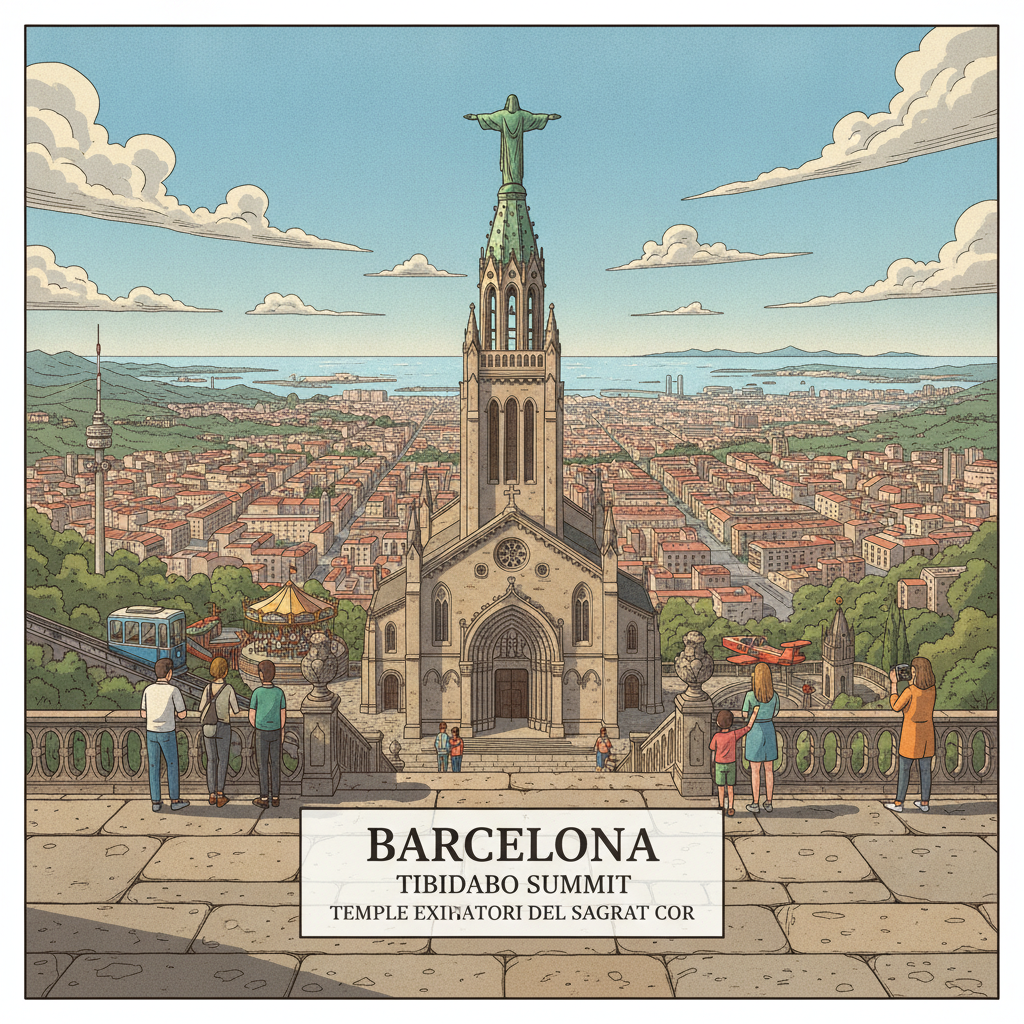
The Temple Expiatori del Sagrat Cor (Expiatory Temple of the Sacred Heart of Jesus), at the summit of Tibidabo (512 meters), is a neo-Romanesque and neo-Gothic church built between 1902 and 1961 (60 years of construction, funded entirely by donations), whose bronze figure of Christ with outstretched arms at the very top of the tower is the highest point in the Barcelona metropolitan area and visible from almost everywhere in the city on a clear day. The architect Enric Sagnier designed the lower church (1902–1915); his son Josep Maria Sagnier i Vidal completed the upper church in a different, more Gothic style (1915–1961). The views from the terrace at the base of the upper church — 512 meters above the city, with the entire Eixample grid, the harbor, and on clear days the silhouette of Mallorca 200 kilometers away visible — are the most comprehensive in greater Barcelona. The adjacent Parc d'Atraccions del Tibidabo (amusement park, 1901, the oldest in Spain still in operation) has a charming collection of early 20th-century rides.
- 2
Torre de Collserola — Foster's Needle
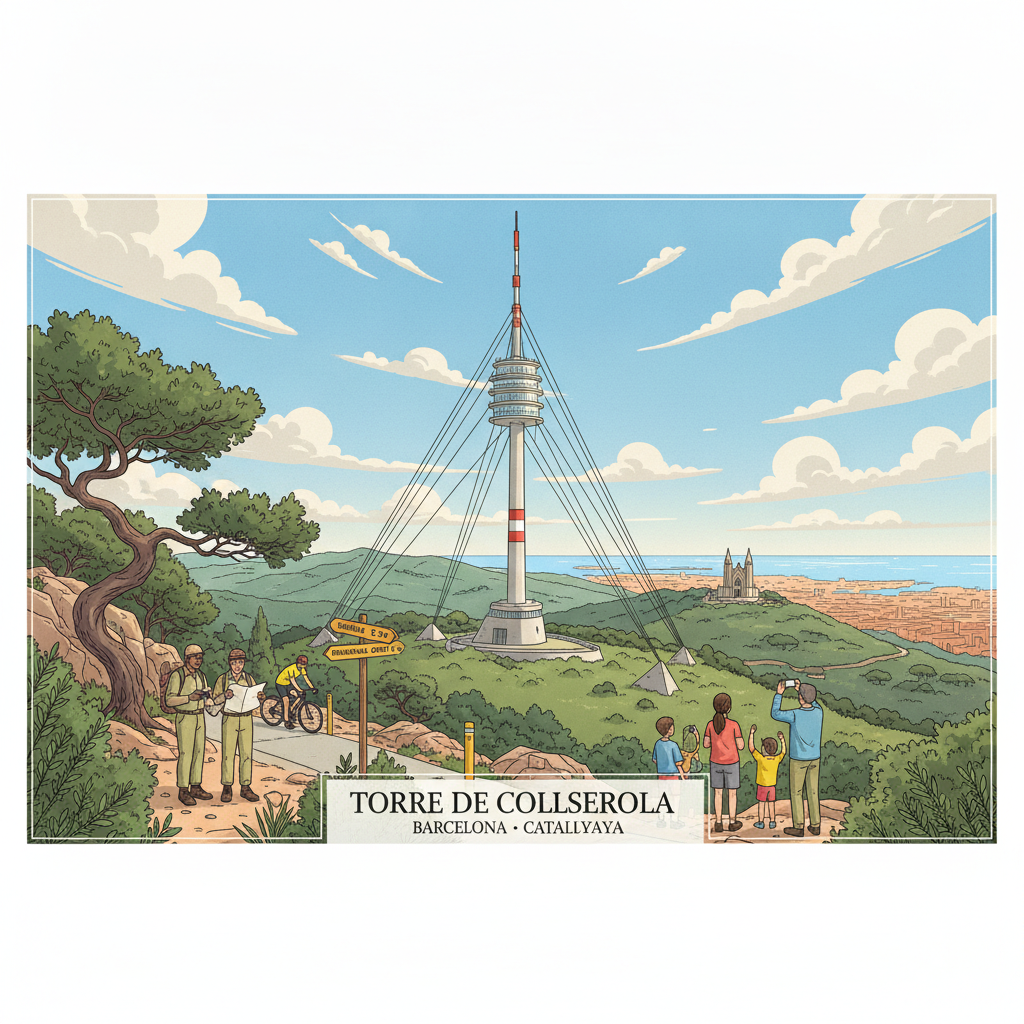
The Torre de Collserola, the 288-meter telecommunications tower designed by Norman Foster and built for the 1992 Barcelona Olympics (to relay the television broadcast signal over the Collserola ridge), is one of the finest examples of late 20th-century structural engineering in Spain: a central concrete shaft, 4.5 meters in diameter, from which 13 horizontal platforms are suspended by a system of steel cables anchored to the ground — the entire structure held upright by the tension of the cables rather than by mass. The observation deck at the 10th platform (115 meters) offers views equivalent to Tibidabo in a more rational, glass-enclosed setting. The tower can be reached by a short walk from the Tibidabo funicular terminus. Foster's design won a competition over Calatrava and other international finalists; the budget constraint ($28 million) required structural innovation that resulted in what many engineers consider the most efficient telecommunications tower ever built for its height.
- 3
Carretera de les Aigües — The Hillside Promenade
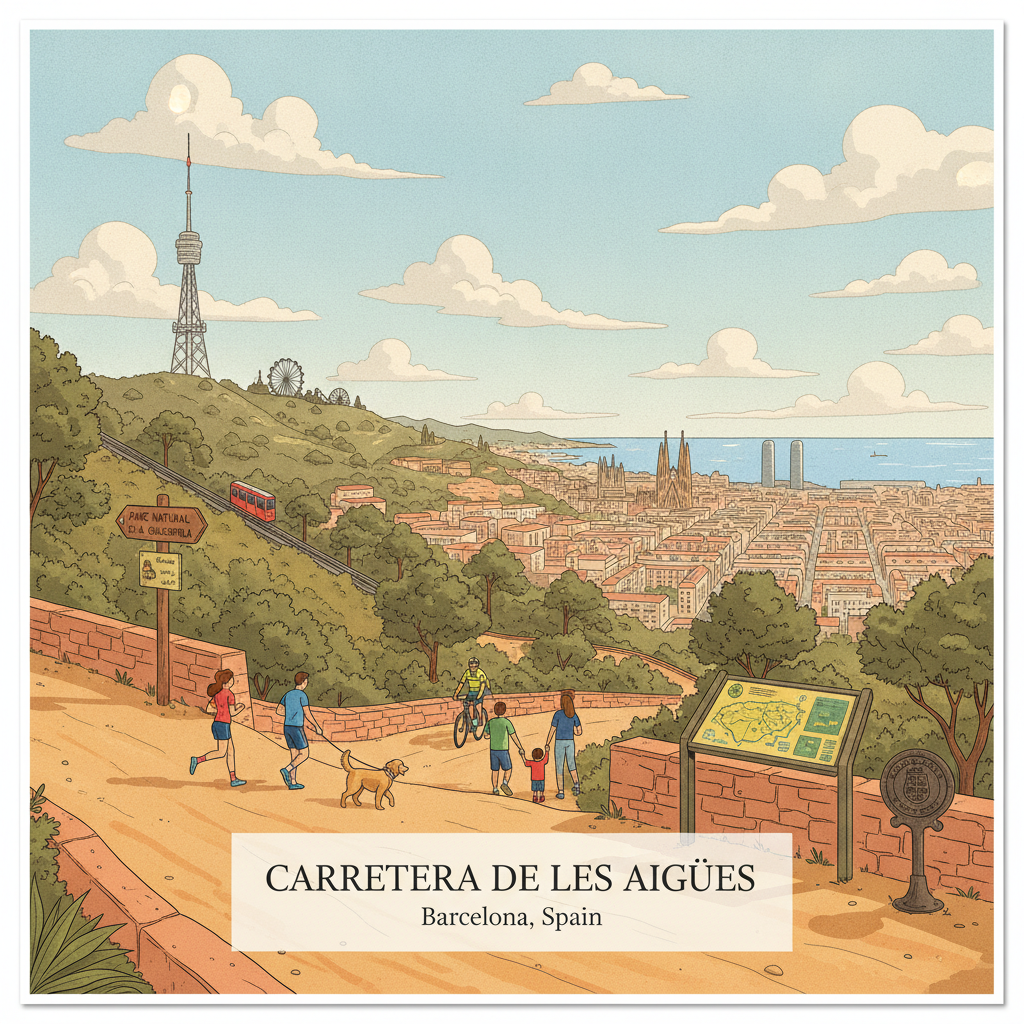
The Carretera de les Aigües (Road of the Waters), a dirt track running along the eastern face of the Collserola ridge at approximately 300 meters elevation, is the most popular recreational path in Barcelona: a 10-kilometer route with panoramic views over the entire city and the sea, used daily by runners, cyclists, dog-walkers, and families escaping the urban heat. The name refers to the 19th-century water supply infrastructure that ran along this contour line to maintain consistent pressure in Barcelona's early piped water system. The path can be reached by the Vallvidrera funicular from the FGC railway station at Peu del Funicular, or by road from Tibidabo. The views from the path — at a height where the entire city is visible but close enough to see individual buildings — are arguably better than from the summit of Tibidabo for understanding Barcelona's geography.
- 4
Sarrià — The Village That Refused to Merge
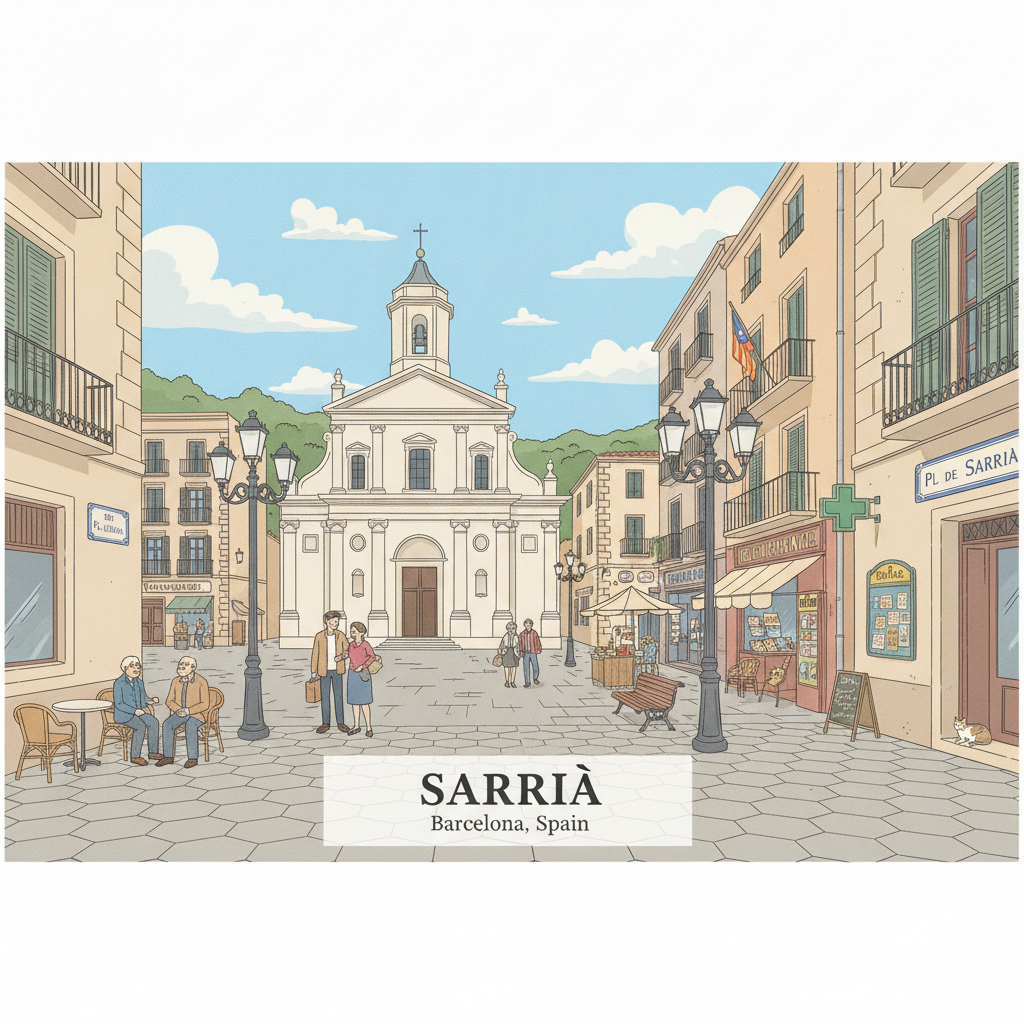
Sarrià, the village (now a Barcelona neighborhood) at the base of the Collserola hills, is one of the most interesting of the former independent municipalities absorbed into Barcelona's expansion (annexed in 1921, the last to be incorporated). Unlike most absorbed villages, Sarrià has retained an exceptionally strong local identity: a commercial center along the Carrer Major de Sarrià (village high street atmosphere, independent shops, morning market) and the Plaça de Sarrià (with the 18th-century church of Sant Vicenç de Sarrià) that feel genuinely village-like rather than metropolitan. The neighborhood is predominantly upper-middle-class and quiet, home to many of Barcelona's international schools. The Poet Joan Salvat-Papasseit, the philosopher Eugeni d'Ors, and the architect Enric Sagnier all lived here.
- 5
Monestir de Pedralbes — The Best-Preserved Gothic Convent in Europe
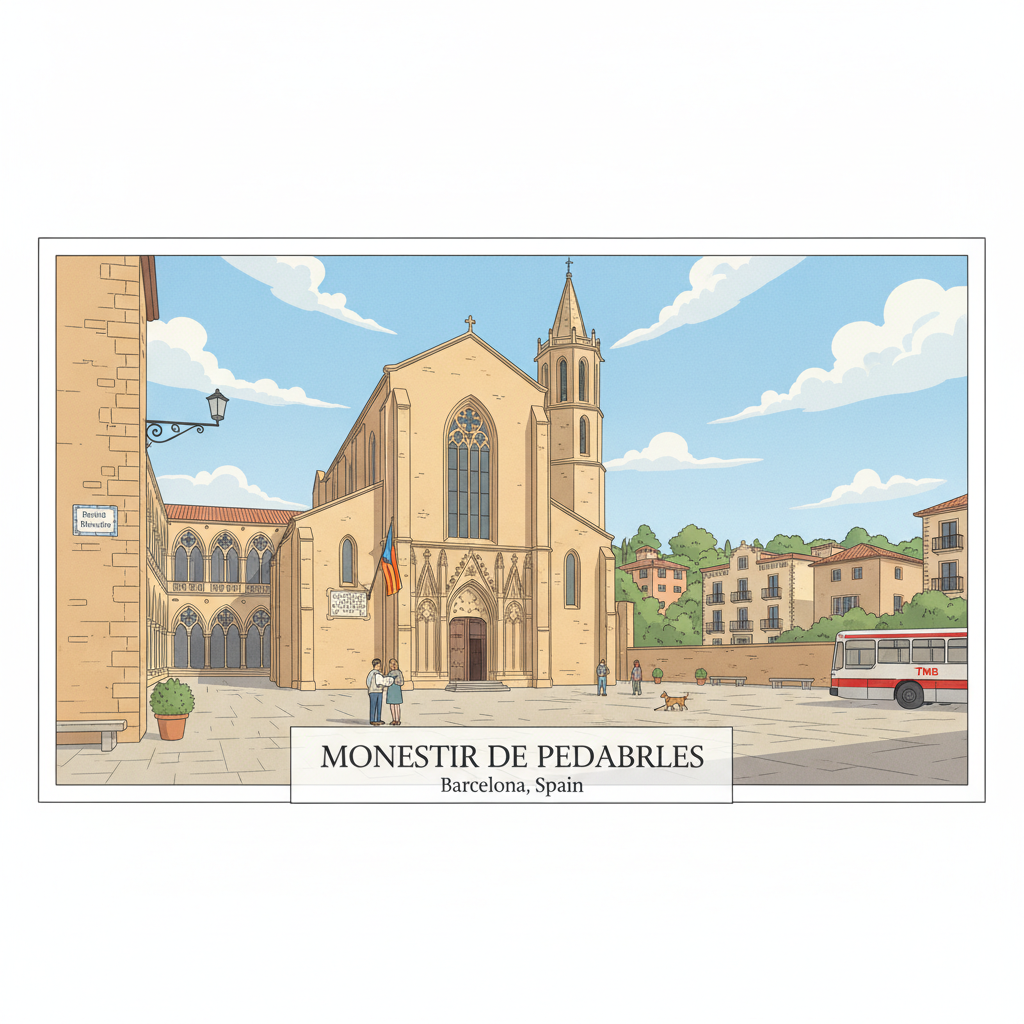
The Monestir de Pedralbes, founded in 1327 by Queen Elisenda de Montcada (widow of King James II of Aragon) and built within a single year in a remarkable feat of medieval construction, is the most complete and best-preserved Gothic convent in Europe: a three-story cloister of exceptional elegance (each of the 40-meter sides of the cloister has 26 Gothic arches on each floor), the original convent church (single nave, Gothic, with the tomb of Queen Elisenda in the wall between the church and the cloister), and the surviving refectory, dormitory, and infirmary of the original 14th-century complex. The Capella de Sant Miquel, a small chapel off the cloister, contains the only surviving complete cycle of murals by Ferrer Bassa (1343) — the finest Catalan Gothic painting, strongly influenced by Giotto and the Siena school. The Poor Clares who founded the convent still live in the complex; the medieval parts are open as a museum.
- 6
Palau Reial de Pedralbes — Royal Gardens and Art Nouveau Gates
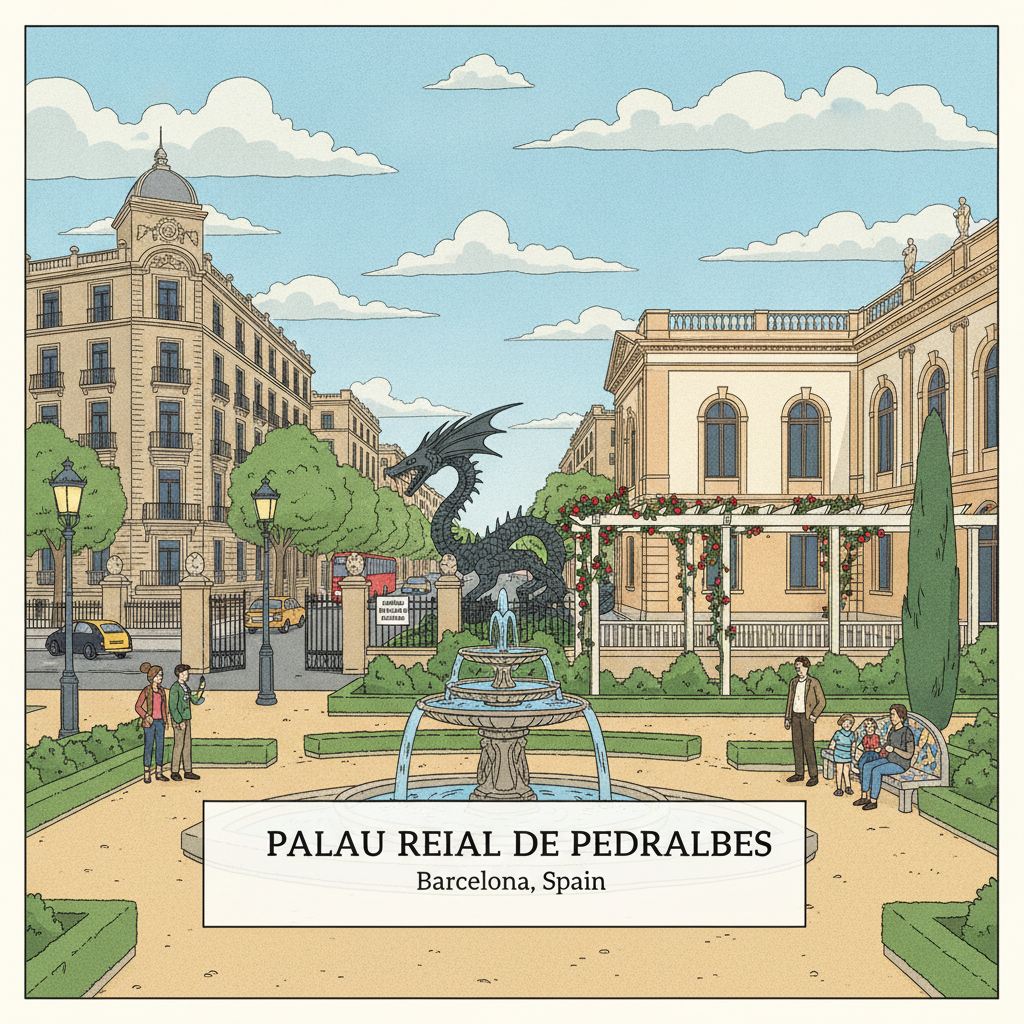
The Palau Reial de Pedralbes, on the Avinguda Diagonal at the bottom of the Pedralbes neighborhood, was the royal residence of the Spanish monarchs in Barcelona from 1926 (when Alfonso XIII accepted it as a gift from the Güell family) until 1931. The palace itself (1920s neo-classical, built to receive the king) is now divided between the Museu de Ceràmica and the Museu de les Arts Decoratives. The gardens (open free of charge) are a formal Italianate composition of terraces, fountains, pergolas, and mature trees designed by Nicolau Rubió i Tudurí. Hidden within the gardens, accessible only to those who know to look, is one of Antoni Gaudí's earliest works: the Fountain of Hercules (1884), a decorative dragon-wrapped iron gate and fountain designed for the Finca Güell (the Güell family estate on this site before the palace was built). The gate's iron dragon — writhing, scaled, with an open mouth — is an early expression of the animal morphology Gaudí would develop in Park Güell and the Sagrada Família.
Walk this route with audio
Stories play automatically as you reach each stop — no tapping needed.
More in barcelona
Pedralbes, Camp Nou & Sarrià: Barcelona's Quiet Upper City
Palau de la Música & Sant Pere: The Greatest Concert Hall in Spain and the City of Iron
Barceloneta & the Olympic Waterfront: From Columbus to the Mediterranean
La Rambla, Boqueria & El Raval: The Street, the Market, and the Other Barcelona
Poblenou, 22@ & the Design Hub: Barcelona's Creative Frontier