Wat Benchamabophit, Dusit Palace, Ananta Samakhom Throne Hall & Vimanmek Mansion
The Dusit district — the royal administrative district of Bangkok established by King Chulalongkorn (Rama V) in the 1890s-1900s as the location of a new European-influenced royal palace complex — preserves the most complete example of early 20th-century Thai royal architecture outside the Rattanakosin Island, combining the Italian-inspired Ananta Samakhom Throne Hall (the parliament building), the teak Vimanmek Mansion (the world's largest golden teak building), Wat Benchamabophit (the Marble Temple, the most recent of the major royal temples in Bangkok), and the formal planning of Ratchadamnoen Avenue and the Royal Plaza.
- 1
Wat Benchamabophit Dusitwanaram (วัดเบญจมบพิตรดุสิตวนาราม) — The Marble Temple
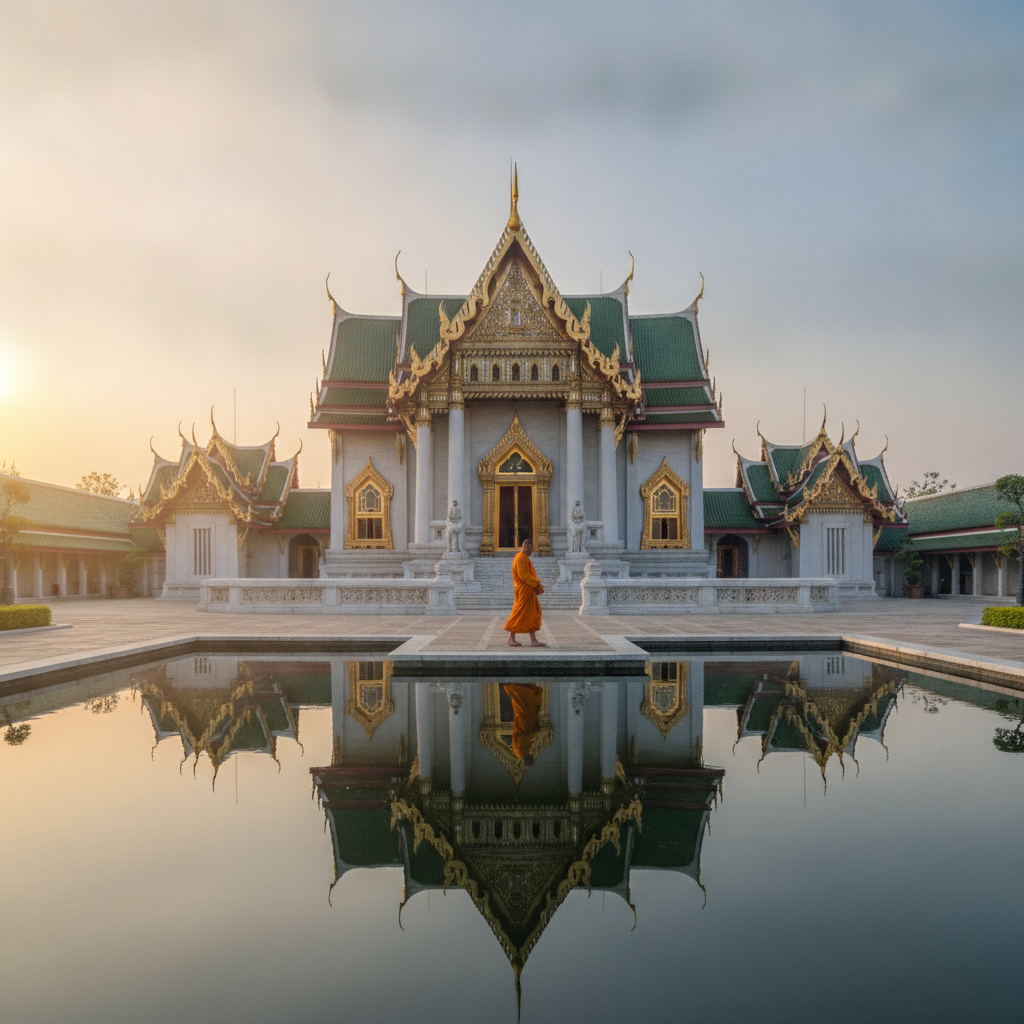
Wat Benchamabophit Dusitwanaram (วัดเบญจมบพิตรดุสิตวนาราม, Si Ayutthaya Road, Dusit — the royal temple built in 1899 by King Chulalongkorn (Rama V) adjacent to the new Dusit Palace, designed by Prince Naris (Narisara Nuvadtivongs) with the assistance of the Italian architect Hercules Manfredi: the temple is known colloquially as the Marble Temple (วัดหินอ่อน, Wat Hin On) due to its primary construction material — the white Carrara marble imported directly from Italy that clads the exterior walls of the ordination hall (ubosot) and the surrounding cloisters; the ordination hall of Wat Benchamabophit is considered one of the finest examples of Thai Buddhist architecture of the modern era, combining traditional Thai architectural forms (the characteristic multi-tiered sloped roof with ceramic roof tiles in the standard Thai green glazed style, the gilded chofa roof ornaments, the gilded gable panels) with European structural techniques (the use of reinforced concrete underneath the marble cladding, the symmetrical cruciform floor plan) and materials (the Carrara marble, the stained-glass windows above the main entrance, the Italian-manufactured decorative elements); the cloisters surrounding the main courtyard contain 52 bronze Buddha images — representing the principal image types (poses or mudras) found across the different schools of Thai and pan-Asian Buddhism — donated by King Chulalongkorn as a collection of Thai Buddhist art; the principal Buddha image inside the ubosot is the Phra Phuttha Chinnaraj — a copy of the highly revered Phra Phuttha Chinnaraj at Wat Phra Sri Rattana Mahathat in Phitsanulok (dating from the Sukhothai period); the temple is open daily from 08:00 to 17:30 and entry requires a modest admission fee.
- 2
Ananta Samakhom Throne Hall (พระที่นั่งอนันตสมาคม) — The Italian Renaissance Parliament
Ananta Samakhom Throne Hall (พระที่นั่งอนันตสมาคม, Royal Plaza, Dusit — the most architecturally significant European-influenced building in Thailand, built between 1907 and 1915 by King Chulalongkorn (Rama V) and completed during the reign of King Vajiravudh (Rama VI): the throne hall was designed by the Italian architects Mario Tamagno and Annibale Rigotti in the Italian Renaissance style, with a prominent central dome (modeled on the Panthéon in Paris and the dome of St. Peter's Basilica in Rome), two flanking wings, and a facade of Thai Ratchaburi marble with Italian Carrara marble detailing; the building rises to 49.5 metres at the top of the central dome and served as the royal reception hall for foreign dignitaries during the absolute monarchy period (1915-1932); following the end of the absolute monarchy in 1932, the throne hall was converted for use as the National Assembly of Thailand — the first elected parliament of the country — and served this function until a dedicated parliament building was completed in the 1970s; the throne hall has been used for various state functions since then and now operates as the main exhibition hall of the APEC 2022 summit permanent museum, housing permanent exhibitions on Thai history and the reign of King Chulalongkorn; the Royal Plaza in front of the throne hall — the large formal parade ground connecting the Ananta Samakhom to the statue of King Chulalongkorn on horseback (the Equestrian Statue of King Chulalongkorn, or พระบรมรูปทรงม้า) and to Ratchadamnoen Avenue — is the venue for state ceremonies.
- 3
Vimanmek Mansion (พระที่นั่งวิมานเมฆ) — The World's Largest Golden Teak Building
Vimanmek Mansion (พระที่นั่งวิมานเมฆ, Ratchawithi Road within the Dusit Palace compound, Dusit — the 81-room royal residence built in 1901 by King Chulalongkorn (Rama V) and moved to its current location in the Dusit Palace compound from Koh Si Chang island, where it was originally constructed in 1893: the mansion is constructed entirely from golden teak (ไม้สักทอง, mai sak thong) — the most valuable tropical hardwood in Thailand — without the use of a single nail, with all structural joints made using wooden pegs and traditional Thai woodworking joinery techniques; the mansion is currently cited in Guinness World Records as the world's largest golden teak structure (though this claim has been contested); the building's three-storey L-shaped plan combines Western Victorian architectural influences (the wrap-around verandas, the octagonal corner tower, the decorative wooden fretwork, the louvered shutters, the formal reception rooms) with Thai vernacular construction techniques (the traditional mortise-and-tenon woodworking, the high-ceilinged rooms designed for natural ventilation in the tropical climate, the integration of the building with the surrounding garden); King Chulalongkorn used the mansion as his primary personal residence between 1901 and 1906, and the building has been preserved with its original furnishings and royal possessions — European antique furniture and decorative art, Chinese ceramics, the king's personal photography equipment (he was an enthusiastic early photographer), and memorabilia from his two visits to Europe in 1897 and 1907; admission is included in the Dusit Palace combined ticket and requires respectful dress.
- 4
Dusit Palace Grounds (พระราชวังดุสิต) & Royal Ceremonial Route
Dusit Palace Grounds (พระราชวังดุสิต, Ratchawithi Road, Dusit — the enclosed royal palace compound covering approximately 67 hectares in the Dusit district, established by King Chulalongkorn (Rama V) beginning in 1897 as an alternative to the original Rattanakosin palace complex: the compound includes multiple throne halls and royal residences beyond Vimanmek Mansion and the Ananta Samakhom (these include the Amporn Sathan Mansion — still used as the official royal residence for state functions — the Abhisek Dusit Throne Hall, which now houses a museum of traditional Thai crafts and the Support Foundation craft exhibitions), formal gardens in the European manner (influenced by Chulalongkorn's visits to European royal palaces), the Royal Elephant National Museum (ช้างต้น, the museum of the royal elephants housed in the former royal elephant stables), and the Queen Savang Vadhana Memorial Museum; the Dusit Palace compound connects to Ratchadamnoen Avenue — the ceremonial boulevard — via the Royal Plaza in front of the Ananta Samakhom, creating a processional route that extends approximately 1 kilometre from the original city at Sanam Luang to the Dusit Palace gates; the route along Ratchadamnoen Avenue between the Democracy Monument and the Royal Plaza is the venue for the most significant state ceremonies in Thailand — royal birthdays, coronation processions, and national celebration events.
- 5
Royal Chitralada Villa & Agricultural Projects (พระราชวังจิตรลดารโหฐาน)
Royal Chitralada Villa (พระราชวังจิตรลดารโหฐาน, Ratchawithi Road and Sri Ayutthaya Road, Dusit — the private royal residence immediately south of the Dusit Palace complex, accessed via its own gates and not publicly accessible except during specific royal events: the Chitralada Villa was the principal private residence of King Bhumibol Adulyadej (Rama IX) and Queen Sirikit throughout most of their reign — King Bhumibol moved to Chitralada following his return from Europe in 1951 and continued to reside there until his death in 2016; the palace grounds are notable for containing the Royal Agricultural Projects established by King Bhumibol — experimental farms, fish farms, rice paddy plots, and food processing facilities established on the palace grounds beginning in the 1950s as demonstrations of sustainable agricultural practices appropriate for rural Thailand (the palace produced dairy products — the Chitralada brand milk and dairy products were available commercially for many years as a social enterprise); the area visible from the palace perimeter on Ratchawithi Road and Sri Ayutthaya Road includes the distinctive high walls of the Chitralada compound, the 11th Infantry Regiment barracks (the military unit responsible for palace security), and the formal tree-lined avenues that give the Dusit district its distinctive atmosphere as the greenest and most formally planned area of inner Bangkok.
- 6
Dusit Zoo (สวนสัตว์ดุสิต) Site & Royal Thai Air Force Museum
Dusit Zoo Site (สวนสัตว์ดุสิต, Ratchawithi Road, Dusit — the former Dusit Zoo which operated on the grounds of the original Suan Dusit (Dusit Garden) established by King Chulalongkorn between 1897 and 1902: the zoo operated from 1938 until 2018, when it was closed permanently and the animals transferred to the new Zoological Park of Thailand in Pathum Thani province (approximately 40 kilometres north of Bangkok); the zoo grounds have been returned to their original function as a formal garden within the Dusit Palace complex — the trees (many of which are the original specimens planted during King Chulalongkorn's era, now over 120 years old) and the artificial lake within the former zoo grounds are being preserved as a public park; the Royal Thai Air Force Museum (พิพิธภัณฑ์กองทัพอากาศและการบินแห่งชาติ, adjacent to Don Mueang International Airport in the northern Bangkok area — approximately 20 kilometres from the Dusit district) contains the most comprehensive collection of Thai military aviation history in Thailand, with over 60 aircraft on display including vintage propeller aircraft from the World War II era, the Korean War era jet fighters, and modern jet trainers; the museum is open Tuesday-Sunday 08:00-16:00 with free admission.
Walk this route with audio
Stories play automatically as you reach each stop — no tapping needed.
More in bangkok
Chinatown Yaowarat, Pahurat Fabric Market & Bangkok Old Town Street Food
Chatuchak Weekend Market, Siam Square & Bangkok's Shopping Culture
Khao San Road, Democracy Monument & the Banglamphu Backpacker District
Damnoen Saduak Floating Market, Maeklong Railway & Amphawa Day Trip
Wat Arun, the Chao Phraya & Thonburi's Ancient Waterways