Khao San Road, Democracy Monument & the Banglamphu Backpacker District
The Banglamphu district — bounded by the Chao Phraya River to the west, Ratchadamnoen Avenue to the south, and the old city canal to the east — preserves the most intact examples of Rattanakosin-era Bangkok street life: traditional shophouses, neighbourhood temples, canal-side communities, and the Khao San Road (the world's most famous backpacker street, which has evolved from a 1970s budget guesthouse strip into a global nightlife destination) are all within walking distance of each other.
- 1
Khao San Road (ถนนข้าวสาร) — The World's Most Famous Backpacker Street
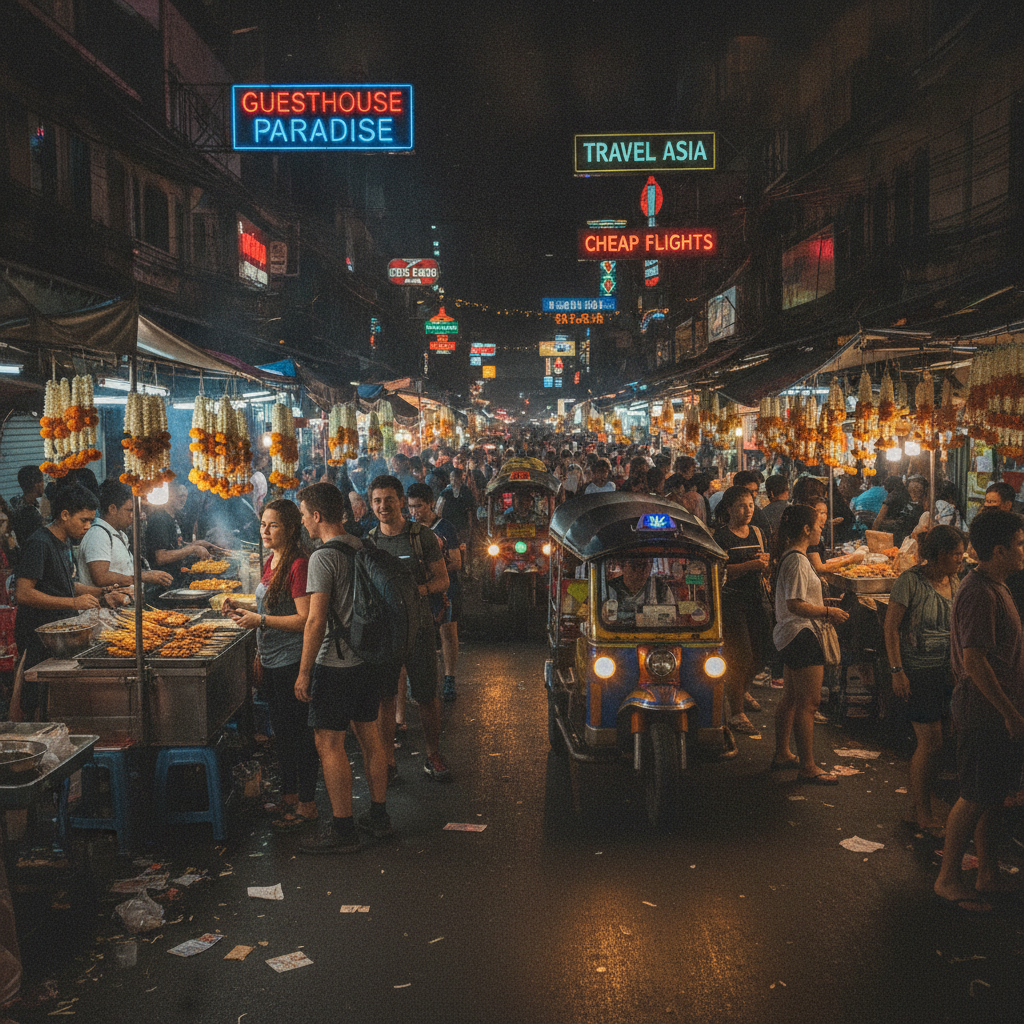
Khao San Road (ถนนข้าวสาร, Khao San Road, Banglamphu, Phra Nakhon — the 400-metre pedestrianized street (partially closed to vehicle traffic most evenings) that has served as the epicentre of budget backpacker travel in Southeast Asia since the 1970s and is now one of the most internationally recognizable streets in Bangkok: the street takes its name from the rice trading that historically occurred in the Banglamphu area (Khao San means 'milled rice') — the street was lined with rice warehouses and shops selling uncooked rice to the residents of the old city quarter before the development of the guesthouse trade; the first guesthouses opened in the late 1970s and early 1980s to serve the growing numbers of independent travellers using Bangkok as a hub for regional Southeast Asian travel (the combination of cheap accommodation, forged student ID services, discounted air and train tickets, and concentrated social activity made the street an almost inevitable staging post for anyone traveling independently through Asia); by the late 1980s the street had established its global reputation through the backpacker networks that preceded the internet, and by the 1990s it was referenced in travel literature and eventually in Alex Garland's novel 'The Beach' (1996); the contemporary Khao San Road has evolved considerably from its budget guesthouse origins — the accommodation on the street itself ranges from mid-range to boutique, the bars are now purpose-built venues rather than converted shophouses, the street food represents some of the best-value food in Bangkok (pad thai, khao man gai, mango with sticky rice, fried insects for the adventurous), and the street attracts Thai domestic tourists and Bangkok's younger residents alongside the international backpacker community; the street is open and active from approximately 10:00 until 03:00 or later.
- 2
Rambuttri Road (ถนนรามบุตรี) — Banglamphu's Calmer Alternative
Rambuttri Road (ถนนรามบุตรี, Rambuttri Road, Banglamphu, Phra Nakhon — the parallel street one block north of Khao San Road, connected by a series of short sois and accessible from both Chakraphong Road to the west and the canal road to the east: Rambuttri is the quieter, more local alternative to Khao San Road that has attracted the more discerning segment of Bangkok's independent travel community since the 1990s; the street is lined with independently-owned guesthouses (many in traditional shophouse buildings that have been adapted with minimal renovation), open-air restaurants and bars with rattan furniture and string lights set beneath the mature trees that line the street, travel agencies, bookshops, yoga studios, and the Wat Chana Songkhram (วัดชนะสงคราม, one of the oldest temples in the Banglamphu area, dating from the Thonburi period) at its western end; the atmosphere on Rambuttri is markedly different from Khao San Road — slower, less commercial, more oriented toward conversation than drinking, and with a higher proportion of independent cafes and restaurants relative to chain outlets; the Khao San-Rambuttri corridor is also the location of the highest concentration of tuk-tuk drivers in Bangkok (motorcycle-powered three-wheeled taxi vehicles) and the departure point for many of the organized tours and transport services targeting the independent traveler market.
- 3
Democracy Monument (อนุสาวรีย์ประชาธิปไตย) — Ratchadamnoen Avenue
Democracy Monument (อนุสาวรีย์ประชาธิปไตย, Ratchadamnoen Klang Road, Phra Nakhon — the monument at the centre of the large roundabout on Ratchadamnoen Avenue (the 'Royal Way' of Bangkok, designed in imitation of the Champs-Elysées in Paris on the orders of King Vajiravudh (Rama VI) and completed in the 1930s): the Democracy Monument was designed by the Italian sculptor Corrado Feroci (who adopted the Thai name Silpa Bhirasri and became the founder of Thai modern art) and built in 1940 to commemorate the Siamese Revolution of 1932, in which the Khana Ratsadon (People's Party) ended the absolute monarchy of Siam and established a constitutional monarchy; the monument's four wing-shaped structures (representing the Thai armed forces) reach 24 metres high and surround a central pedestal holding a golden tray on which sits the Constitution of 1932; the monument has become one of the most politically charged locations in Bangkok — it was the starting point and destination of the October 1973 student uprising (which resulted in the fall of the military government of Thanom Kittikachorn), the October 1976 massacre, the Black May 1992 protests, the 2010 Red Shirt demonstrations (in which the street adjacent to the monument was the site of a military crackdown resulting in approximately 90 deaths), and multiple subsequent protests; Ratchadamnoen Avenue between the Democracy Monument and the Royal Plaza (at the north end near Dusit Palace) is the most ceremonially significant boulevard in Bangkok.
- 4
Wat Bowon Niwet (วัดบวรนิเวศวิหาร) — Royal Temple & Phra Nakhon's Oldest School
Wat Bowon Niwet Worawihan (วัดบวรนิเวศวิหาร, Bowon Niwet Road, Phra Nakhon — the temple most closely associated with the Thai royal family of the modern era: Wat Bowon Niwet has been the temple of ordination for multiple members of the royal family including King Bhumibol Adulyadej (Rama IX), King Vajiralongkorn (Rama X), and other senior members of the Chakri Dynasty; the temple also serves as the headquarters of the Dhammayuttika Nikaya — the reform Buddhist sect established by King Mongkut (Rama IV) in the 1830s when he was a monk, which emphasized a return to strict Pali scholarship and Vinaya discipline over the more relaxed practices of the majority Maha Nikaya sect; the ordination hall of the temple contains the revered Phra Phuttha Chinasi — a large bronze Buddha image in the late Sukhothai style; the temple compound also contains Vajiravudh College (โรงเรียนวชิราวุธ), the oldest and most prestigious private secondary school in Thailand, founded by King Vajiravudh (Rama VI) in 1910 on the model of an English public school, which has educated the sons of the Thai royal family and aristocracy since its founding; admission to the inner sanctum of the temple requires respectful dress and is regulated due to the temple's royal status.
- 5
Banglamphu Canal (Klong Banglamphu) & Old City Shophouses
Klong Banglamphu (คลองบางลำพู, Banglamphu Canal, the canal forming the eastern boundary of the Banglamphu district and the northern section of the Bangkok old city canal system (คลองคูเมืองเดิม, Klong Khu Mueang Doem) — the artificial canal dug in 1783-1784 as part of the fortification of Rattanakosin Island (the original city of Bangkok as established by Rama I): the canal extended the river island fortification system by cutting through the existing land to the east of the original Rattanakosin perimeter, enclosing the royal and civic core of the new capital; the canal is now largely decorative, its water maintained by tidal flaps that regulate its level, but it preserves one of the last examples of Bangkok's original canal fortification landscape; the shophouses along Ratchadamnoen Road (between Banglamphu and the Democracy Monument) and the side streets of Dinso Road and Tanao Road preserve some of the finest surviving examples of Rattanakosin-era shophouse architecture — the two- and three-storey shophouses in the Chinese-influenced Sino-Portuguese style (or the 'Bangkok colonial' style) of the late 19th and early 20th centuries, with ground-floor shops opening directly onto the pavement, upper floors used for residential space, and decorative plaster facades in pale yellow, white, and terracotta.
- 6
Sanam Luang-Khao San Road Night Walk — Street Food & Temple Illumination
The Sanam Luang-Khao San Road Night Walk (the evening pedestrian route connecting the Grand Palace area with the Banglamphu district — approximately 1 kilometre and 15-20 minutes on foot along Na Phra That Road, Phra Chan Road, or the riverside walkway): the route passes through the Na Phra Lan administrative district (the narrow streets of government offices and shophouses immediately adjacent to the Grand Palace outer wall) and the Na Phra That area (the street market immediately south of the Grand Palace outer wall selling amulets, Buddha images, monks' robes, and religious accessories — one of the most concentrated amulet markets in Bangkok and the destination for collectors and believers from across Thailand seeking powerful protective images); the evening lighting of the Grand Palace outer walls and Wat Pho provides one of the most atmospheric visual experiences in Bangkok — the white crenellated walls lit from below in warm yellow light, with the roof structures of the temple spires visible above the wall — accessible from the Khao San Road area in under 20 minutes on foot; the Na Phra That amulet market (operating from approximately 08:00-17:00 daily) is one of the most authentic and least tourist-oriented markets in central Bangkok, frequented almost exclusively by Thai devotees and collectors.
Walk this route with audio
Stories play automatically as you reach each stop — no tapping needed.
More in bangkok
Chinatown Yaowarat, Pahurat Fabric Market & Bangkok Old Town Street Food
Wat Benchamabophit, Dusit Palace, Ananta Samakhom Throne Hall & Vimanmek Mansion
Chatuchak Weekend Market, Siam Square & Bangkok's Shopping Culture
Damnoen Saduak Floating Market, Maeklong Railway & Amphawa Day Trip
Wat Arun, the Chao Phraya & Thonburi's Ancient Waterways