Chinatown Yaowarat, Pahurat Fabric Market & Bangkok Old Town Street Food
Bangkok's Chinatown district — known in Thai as Samphanthawong (สัมพันธวงศ์, the name of the administrative district) and internationally as Yaowarat (after Yaowarat Road, the main street) — was established by the Chinese community that migrated to Bangkok in the late 18th and early 19th centuries following the founding of the capital by Rama I, who invited the established Chinese merchant community to relocate from Thonburi (where they had been settled since the earlier Ayutthayan period) to the east bank of the Chao Phraya river, providing them with land adjacent to the new royal city.
- 1
Yaowarat Road (ถนนเยาวราช) — Bangkok's Golden Mile of Gold Shops & Night Food
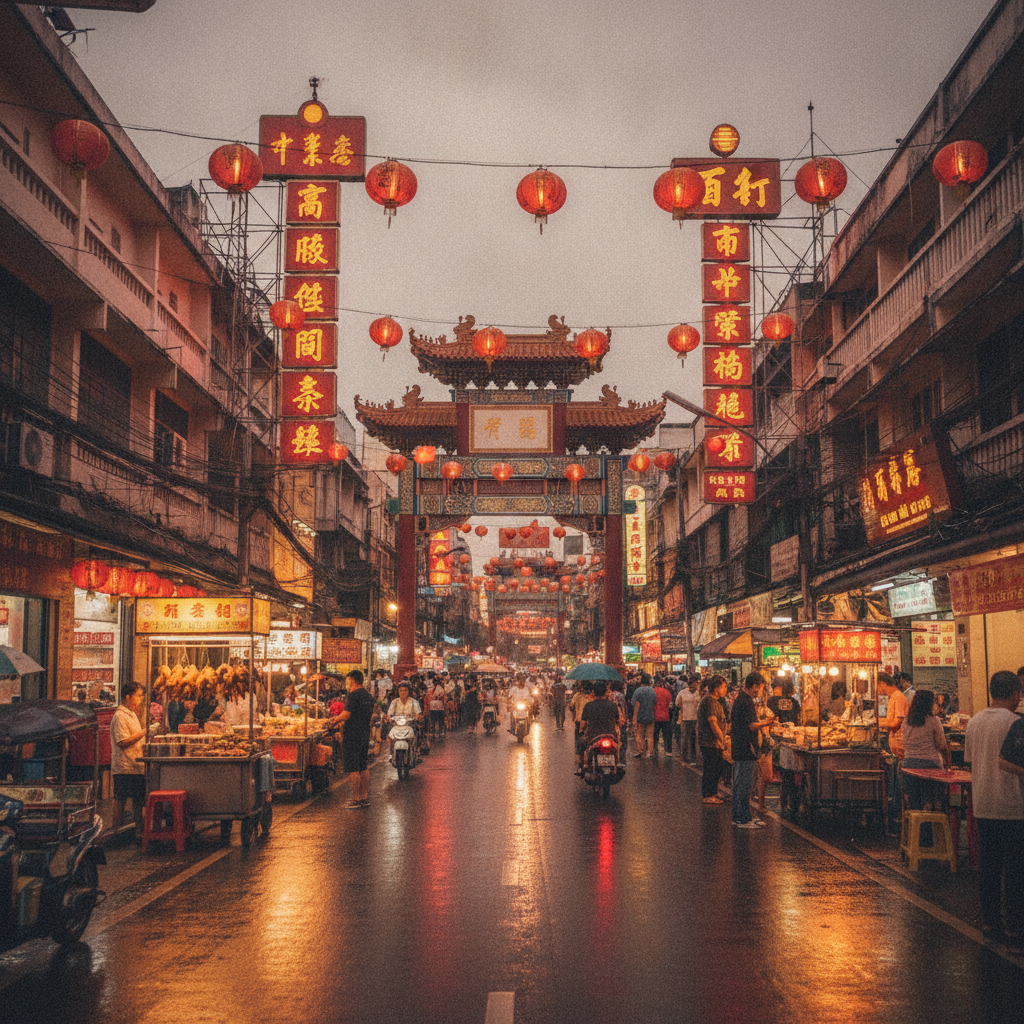
Yaowarat Road (ถนนเยาวราช, Yaowarat Road, Samphanthawong — the main artery of Bangkok's Chinatown, running approximately 1.5 kilometres from the Odean Circle (where the Chinese ceremonial gate/arch stands) in the west to the Ratchawong Pier on the Chao Phraya River in the east: the road is lined on both sides with gold shops (ร้านทอง, ran thong) — the gold trade being the most traditional economic activity of Bangkok's Chinese community; the concentration of gold shops on Yaowarat Road is one of the densest in Southeast Asia, with many shops dating from the early 20th century operating behind unchanged wooden shopfront facades displaying gold necklaces, rings, amulets, and gold ingots; the gold price is standardized daily by the Gold Traders Association of Thailand and all shops display the current day's buying and selling prices; the evening transformation of Yaowarat Road from daytime commercial street to night food destination is one of Bangkok's most dramatic daily events — from approximately 18:00, food carts and mobile restaurants begin setting up along both pavements, serving the dishes most closely associated with Bangkok's Chinese community: roast duck (เป็ดย่าง, ped yang), Chinese-style barbecued pork (หมูแดง, mu daeng), braised pork leg over rice (ข้าวขาหมู, khao kha mu), oyster omelette (หอยทอด, hoi thod), prawn noodle soup (บะหมี่กุ้ง, ba mee kung), and a range of dim sum items; the seafood restaurants along Pad Thai Alley (the narrow lanes running south from Yaowarat Road) are among the best-value fresh seafood restaurants in Bangkok.
- 2
Wat Mangkon Kamalawat (วัดมังกรกมลาวาส) — Dragon Flower Temple
Wat Mangkon Kamalawat (วัดมังกรกมลาวาส, Charoen Krung Road, Samphanthawong — the most important and revered Chinese Buddhist temple in Bangkok, commonly known as Wat Leng Noei Yi (วัดเล่งเนยยี่) in the Teochew Chinese dialect: the temple was built in 1871 by Teochew (Chaozhou) Chinese immigrants during the reign of King Chulalongkorn (Rama V) and follows the architectural traditions of southern Chinese Buddhist temples, incorporating elements of Chinese Buddhism, Taoism, and Confucianism into its religious practice — it is thus technically a Chinese 'Three Religions' temple (三教, San Jiao) rather than a purely Buddhist one; the temple's name, Dragon Flower (มังกรกมลาวาส in Thai, Leng Nei Yi in Teochew), refers to the dragon as the primary auspicious symbol of Chinese culture and the lotus flower as the primary symbol of Buddhist enlightenment; the temple is the most active place of Chinese religious practice in Bangkok and is particularly crowded during Chinese New Year (January-February), the Vegetarian Festival (October), and the Jade Emperor's birthday (the ninth day of the first lunar month, which is among the most important festivals in Teochew-Chinese religious practice); the approach to the temple along Charoen Krung Road passes through the most intact surviving section of Bangkok's Chinese shophouse streetscape.
- 3
Odean Circle & the Chinatown Gate (ประตูเฉลิมพระเกียรติ)
Odean Circle (วงเวียนโอเดียน, Odean Roundabout, junction of Yaowarat Road and Charoen Krung Road, Samphanthawong — the western gateway to Yaowarat Road and the symbolic entrance to Bangkok's Chinatown district, marked by the ornate Chinese-style ceremonial gate (ประตูเฉลิมพระเกียรติ) that was constructed in 1999 to commemorate the 72nd birthday of King Bhumibol Adulyadej (Rama IX); the gate features the characteristic Chinese architectural elements of curved rooflines, dragon decorations, and auspicious red-and-gold colour scheme, and has become the most photographed landmark of Chinatown at night when it is illuminated against the dark sky; the area around Odean Circle is the busiest intersection in Chinatown and the hub of the evening street food scene — the stretch of Yaowarat Road immediately east of the gate (from Odean Circle to Ratchawong Road) concentrates the greatest number of street food vendors; the area is also the starting point for the informal foot tour of Chinatown that begins at the gate and proceeds east along Yaowarat Road, turning south into the Talat Noi (ตลาดน้อย, 'small market') district — a neighborhood of 19th-century shophouses, mechanics workshops, Chinese clan association buildings, and the French-built Church of Santa Cruz (built for the Portuguese community in the early 19th century).
- 4
Pahurat Market (ตลาดพาหุรัด) — Bangkok's 'Little India' Textile District
Pahurat Market (ตลาดพาหุรัด, Pahurat Road, Samphanthawong — the textile and fabric market district centered on Pahurat Road, immediately west of the Chinatown district across the Ong Ang Canal: the Pahurat area is known colloquially as Bangkok's 'Little India' due to the large concentration of Sikh and Hindu merchants from Punjab, Sindh, and Rajasthan who established textile businesses in the area in the late 19th and early 20th centuries (the Indian merchant community of Bangkok, like the Chinese community, was actively encouraged by the early Chakri kings to settle in Bangkok and contribute to the commercial development of the new capital); the Pahurat area specializes in wholesale and retail textile trade — the market sells silk, cotton, brocade, lace, trim, buttons, sequins, and virtually every fabric-related accessory at prices significantly lower than regular retail; the area also contains the Sri Guru Singh Sabha Gurdwara (the most prominent Sikh temple in Bangkok, active since 1932), multiple Hindu temples, and Indian restaurants serving North and South Indian cuisine that are frequented by Bangkok's Indian community and by food tourists; the Indian-owned restaurants along Pahurat Road and the adjacent sois serve some of the most authentic Indian food in Bangkok, including North Indian dhal, paratha, and biryani, and South Indian idli, dosa, and sambar.
- 5
Sampeng Lane (ซอยวาณิช 1) — Bangkok's Oldest Wholesale Market
Sampeng Lane (ซอยวาณิช 1, Vanich 1 Alley, Samphanthawong — the narrow pedestrian lane approximately 1 kilometre long running parallel to and one block south of Yaowarat Road, from the Pahurat area in the west to the riverside in the east: Sampeng Lane is the oldest commercial street in Bangkok, predating the founding of the Rattanakosin capital in 1782 — the Chinese merchant community that relocated from the earlier Thonburi settlement established their trading operations along this lane from the very early years of the new city, and the lane has been in continuous commercial operation for over two centuries; the lane's current commercial character — selling wholesale quantities of accessories, cosmetics, clothing, stationery, household goods, toys, and novelties at prices significantly below retail — reflects the wholesale/distribution function that Chinese merchant networks have performed in Bangkok's economy since the 18th century; the lane is approximately 2 metres wide in most sections and is navigable only on foot or by handcart (the carts loaded with merchandise that move through the lane at speed are one of the primary navigation hazards); the architecture of the Sampeng Lane shophouses — many of which retain their original two-storey structure with living accommodation above the shop, narrow frontage, and deep internal layout — provides the most intact surviving example of 19th-century Bangkok Chinese commercial architecture.
- 6
Chao Phraya River Express Pier at Ratchawong (ท่าเรือราชวงศ์)
Ratchawong Pier (ท่าเรือราชวงศ์, Ratchawong Road, Samphanthawong — the Chao Phraya River Express Pier at the eastern end of Chinatown, approximately 400 metres south of the Yaowarat Road-Ratchawong Road intersection, and one of the most active river piers in Bangkok: the pier is the embarkation point for river travel south toward the Silom district and north toward Banglamphu, the Grand Palace, and Nonthaburi, and provides the most direct connection between Chinatown and the other major riverside districts of Bangkok (traveling by river is significantly faster than by road in most peak traffic conditions); the riverside area immediately adjacent to the pier — the Talat Noi (ตลาดน้อย) neighbourhood — is one of the most historically significant and architecturally intact districts in Bangkok: the neighbourhood preserves a high density of 19th-century Chinese shophouses, the headquarters buildings of old Chinese clan associations (Teochew, Hokkien, Hakka, and Hainanese), early automobile mechanics workshops that have been in operation since the 1920s-1930s and now constitute an informal automotive heritage district, the Kuan Im Shrine (a major Chinese Guanyin goddess shrine), and the Santa Cruz Church (สุสานซางตาครู้ส, built by the Portuguese Dominican Order in 1835 on the site of an earlier church dating from 1770, now surrounded by Chinese shophouses and serving Bangkok's small remaining Roman Catholic community of Portuguese descent).
Walk this route with audio
Stories play automatically as you reach each stop — no tapping needed.
More in bangkok
Wat Benchamabophit, Dusit Palace, Ananta Samakhom Throne Hall & Vimanmek Mansion
Chatuchak Weekend Market, Siam Square & Bangkok's Shopping Culture
Khao San Road, Democracy Monument & the Banglamphu Backpacker District
Damnoen Saduak Floating Market, Maeklong Railway & Amphawa Day Trip
Wat Arun, the Chao Phraya & Thonburi's Ancient Waterways