Panathenaic Stadium, Zappeion & National Garden: Olympic Legacy and Royal Athens
The southeast corner of central Athens — between the Acropolis, the Ilissos valley, and the Ardittos Hill — contains the most concentrated group of 19th-century neoclassical monuments in Greece, including the world's only all-marble stadium (venue of the 1896 Olympics), the Zappeion Exhibition Hall, the National Garden, and the Byzantine & Christian Museum, all within a 10-minute walk of each other.
- 1
Panathenaic Stadium (Kallimarmaro / Καλλιμάρμαρο)
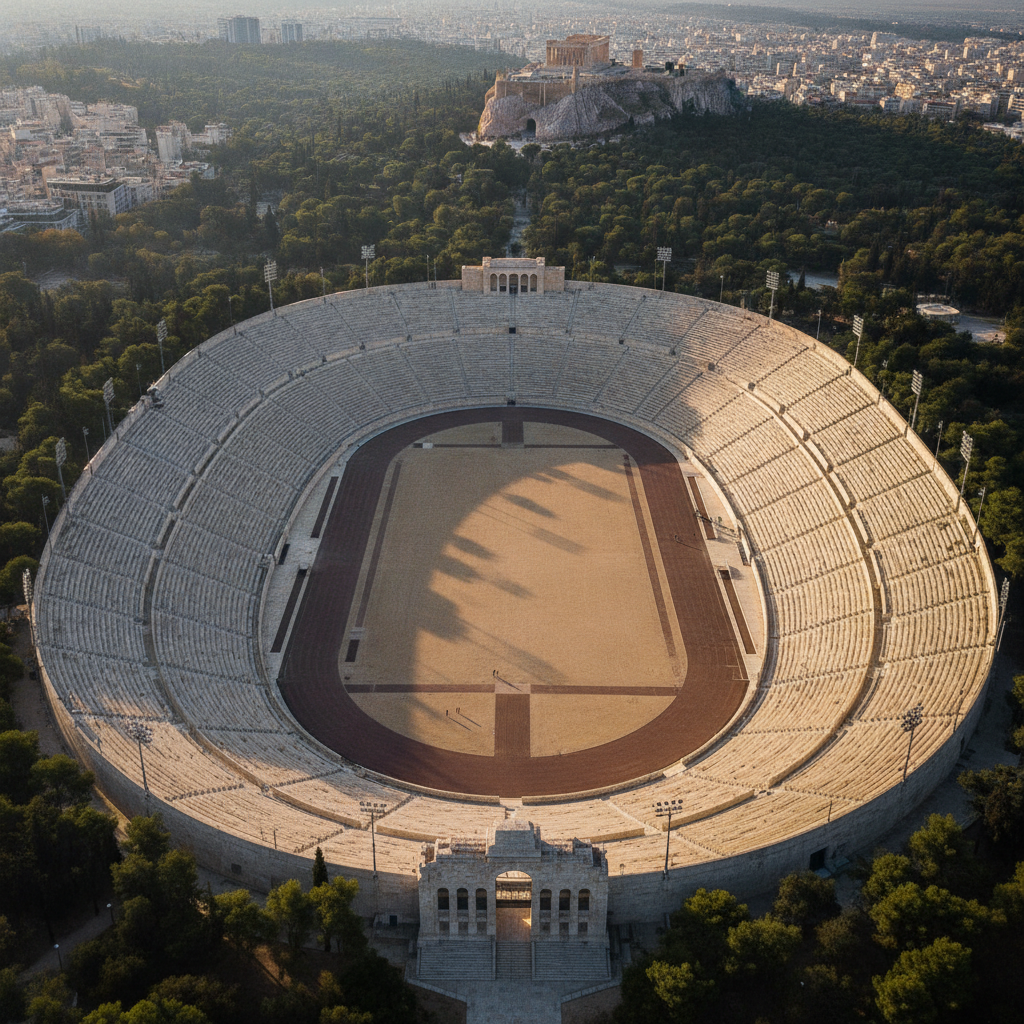
The Panathenaic Stadium — universally known as the Kallimarmaro (καλλιμάρμαρο, 'beautifully marbled') — is the only stadium in the world built entirely of white Pentelic marble, and one of the oldest sporting venues still in active use. The original stadium was built by the Athenian statesman Lykourgos in 330 BC on the banks of the Ilissos river for the Panathenaic Games (the second-most important festival in ancient Greece after the Olympic Games at Olympia); it was rebuilt and expanded in marble by Herodes Atticus in 144 AD for the Roman Emperor Hadrian's visit, accommodating approximately 50,000 spectators. The stadium then fell into disuse and was gradually dismantled for building material. The German archaeologist Ernst Ziller excavated the site in 1869-1870 under commission from Evangelos Zappas (whose will funded Greek Olympic revival efforts); the stadium was completely rebuilt in Pentelic marble for the first modern Olympic Games in 1896, designed by the architect Anastasios Metaxas. The 1896 Games (13 nations, 241 athletes, all male) — organized on the initiative of Pierre de Coubertin — were held here, with the marathon (the new event invented for the occasion) won by Greek water-carrier Spiridon Louis. The stadium still hosts the marathon finish line of the Athens Classic Marathon, the Olympic torch relay handover ceremony, and Olympic archery competitions.
- 2
Ardittos Hill & Ilissos Valley
Ardittos Hill — the wooded ridge rising east of the Panathenaic Stadium between the Ilissos valley and the Pangrati neighborhood — is one of the least-visited archaeological zones in central Athens, containing the ruins of a sanctuary of Tyche (Fortune) of the Hellenistic period and the remains of an ancient theater. The hill offers the best elevated view of the stadium's horseshoe shape. The Ilissos river — which once flowed through this valley (its course is now underground, channeled beneath Ardittou Street after it was paved over in the 1960s; occasional flooding reveals sections of the ancient streambed) — was one of the sacred rivers of Athens, associated with Pan, the Muses, and the nymphs; Plato set a dialogue between Socrates and Phaedrus on the banks of the Ilissos (Phaedrus, 229a). The area between the stadium and the Temple of Olympian Zeus was in antiquity the park-like area of the Kynosarges (a gymnasium for non-citizen boys), later identified as the site of the philosophical school of Antisthenes.
- 3
Zappeion Exhibition Hall (Ζάππειον)
The Zappeion — the neoclassical rotunda designed by the Danish architect Theophil Hansen (1874-1888), funded by the Greek-Romanian merchant Evangelos Zappas (1800-1865) whose bequest specifically funded a building for national assemblies and Olympic revival efforts — is the finest example of the Greek Revival neoclassical style in Athens. The building served as the press center for the 1896 Olympic Games; as the International Olympic Committee fencing venue for the 2004 Athens Olympics; as the venue where Greece signed the Treaty of Accession to the European Economic Community (1979); and as the site where the Greek government agreed to the eurozone bailout memoranda (2010, 2012, 2015). The building's central hall — an octagonal neoclassical rotunda with Corinthian columns and a coffered dome — remains one of the most elegant interior spaces in Athens. The surrounding Zappeion gardens connect directly with the National Garden, forming a continuous 280-hectare green space in the center of Athens.
- 4
National Garden (Εθνικός Κήπος)
The National Garden (15.5 hectares) — immediately behind the Hellenic Parliament building on Syntagma Square — was laid out as the Royal Garden of Queen Amalia (consort of King Otto) between 1838 and 1860, planted with specimens from the royal gardens of Europe and from the expeditions of the botanist Theodoros Orphanidis. The garden contains over 7,000 plant species from around the world, making it one of the most botanically diverse urban parks in the Mediterranean. Notable features include a small botanical museum, a zoo (mostly native Greek species), duck pond, a children's library, and several archaeological remains found during the original landscaping — including mosaic floors from a large Roman villa, column bases, and an early Christian basilica. The garden served as the Royal Palace garden (the palace is now the Hellenic Parliament) and retains its original 19th-century character, with winding shaded paths and dense subtropical planting that makes it the most pleasant refuge from summer heat in central Athens.
- 5
Byzantine & Christian Museum (Βυζαντινό και Χριστιανικό Μουσείο)
The Byzantine & Christian Museum — housed in the Italianate villa Ilissia (1840-1848), built for the Duchess of Plaisance (Sophie de Marbois-Lebrun, a French-American aristocrat, widow of General Lebrun, who settled in Athens after the revolution) and extended with a modern underground wing (2004) — contains the largest and most important collection of Byzantine art outside Constantinople/Istanbul. The collection of approximately 25,000 objects spans the early Christian period (3rd-5th century) through the Byzantine (6th-15th century) to the post-Byzantine (16th-19th century), with particular strength in monumental mosaic icons, illuminated manuscripts, portable icons (including the finest collection of 13th-15th century Palaeologan icons outside Mount Athos), liturgical objects (chalices, reliquaries, processional crosses, Episcopal vestments), and architectural sculpture from Byzantine churches dismantled during Ottoman and later periods. The underground galleries (opened 2004, designed by architect Mihail Photiadis) contain a reconstruction of an early Christian basilica (4th century) with original floor mosaics.
- 6
Kolonaki & Lycabettus Hill Funicular
Lycabettus Hill (Λυκαβηττός) — the steep limestone peak rising 277 meters above sea level in the heart of Athens (about 2 km northeast of the Acropolis) — is the highest natural point within the urban grid of Athens and offers the most complete panoramic view of the city: the Acropolis, the Saronic Gulf, Piraeus, Mounts Hymettus, Penteli, and Parnitha, and on the clearest days the island of Aegina. The hill is accessed either by the funicular railway (built 1965, renovated 2020; 4 minutes from the Kolonaki station at Aristippou Street) or by footpath. The summit contains the small whitewashed Chapel of St. George (1834, one of the oldest post-independence structures in Athens), an outdoor theater used for international concerts during the Athens Festival (capacity 3,000), and the Orizontes restaurant (panoramic fine dining). The upper slopes of Lycabettus are pine forest planted in the early 20th century — the hill was bare limestone until the late Ottoman period, when it was used as a stone quarry.
Walk this route with audio
Stories play automatically as you reach each stop — no tapping needed.
More in athens
Keramikos, Gazi & Thisseio: Ancient Cemeteries, Creative Districts & Democratic Hills
Piraeus, Mikrolimano & the Saronic Riviera: Athens' Ancient Port and Yacht Harbor
Plaka, Monastiraki & Psyrri: Athens Beneath the Acropolis
Cape Sounion & the Attica Coast: Poseidon's Temple Above the Aegean
National Archaeological Museum & Exarcheia: Greece's Greatest Treasures