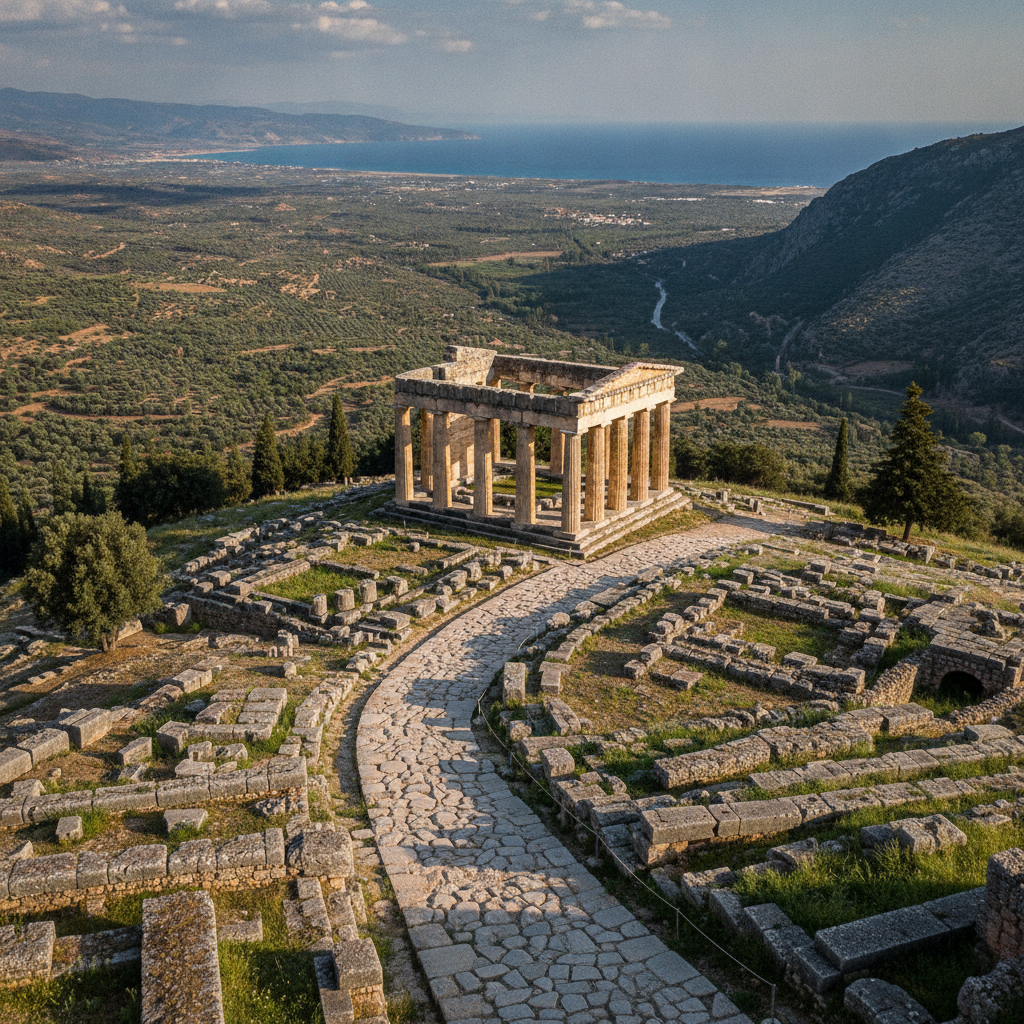
Delphi & Mount Parnassus: The Navel of the Ancient World
The day trip from Athens to Delphi (178 km, approximately 2.5 hours by car via the Athens-Lamia motorway and the E65 national road) is the single most rewarding archaeological excursion from the Greek capital, visiting the sanctuary that the ancient Greeks considered the center of the world (omphalos/navel) and the source of divine wisdom through the Oracle of Apollo — one of the most important religious sites of antiquity.
- 1
Road from Athens: Thebes, Livadeia & Hosios Loukas
The road from Athens to Delphi crosses the Boeotian plain — the agricultural heartland of central Greece — passing through Thebes (modern Thiva, 87 km from Athens; the site of ancient Thebes, one of the most powerful city-states of the Greek world in the 4th century BC, home of Epaminondas and Pelopidas and birthplace of Pindar and Heracles in mythology, virtually nothing visible above ground), Livadeia (120 km, notable for the ancient oracle of Trophonius, a chthonic prophetic site described in detail by Pausanias, and for the Springs of Lethe and Mnemosyne still visible in the town center), and the optional detour to the Byzantine monastery of Hosios Loukas (Blessed Luke, 140 km from Athens, 20 km south of the Delphi road) — an 11th-century monastic complex (constructed 1011 AD) with the finest surviving ensemble of middle Byzantine mosaic decoration in the world, a UNESCO World Heritage Site since 1990. The mosaics of Hosios Loukas — executed in gold, blue, and earthen tones with the characteristic hieratic Byzantine style — are among the most important survivals of the Macedonian Renaissance artistic tradition.
- 2
Delphi Village & Museum Approach
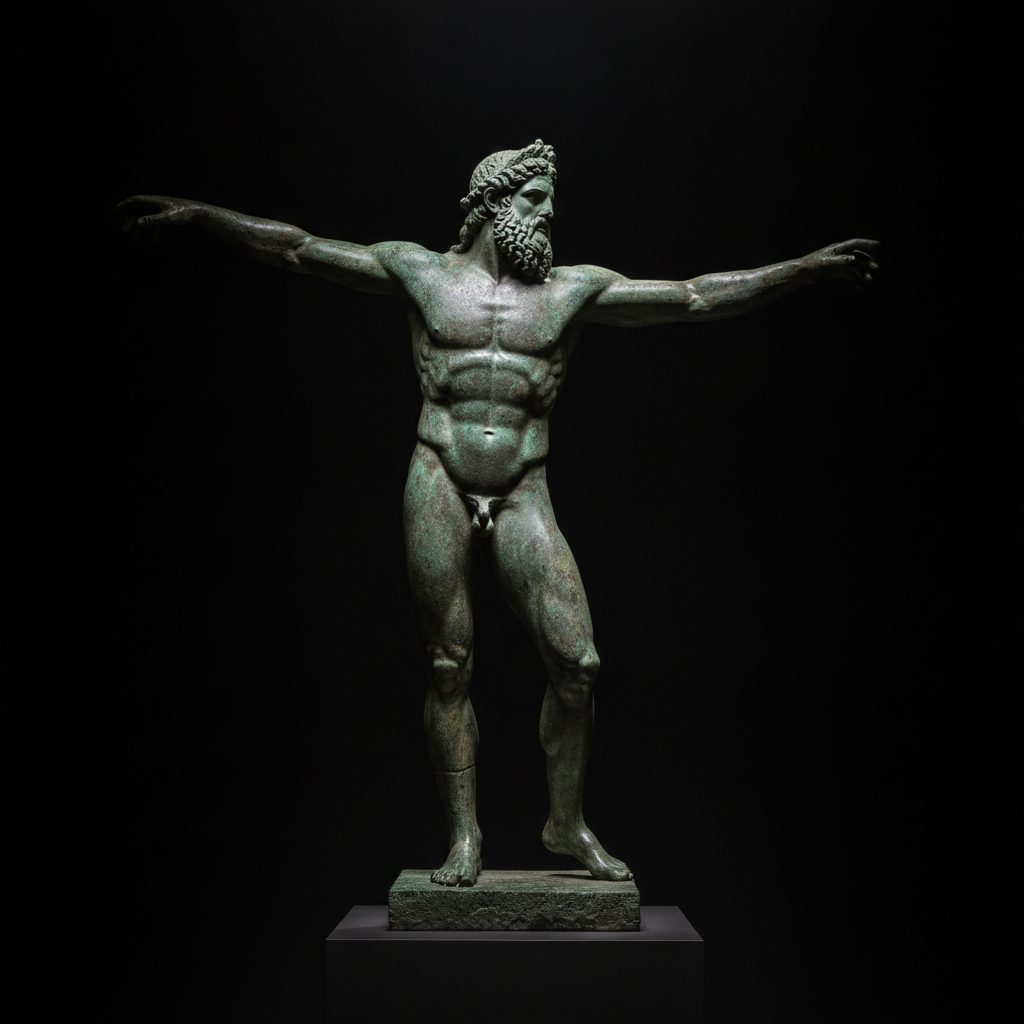
The modern village of Delphi (Δελφοί, population 1,400) — built in the late 19th century when the Greek government relocated the previous village of Kastri to allow the French School of Archaeology to excavate the ancient site (the 'Grand Fouille' of 1892-1903, under Théophile Homolle) — sits on the narrow ridge above the sanctuary, with the Pleistos river valley descending steeply to the south and the twin rock faces of the Phaedriades (Shining Rocks, 750 meters) rising vertically to the north behind the sanctuary. The Delphi Archaeological Museum (rebuilt 1903, most recently renovated 2004) contains the finds from the excavation including the finest collection of archaic Greek sculpture outside Athens: the Sphinx of the Naxians (560 BC), the Charioteer of Delphi (the Ηνίοχος, 478/474 BC, a large-scale bronze masterpiece commissioned by Polyzalos of Gela to celebrate a chariot victory, with glass-paste eyes still intact), the Twins of Argos (Kleobis and Biton, late 7th century BC kouros pair), and the Omphalos stone (Roman copy of the original marker of the navel of the world). The museum also contains the Antikythera Mechanism's companion piece — the Delphi tablet, an ancient astronomical calculator.
- 3
The Sacred Way & Treasury of Athens (380-370 BC)
The Sacred Way (Iera Odos) of Delphi — the processional path rising from the sanctuary entrance (where pilgrims arrived after the Sacred Way from Athens through Eleusis and across the Corinthian Gulf by boat, a 3-4 day journey in antiquity) through the sanctuary precinct to the Temple of Apollo at the upper level — was lined on both sides with treasuries (small temple-like buildings housing city-state votive offerings) and votive monuments (bronze tripods, statues, columns) competing in a visual display of panhellenic rivalry. The most significant structure along the Sacred Way is the Treasury of the Athenians (Αθηναίων Θησαυρός) — built ca. 490 BC, partially reconstructed 1904-1906 using original blocks — which was dedicated either to commemorate the Battle of Marathon (490 BC) or, more likely, the founding of Athenian democracy (508/507 BC). The treasury's metopes (32 carved marble reliefs depicting the labors of Heracles and the exploits of Theseus) are among the finest surviving examples of early classical sculpture. The adjacent Halos (threshing floor) area and the Rock of the Sibyl (where the original pre-Apollonian oracle was reputed to have been located) are also on the Sacred Way.
- 4
Temple of Apollo & the Oracle (4th century BC)
The Temple of Apollo — the sixth temple on the site (each successive temple was destroyed by earthquake, fire, or Persian attack and rebuilt), the current version built 370-329 BC in Doric style (6 × 15 columns, the same proportions as the Parthenon but 12 meters shorter), with 15 columns of the original colonnade still partially preserved — was the religious center of the sanctuary and the location of the Oracle (the Pythia). The Pythia — a local woman of Delphi chosen for life (required to be a virgin until the institution changed in the historical period to a woman of over 50, following the abduction of a young Pythia by a Thessalian pilgrim, as reported by Diodorus Siculus) — gave oracular pronouncements while seated on a tripod in the inner adyton (a restricted inner chamber, below floor level), allegedly while inhaling vapors rising from a chasm in the rock. Modern geological analysis (John Hale, Jelle de Boer, 2001) has confirmed that a geological fault beneath the temple allows ethylene gas (a sweet-smelling petrochemical with anesthetic and psychoactive properties) to escape through the limestone bedrock — providing a plausible scientific basis for the Pythia's altered state of consciousness. The maxims 'Know thyself' (Γνῶθι σαυτόν) and 'Nothing in excess' (Μηδὲν ἄγαν) were inscribed at the temple entrance; the enigmatic 'E' at Delphi was the subject of an essay by Plutarch.
- 5
Theatre, Stadium & Tholos of Delphi
The Delphi sanctuary contains several additional major monuments above the Temple of Apollo: the Theatre of Delphi (4th century BC, capacity 5,000, extensively restored in the Roman period under Hadrian; offers the most dramatic theatrical setting in Greece, with the Pleistos valley as a backdrop), where the musical and dramatic competitions of the Pythian Games took place; and the Stadium of Delphi (6th century BC, Roman stone seats added 2nd century AD, capacity 6,500, the best-preserved ancient Greek athletic stadium still intact), where the Pythian Games athletic events took place. The Tholos of the Sanctuary of Athena Pronaia (Μαρμαρία, 'the marble quarry') — a circular peristyle temple of 380 BC with 20 Doric columns (three partially reconstructed, one of the most-photographed images in Greek archaeology) — stands at the lower precinct of the Delphi sanctuary, 1 km east of the main archaeological site. The Castalian Spring — the sacred spring where pilgrims purified themselves before consulting the oracle — is between the two precincts, carved into the Phaedriades rock face.
- 6
Arachova Village & Mount Parnassus
Arachova (Αράχωβα, 970 meters elevation, 11 km east of Delphi) — a mountain village on the slopes of Mount Parnassus, the highest peak in central Greece (2,457 meters, home of the Muses in Greek mythology and location of Dionysus' winter retreat while Apollo was away from Delphi) — is the most picturesque mountain village in central Greece, known for its production of hand-woven kilim rugs (forerinó), formaela cheese (a semi-hard local cheese resembling saganaki), and tsipouro (grape marc spirit). The village was the site of a significant battle during the Greek War of Independence (November 18-22, 1826), when a force of 2,000 Greek irregulars under Georgios Karaiskakis decisively defeated an Ottoman army of 4,000 in the olive groves below the village. The Parnassus Ski Center (1976, 2,350 meters maximum elevation, 23 km of ski runs) is the largest and most popular ski resort in southern Greece, accessible from both the Athens highway and Arachova. Arachova's main street Delphon is lined with shops selling local products and is the base for hikers tackling Parnassus summit via the E4 European Long Distance Path.
Walk this route with audio
Stories play automatically as you reach each stop — no tapping needed.
More in athens
Keramikos, Gazi & Thisseio: Ancient Cemeteries, Creative Districts & Democratic Hills
Piraeus, Mikrolimano & the Saronic Riviera: Athens' Ancient Port and Yacht Harbor
Plaka, Monastiraki & Psyrri: Athens Beneath the Acropolis
Panathenaic Stadium, Zappeion & National Garden: Olympic Legacy and Royal Athens
Cape Sounion & the Attica Coast: Poseidon's Temple Above the Aegean