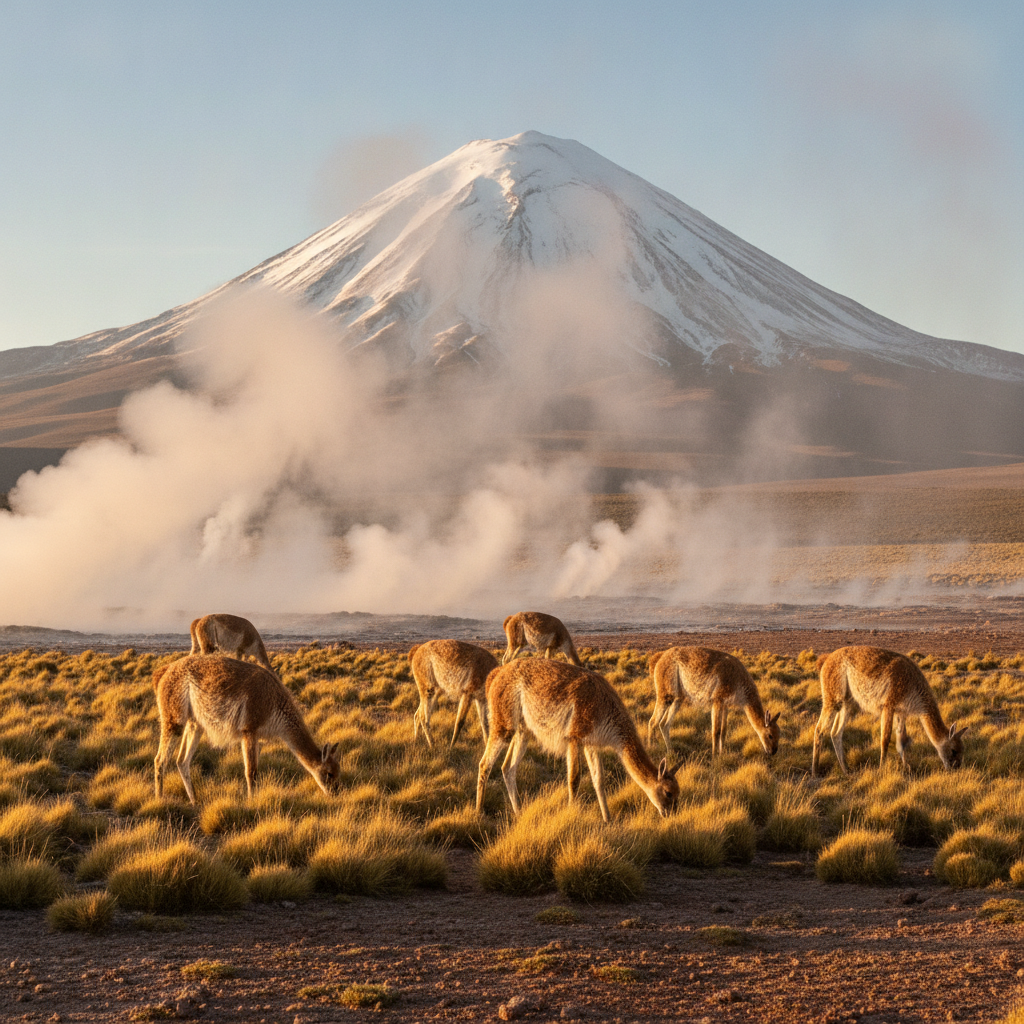
Atacama Wildlife: Vicunas, Flamingos, Viscachas, and the Andean Cat
The extreme aridity of the Atacama is deceptive as a wildlife habitat: the high-altitude wetlands, salt lakes, and altiplano grasslands of the desert support a surprisingly rich community of endemic and near-endemic species adapted to the extreme conditions, including three flamingo species, the vicuna, the viscacha, and one of the rarest cats on Earth.
- 1
Vicuna: The Wild Ancestor of the Alpaca
The vicuna, the wild camelid of the Andean altiplano and the ancestor of the domesticated alpaca, is abundant on the high-altitude grasslands and bofedal wetlands of the Atacama altiplano at elevations above 3,500 meters, where herds of several dozen individuals are commonly encountered grazing the sparse vegetation of the volcanic plateau. The finest natural fiber in the world, finer than cashmere, is produced from the vicuna fleece and was reserved exclusively for Inca royalty in the pre-Columbian period.
- 2
Three Flamingo Species: James, Andean, and Chilean
The salt lakes of the Los Flamencos National Reserve support breeding colonies of the James flamingo, the Andean flamingo, and the Chilean flamingo, the three species found in the Chilean Atacama. The rarest is the Andean flamingo, whose world population is estimated at fewer than 40,000 individuals distributed across a handful of high-altitude salt lakes in Chile, Argentina, Bolivia, and Peru; the Atacama lakes are among the most accessible breeding sites.
- 3
Viscacha: The Long-Eared Chinchilla Relative
The viscacha, a large rabbit-like rodent related to the chinchilla, is resident on the rocky slopes and canyon walls throughout the Atacama region and is one of the most reliably encountered mammals for visitors who look carefully at the rock faces near the El Tatio geyser field and the Valle de la Muerte canyon walls. The animals bask in the morning sun on rocks and are approachable to within a few meters before retreating into rock crevices.
- 4
Andean Cat: One of the World's Rarest Felines
The Andean cat, a small spotted wild cat restricted to the rocky altiplano habitats of the Andes from Peru to Argentina, is one of the least known and rarest felids in the world with a total population estimated at fewer than 2,500 individuals. The Atacama altiplano is within the range of the species but sightings are extremely rare; the cat is nocturnal and secretive and is encountered almost exclusively by researchers using camera trap methodology.
- 5
Greater Rhea: The Flightless Giant of the Desert
The greater rhea, South America's largest bird at up to 1.5 meters tall, inhabits the dry steppe areas of the Atacama at lower altitudes and is occasionally encountered on the roads between San Pedro and the coastal desert towns. The female-absence in parental care, with the male incubating the communal nest and raising the chicks, represents one of the most unusual reproductive strategies among large birds.
- 6
Andean Avocet and the Altiplano Shorebirds
The Andean avocet, a striking black and white shorebird with an upturned bill, is common on the shallow shores of the altiplano salt lakes and is one of the most distinctive birds of the Atacama altiplano bird community. The shores of the flamingo lagoons also support Andean lapwing, puna plover, and several species of Andean teal in a shorebird community that includes several near-endemic species of the high-altitude wetland ecosystem.
Walk this route with audio
Stories play automatically as you reach each stop — no tapping needed.
More in Atacama

Atacama Desert: Moon Valley, El Tatio Geysers, Flamingo Lagoons, and the World's Best Stargazing

Atacama Geology: Salt Flats, Volcanoes, and the Science of the World's Driest Desert

Atacama Nitrate Era: Ghost Towns, Humberstone, and the Rise and Fall of White Gold

Atacama Astronomy: ALMA, World-Class Observatories, and Astrophotography

Atacameno Culture: Pukara Fortresses, Village Traditions, and 10,000 Years of Desert Life