Atacama Nitrate Era: Ghost Towns, Humberstone, and the Rise and Fall of White Gold
The Atacama Desert witnessed the most dramatic economic boom and bust in South American history during the nitrate era from 1880 to 1930, when the desert became the world's primary source of the natural fertilizer that fed the agricultural revolution in Europe and North America, creating enormous wealth for the Chilean state and then collapsing into ghost towns when synthetic nitrogen fertilizer was invented in Germany.
- 1
The Nitrate Boom: How Desert Salt Built a Nation
Sodium nitrate, mined from the caliche ore deposits of the Atacama Desert and processed into fertilizer for European agriculture, was the most valuable export commodity in the world during the late 19th century and financed the infrastructure of modern Chile including the railways, ports, and public buildings of Santiago and Valparaiso. The War of the Pacific from 1879 to 1884, in which Chile conquered the nitrate-rich Atacama from Peru and Bolivia, was fundamentally a resource war for control of the white gold of the desert.
- 2
Humberstone: The UNESCO Ghost Town
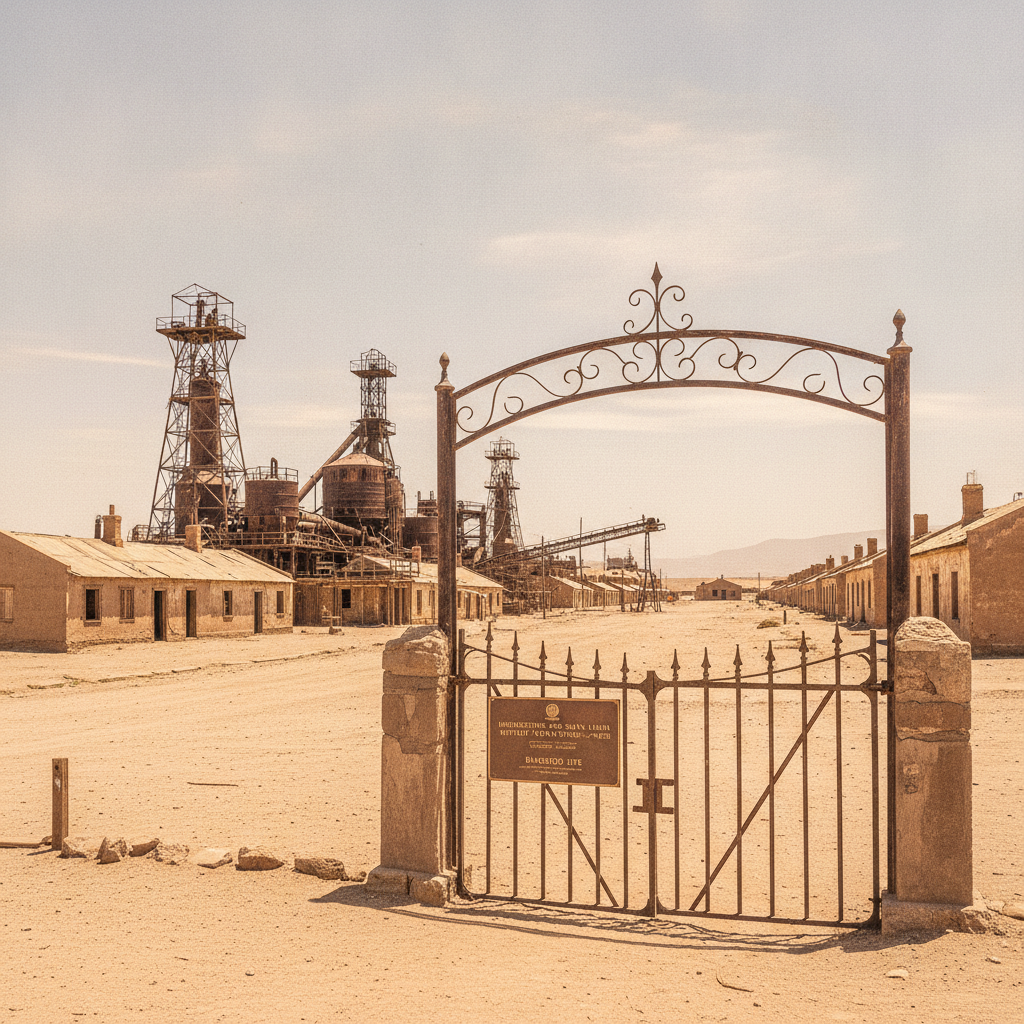
Humberstone and Santa Laura, the best-preserved nitrate processing towns in the Atacama and a UNESCO World Heritage Site, preserve in extraordinary condition the complete industrial and social infrastructure of a nitrate company town of the early 20th century: the processing plant machinery, the worker housing, the cinema, the swimming pool, the hotel, and the company store that constituted the self-contained universe of the nitrate mine workers. The buildings survive intact because the extreme aridity of the Atacama prevents the wood and metal decay that would destroy similar structures in any wetter climate.
- 3
The Haber-Bosch Process: The Chemistry That Killed the Boom
The development of the Haber-Bosch process for synthesizing ammonia from nitrogen and hydrogen, patented by the German chemists Fritz Haber and Carl Bosch in 1909 and scaled to industrial production during World War I, eliminated the dependence of European and American agriculture on Chilean nitrates within a decade of its introduction. The collapse of the nitrate price between 1914 and 1930 abandoned the hundreds of oficinas nitrateras to the desert air, creating the ghost town landscape visible throughout the Atacama today.
- 4
Chacabuco: The Nitrate Town That Became a Concentration Camp
Chacabuco, a nitrate town north of Calama that was abandoned when the nitrate era ended, was reopened by the Pinochet military government in 1973 as a concentration camp for political prisoners following the September coup. The combination of economic ghost town and political prisoner history makes Chacabuco one of the most layered and morally complex historical sites in Chile; it is currently preserved as a memorial and is accessible by guided tour from Calama.
- 5
Pedro de Valdivia and Other Ghost Towns
The Atacama contains dozens of abandoned nitrate towns in various states of preservation, each with its own architectural character reflecting the specific company that built and operated it and the nationality of the company management. The Pedro de Valdivia complex north of Calama preserves one of the largest nitrate processing plants in the Atacama; the scale of the industrial infrastructure visible in the ruins gives a physical sense of the industrial intensity of the nitrate extraction operation.
- 6
Iquique: The Living Heritage of the Nitrate Era
Iquique, the largest city in the Chilean Atacama region, preserves the most complete collection of nitrate-era architecture in a living urban context, with the Plaza Prat and the surrounding historic center containing elegant Georgian and Victorian buildings built with nitrate wealth. The Baquedano pedestrian street is lined with Georgian-style wooden mansions whose tin facades are characteristic of the hybrid architecture of the Chilean nitrate boom period.
Walk this route with audio
Stories play automatically as you reach each stop — no tapping needed.
More in Atacama
Atacama Wildlife: Vicunas, Flamingos, Viscachas, and the Andean Cat
Atacama Desert: Moon Valley, El Tatio Geysers, Flamingo Lagoons, and the World's Best Stargazing
Atacama Geology: Salt Flats, Volcanoes, and the Science of the World's Driest Desert

Atacama Astronomy: ALMA, World-Class Observatories, and Astrophotography
Atacameno Culture: Pukara Fortresses, Village Traditions, and 10,000 Years of Desert Life