Asuncion Practical Guide: Getting There, Getting Around, and Paraguay Circuit
Asuncion is one of the least-visited capital cities in South America, which means that the infrastructure for international tourism is less developed than in Buenos Aires, Lima, or Santiago, but also that the city retains an authenticity and a lack of tourist-industry pressure that many travelers find refreshing. The practical logistics of visiting Asuncion and Paraguay more broadly require some planning around transport, accommodation, currency, safety, and the circuit of sites outside the capital that make a visit to Paraguay worthwhile beyond the city itself.
- 1
Arrival: Silvio Pettirossi International Airport and Overland Entry
Silvio Pettirossi International Airport, situated approximately 15 kilometers northeast of the city center in the municipality of Luque, receives direct flights from Buenos Aires, Sao Paulo, Lima, Bogota, Miami, and a small number of other regional and international destinations; the limited route network means that most international travelers arrive via connection through Buenos Aires or Sao Paulo. The airport itself is modest in scale and facilities relative to its status as a national capital airport, reflecting the limited volume of international travel to Paraguay; immigration and customs processing is generally efficient. Overland entry from Argentina via the Puente Internacional San Ignacio de Loyola bridge connecting Clorinda with the Paraguayan border at Puerto Falcón is a common entry point for travelers from Buenos Aires by bus; the crossing is straightforward but can involve waiting during busy periods. Entry from Brazil via Ciudad del Este on the Brazilian side and the Friendship Bridge to Foz do Iguazu is the most used land crossing in South America by volume of traffic, though most of this volume is commercial and shopping traffic rather than international tourism. Entry requirements for most nationalities visiting Paraguay are simple: many countries have visa-free access for 90-day stays, and the border crossing procedures are less complex than in some neighboring countries.
- 2
Getting Around: Buses, Taxis, and the Metropolitan Area
Public transport within Asuncion and the Gran Asuncion metropolitan area relies primarily on a network of urban buses whose routes and schedules are not always immediately legible to visitors unfamiliar with the system; route information is increasingly available through mapping applications. Taxis and rideshare services including Uber operate throughout the city and are the most practical option for visitors covering significant distances or moving between neighborhoods after dark; fares are reasonable by South American capital standards. The metropolitan area is spread over a large geographic footprint and the distances between attractions can be significant: from the centro historico to Villa Morra is approximately 5 kilometers, and reaching San Bernardino on Lake Ypacarai requires either a car or public bus journey of roughly an hour. Renting a car is a practical option for exploring the interior of Paraguay including the Circuito de Oro and the Jesuit missions, as public transport connections to these sites are infrequent and time-consuming. The road network in the vicinity of Asuncion and along the main routes to Ciudad del Este and Encarnacion is generally in good condition, and driving in Paraguay is less chaotic than in some neighboring countries, though road conditions deteriorate significantly on secondary roads in rural areas.
- 3
Currency, Costs, and Daily Practicalities
The Paraguayan guarani, the national currency, trades at approximately 7,300 guaranies to the US dollar as of 2024; cash in guaranies is the primary means of payment for most transactions including markets, restaurants, taxis, and smaller establishments. ATMs are available throughout Asuncion particularly in Villa Morra and the centro, and international cards are generally accepted; it is advisable to carry cash for transactions in markets and less formal settings. Paraguay is one of the least expensive countries in South America for visitors from strong-currency countries: a comfortable hotel in Villa Morra costs significantly less than equivalent accommodation in Buenos Aires or Lima, restaurant meals including full traditional Paraguayan dishes cost a fraction of what similar meals would cost in neighboring countries, and transport costs are low. The main practical challenges for visitors include the heat and humidity of the summer months from November to March, when temperatures regularly exceed 35 degrees Celsius and outdoor activity in the midday hours is uncomfortable; the dry season from May to September offers more moderate temperatures and lower humidity. Power cuts, while less frequent than in some neighboring countries, do occur particularly during periods of peak summer heat when air conditioning loads stress the electricity grid.
- 4
Safety, Health, and Practical Tips for Asuncion
Asuncion has a lower profile for violence-against-tourists incidents than some South American capital cities, and the main risks for visitors are opportunistic theft in crowded areas including markets and bus stations rather than violent crime targeted at foreigners. The centro historico requires the standard urban vigilance of any South American city center, and certain areas around the port and the older commercial zones are best avoided after dark. The heat in summer combined with high humidity creates a genuine health risk for visitors not accustomed to tropical conditions; staying hydrated and avoiding outdoor exertion during midday hours in summer are practical necessities rather than suggestions. Medical facilities in Asuncion include both public hospitals and private clinics; the private clinics in Villa Morra and surrounding neighborhoods provide high-quality care and are staffed by doctors who often speak English or Spanish and have trained internationally. Travel insurance with medical evacuation coverage is advisable for Paraguay given that serious medical cases may require evacuation to Buenos Aires or Sao Paulo for specialist treatment not available locally.
- 5
The Paraguay Circuit: Jesuit Missions, Encarnacion, and Ciudad del Este
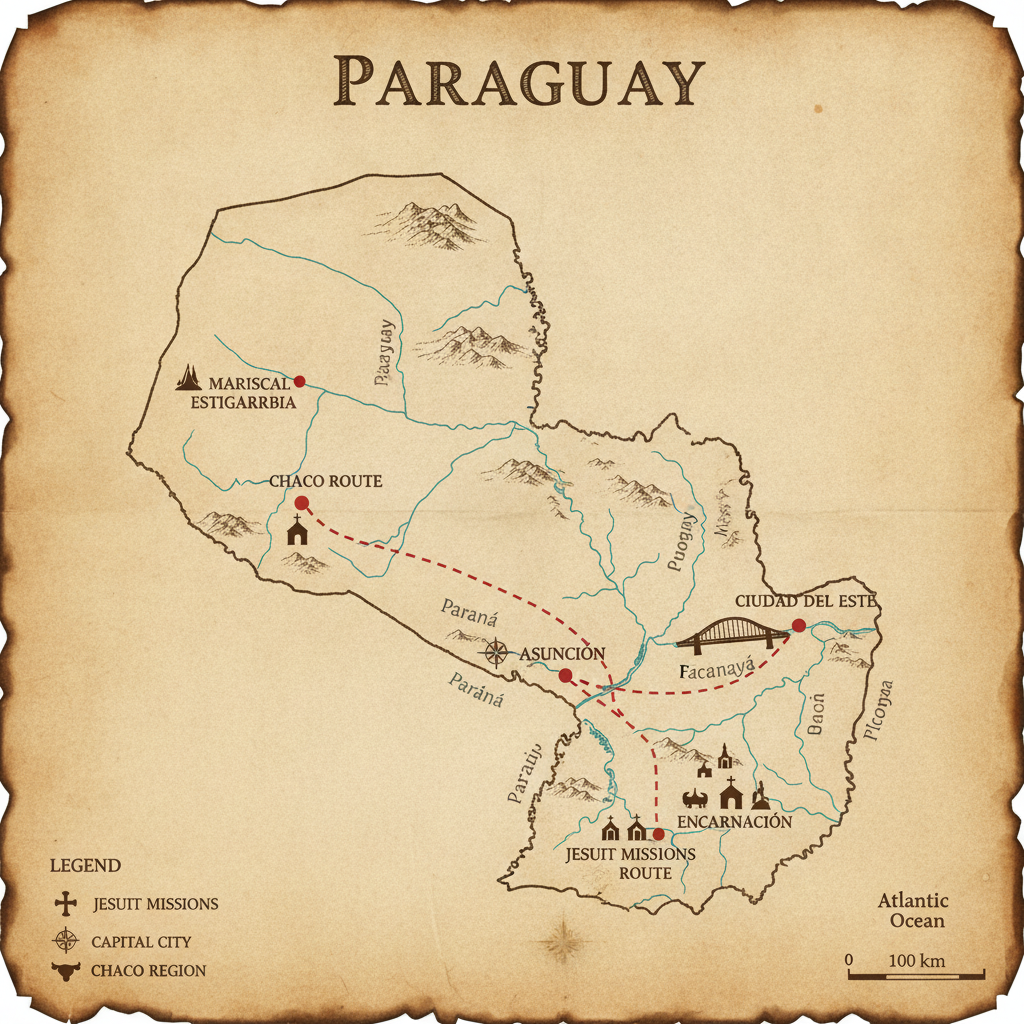
A meaningful visit to Paraguay extends beyond Asuncion to the sites in the interior that provide the full context of Paraguayan history, culture, and geography. The Jesuit missions of the south, particularly Trinidad and Jesus near Encarnacion, are among the best-preserved Jesuit mission ruins in South America and are UNESCO World Heritage Sites; they are reached by a four-hour bus journey from Asuncion or a shorter drive from Encarnacion. Encarnacion itself, on the Rio Parana opposite the Argentine city of Posadas, has developed a modern beach and casino resort on the river and hosts one of the most celebrated carnivals in South America during the summer months. Ciudad del Este on the Brazilian border is the commercial capital of Paraguay and one of the largest free-trade zones in the world; it is chaotic, fascinating, and not particularly tourist-oriented, but provides an insight into the informal and semi-formal commercial economy that is a significant part of Paraguayan economic life. The Chaco region to the west of Asuncion, crossing the Paraguay River, is one of the largest and most biodiverse wilderness areas in South America and is most easily visited through organized tours from Asuncion; the Mennonite colonies of Filadelfia and Loma Plata in the central Chaco combine indigenous Guarani and Mennonite settler cultures in a landscape of remarkable emptiness and ecological richness.
- 6
When to Visit and How Long to Stay in Paraguay
The optimal time to visit Asuncion and Paraguay is during the shoulder seasons of April to June and September to October, when temperatures are moderate, rainfall is manageable, and the main festivals and cultural events are accessible. The summer months of December to February bring intense heat, high humidity, and heavy rainfall that make outdoor activities uncomfortable but also bring the most vibrant social life; carnival in Encarnacion occurs in January and February. The winter months of June and July are the coolest and driest period, with pleasant temperatures for outdoor exploration and clear skies for long drives through the countryside. A minimum of three days in Asuncion covers the main historical and cultural sites of the city center and allows for one day trip to the Circuito de Oro. A week in Paraguay permits a more thorough exploration of Asuncion combined with either the Jesuit missions in the south or the Chaco in the west. Two weeks allows for a comprehensive circuit including Asuncion, the Jesuit missions, Encarnacion, Ciudad del Este, and potentially the Chaco, covering the full range of Paraguayan geography, history, and culture that makes the country one of the most underrated and rewarding destinations in South America for travelers willing to engage with a less-developed tourist infrastructure.
Walk this route with audio
Stories play automatically as you reach each stop — no tapping needed.
More in Asuncion
Asuncion Arts, Music, and the Paraguayan Harp
Asuncion Day Trips: Areguá, Itauguá, Caacupe, and the Circuito de Oro
Asuncion: The Mother of Cities, Guarani Culture, and the Heart of Paraguay
Asuncion History: Foundation, Independence, Dr Francia, and the Lopezas
Asuncion Food and Daily Life: Sopa Paraguaya, Chipa, and the Tereré Culture