Anchorage: Alaska History and Statehood, Seward Highway, Neighborhoods, Glacier Trekking, Economy, and Kenai Salmon Fishing
Anchorage: history (Russian America 1741-1867 Vitus Bering born 1681 Denmark died December 19 1741 Bering Island scurvy, Russian-American Company Sitka 1799, Alaska Purchase March 30 1867 USD 7.2M 2 cents/acre Seward Seward Folly, Klondike Gold Rush August 16 1896 George Carmack Bonanza Creek 100,000 prospectors White Pass Chilkoot Trail Skagway Dyea, Nome 1899 Fairbanks 1902 Prudhoe Bay oil 1968 statehood January 3 1959), Seward Highway (AK-1 235km National Scenic Byway, Turnagain Arm tidal bore beluga whales July-October Dall sheep McHugh Windy Corner, Portage Valley Portage Lake glacier, Mount Marathon Race July 4 945m 5.3km 1915 bar bet men record 41min 27sec 2018, Kenai Peninsula 260km Cook Inlet Gulf Alaska, Kenai NWR 2.1M acres 1941 moose range), neighborhoods (Anchorage 4,900 sqkm largest US city by area larger Rhode Island, JBER 700 sqkm Air Force Army F-22 Raptors 25th Infantry Airborne, Downtown 4th Avenue log cabin visitor center, Ship Creek king salmon visible July-August urban salmon fishing downtown skyline, South Anchorage moose black bear grizzly bear backyards), glacier trekking (Matanuska Glacier Mile 102 Glenn Highway 155km NE 44km long 5.5km wide largest US road-accessible 3-5hr guided USD 80-200, 10,000-year-old Wisconsin glaciation ice, Lake Hood busiest seaplane base world 190 operations/day, Rust's Flying Service 1963 oldest floatplane Anchorage, Denali flightseeing Talkeetna 1-2hr most spectacular aviation tour North America), economy (USD 22B GDP, oil management Prudhoe Bay BP ConocoPhillips ExxonMobil, Port of Anchorage 75% all Alaska goods 5M tonnes, JBER 10,000 military 5,000 civilian, oil decline 2M to 200K barrels/day fiscal crisis no state income or sales tax, UAA 1954 16,000 students), Kenai salmon (world record king 44.2kg May 17 1985 Les Anderson, 30,000+ anglers/year USD 300M peninsula sport fishing economy, Bristol Bay sockeye 35-70M fish largest run on earth USD 300-600M ex-vessel, Pebble Mine USD 500B minerals vs most productive salmon fishery world EPA review, Homer halibut capital Pacific halibut 230kg day charters Small Boat Harbor).
- 1
Alaska Statehood, the Gold Rush, and Russian America
Alaska history: the most dramatic territorial history of any American state, passing through three sovereign periods (Russian America 1741-1867, U.S. Territory 1867-1959, U.S. State since January 3, 1959) in 218 years. The Russian period: Vitus Bering (born August 5, 1681, Horsens, Denmark -- born Danish, died in Russian service; died December 19, 1741, Bering Island, in the Commander Islands chain, stranded by scurvy and storms on his return voyage from discovering Alaska) led the Second Kamchatka Expedition of 1741 that first documented Alaska for Russia, opening the fur trade. The Russian-American Company (the joint-stock company chartered by Tsar Paul I in 1799, headquartered in Sitka) monopolized Alaskan fur trade until the 1867 sale. The Alaska Purchase (signed March 30, 1867, for USD 7.2M -- approximately 2 cents per acre -- by Secretary of State William H. Seward (born May 16, 1801, Florida, NY; died October 10, 1872, Auburn, NY) on behalf of the United States from Russia): called Seward's Folly and Seward's Icebox by contemporary critics who saw no value in the remote, frozen territory. The Klondike Gold Rush (1896-1899): the gold discovery on Rabbit Creek (Bonanza Creek) in the Canadian Yukon on August 16, 1896 by George Carmack, Skookum Jim Mason, and Dawson Charlie triggered a mass migration of 100,000 prospectors through southeast Alaska (the White Pass and Chilkoot Trail routes), establishing the communities of Skagway and Dyea as the primary embarkation points and Dawson City, Yukon as the gold rush capital. The Alaska Gold Rush continued with the Nome gold strike (1899-1900) and the Fairbanks gold strike (1902), establishing the economic and demographic foundation of Alaska before oil was discovered at Prudhoe Bay in 1968.
- 2
The Seward Highway and the Kenai Peninsula
The Seward Highway (AK-1, from Anchorage to Seward, 235 km, designated a National Scenic Byway): the most scenically dramatic paved road in Alaska and one of the most scenic in the United States, running along the edge of Turnagain Arm (with views of the tidal bore, beluga whales feeding on incoming tides from July-October, and Dall sheep (Ovis dalli) visible on the cliffsides of McHugh Creek and Windy Corner), through the Portage Valley (with Portage Lake and the face of Portage Glacier), and into the Kenai Mountains (the southern section of the Chugach Range). Seward (at 334 4th Avenue, Seward, AK, 235 km south of Anchorage, population 2,800): the seaport on Resurrection Bay at the foot of the Kenai Mountains, the terminus of the Alaska Railroad, the primary departure point for Kenai Fjords National Park boat tours, and the home of the Mount Marathon Race (the 4th of July footrace up and down the 945-m summit of Mount Marathon, with a 5.3-km course and 760 m of vertical gain and loss, first run in 1915 as a bar bet -- if the mountain could be climbed and descended in under an hour -- and now one of the most grueling and beloved community races in Alaska, with a men's record of 41 minutes 27 seconds set in 2018). The Kenai Peninsula (the 260-km-long peninsula bounded by Cook Inlet on the west and the Gulf of Alaska on the east, connected to mainland Alaska by the narrow Kenai Mountains corridor crossed by the Seward Highway): the most accessible wilderness peninsula from a major Alaskan city, with Kenai Fjords National Park, the Kenai National Wildlife Refuge (2.1 million acres, established 1941 as the Kenai National Moose Range, renamed 1980), the Kenai River world-class salmon fishing, and Homer as the primary destinations.
- 3
Anchorage Neighborhoods and the Urban Core
Anchorage neighborhoods: the city of Anchorage covers 4,900 square km (larger than the US state of Rhode Island), making it the geographically largest city in the United States by area -- though much of that area is Chugach State Park (500,000 acres), municipal open space, and the Joint Base Elmendorf-Richardson (JBER, the combined Air Force and Army installation covering 700 square km on the north side of Anchorage). The Downtown core: centered on 4th Avenue (historically the main commercial street, now the heart of the tourist district, with the log cabin visitor center of the Anchorage Convention and Visitors Bureau at 524 West 4th Avenue), the Egan Civic and Convention Center (at 555 West 5th Avenue, 3,700-seat arena), and the Performing Arts Center (at 621 West 6th Avenue, completed 1988, the home of the Anchorage Symphony Orchestra (established 1946), the Anchorage Opera, and the Alaska Center for the Performing Arts). The Midtown neighborhood: the commercial and service center of Anchorage, with the majority of the city's retail stores, restaurants, and professional offices along Northern Lights Boulevard and Benson Boulevard. The South Anchorage neighborhood: the most affluent residential area, with the Bear Valley, Rabbit Creek, and Hillside neighborhood subdivisions at the base of the Chugach foothills -- neighborhoods where moose, black bears, and occasionally grizzly bears appear in backyards. The Ship Creek area (adjacent to downtown, the area around the mouth of Ship Creek where it meets Knik Arm of Cook Inlet): the historic railroad district with the Alaska Railroad depot (at 411 West First Avenue) and the Ship Creek salmon viewing platform (where king salmon are visible in Ship Creek July-August during the annual salmon run -- urban salmon fishing within sight of downtown Anchorage skyscrapers).
- 4
Glacier Trekking and Flightseeing from Anchorage
Glacier trekking from Anchorage: the most dramatic outdoor experience available to visitors without significant wilderness experience or equipment -- a professionally guided walk on a living glacier, typically on the Matanuska Glacier (at Mile 102, Glenn Highway, 155 km northeast of Anchorage): the 44-km long, 5.5-km wide glacier (the largest glacier in the United States accessible by road) with organized guided ice hikes (3-hour, 5-hour, and full-day options, approximately USD 80-200 per person) operated by Nova River Runners, Glacier Guides, and other outfitters from the Glacier Park Lodge at the glacier terminus. The Matanuska Glacier is a temperate glacier (not frozen year-round at the base, allowing the ice to flow and creating a dynamic landscape of crevasses, seracs, and moulins) with approximately 10,000-year-old ice accessible to trekkers at the terminus -- ice from the Wisconsin glaciation is still present in the upper reaches of the glacier. Flightseeing: the most accessible and impactful single Alaskan experience for a short visit -- the 1-hour flightseeing tours from Anchorage (departing from Merrill Field, 800 Merrill Field Drive, Anchorage, or Lake Hood Seaplane Base, the busiest seaplane base in the world by operations, handling approximately 190 takeoffs and landings per day in peak season) over the Chugach Mountains, Cook Inlet, and on clear days to Denali. The Rust's Flying Service (at Lake Hood, established 1963): the oldest floatplane service in Anchorage, with tours from USD 150-400 per person. The Denali flightseeing tour (departing from Talkeetna, 225 km north, the definitive Alaska aviation experience): the 1-2 hour tour circling the Denali massif at close range, landing on the Kahiltna Glacier at 2,200 m, and observing the West Buttress route -- the most spectacular aviation tour in North America.
- 5
Anchorage's Economy - Oil, Military, and the Future
Anchorage economy: the Anchorage metropolitan statistical area GDP of approximately USD 22B (2022) is driven by three primary sectors -- oil and gas (the management of the Prudhoe Bay oil field is headquartered in Anchorage, with BP, ConocoPhillips, and ExxonMobil maintaining major offices), transportation and logistics (the Ted Stevens Airport cargo hub, the Port of Anchorage (the port through which 75% of all goods entering Alaska pass, with approximately 5 million tonnes of cargo per year), and the military (JBER, with 10,000 military personnel and 5,000 civilian employees, the 3rd Wing F-22 Raptors and the 25th Infantry Division (Airborne))). The declining oil revenue: the oil production decline at Prudhoe Bay (from 2 million barrels/day in 1988 to 200,000 barrels/day in 2024) has created a structural fiscal crisis for the state of Alaska, which has no state income tax and no state sales tax, relying entirely on oil revenues and the Permanent Fund. The Walker-Dunleavy era fiscal debates (2014-present): the series of budget crises and Permanent Fund Dividend debates that have defined Alaska politics since oil revenues began declining -- the fundamental question of whether Alaska should institute state income and sales taxes (as other states do) to replace declining oil revenue, or whether to cut the Permanent Fund Dividend and reduce government services. The Alaska data center potential: the combination of cold climate (natural cooling for data centers), abundant hydroelectric power (from the Bradley Lake, Susitna River, and other projects), strategic position at the midpoint of transpacific fiber optic cables, and federal land availability has attracted interest from tech companies for Alaska data center development. The University of Alaska Anchorage (at 3211 Providence Drive, Anchorage, established 1954, 16,000 students): the largest university in Alaska, providing the workforce training pipeline for the Anchorage economy.
- 6
Kenai and the Wildest Fishing in Alaska
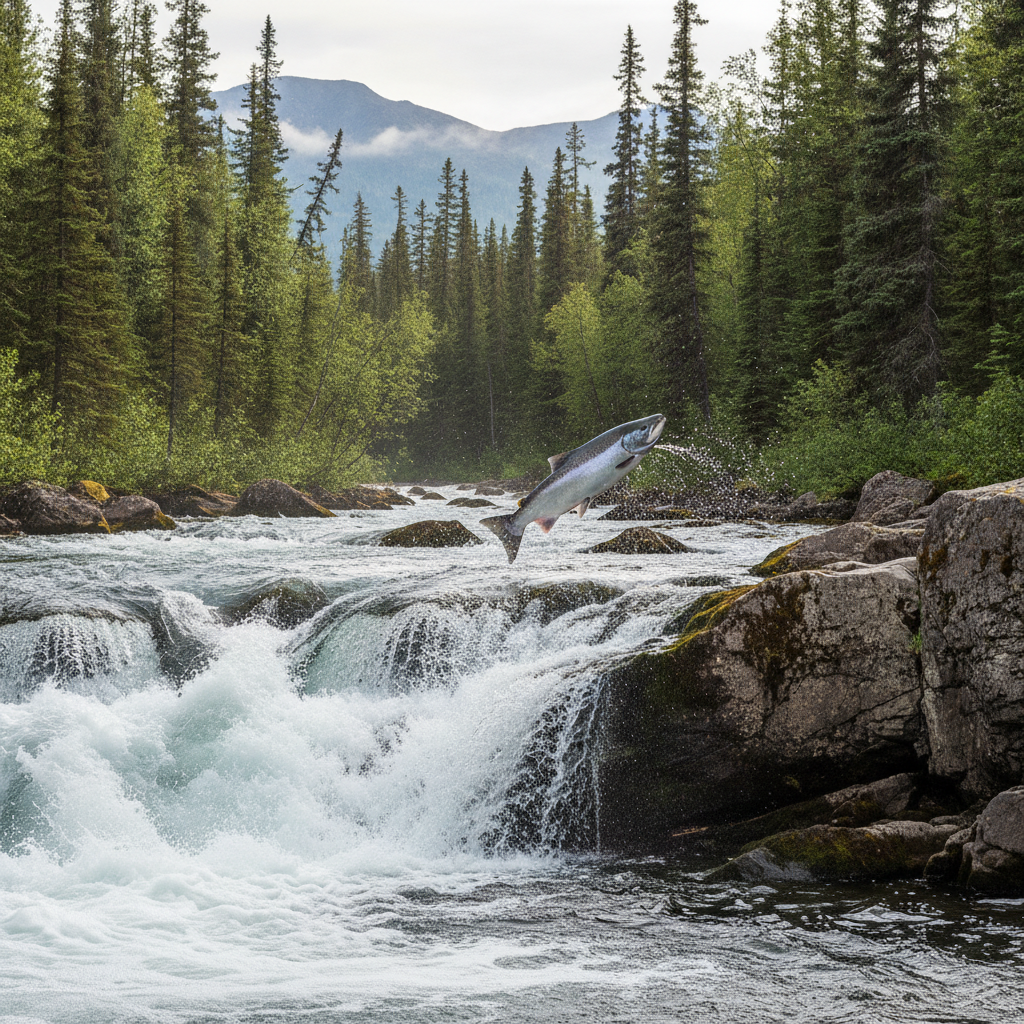
The Kenai River king salmon fishery (the Kenai River, 160 km south of Anchorage, entering Cook Inlet at the city of Kenai): the most celebrated freshwater sport fishing in North America, with the world-record king salmon (44.2 kg, Kenai River, May 17, 1985, Les Anderson) the benchmark of the sport and the late run of Kenai king salmon (July-August) drawing 30,000+ sport fishermen per year from worldwide. The Kenai Peninsula sport fishing economy: the fishing lodges, charter boat operators, guide services, and tackle shops of the Kenai Peninsula generate approximately USD 300M per year in economic activity, making sport fishing the largest single industry on the peninsula outside of oil production (the Swanson River oil field in the Kenai National Wildlife Refuge was discovered 1957 and produced until the late 1990s). The Bristol Bay sockeye salmon run (600 km southwest of Anchorage, accessible by floatplane from the Lake Hood Seaplane Base): the world's largest sockeye salmon run, with approximately 35-70 million sockeye salmon returning to the Kvichak, Naknek, Egegik, and other rivers of the Bristol Bay watershed each summer -- the most important salmon run on earth in terms of total fish and commercial value (approximately USD 300-600M in annual ex-vessel value to commercial fishermen). The Pebble Mine controversy (the proposed copper and gold mine at the headwaters of the Bristol Bay watershed, 315 km southwest of Anchorage): the proposed mine that would create the largest open-pit mine in North America and that opponents argue would irrevocably damage the Bristol Bay salmon runs -- a conflict between approximately USD 500B in mineral value and the most productive salmon fishery in the world, pending environmental review by the EPA. The Homer halibut fishery (350 km south of Anchorage on the Kachemak Bay): Homer bills itself as the halibut capital of the world, with Pacific halibut (Hippoglossus stenolepis) weighing up to 230 kg caught on day charter boats from Homer Small Boat Harbor.
Walk this route with audio
Stories play automatically as you reach each stop — no tapping needed.
More in anchorage
Anchorage: Denali, Chugach Mountains, Alaska Railroad, Iditarod, Kenai Fjords, the 1964 Earthquake, and Practical Info
Anchorage: Native Culture, Wilderness City and the World Cargo Hub
Anchorage: Kincaid Park, Inside Passage, Climate Change in Alaska, Arts Scene, Winter Northern Lights, and Day Hiking
Anchorage: Alaska Native Heritage, Anchorage Museum, Matanuska Valley, Wildlife, Alaska Highway, and the Aurora Borealis
Anchorage: Fjord Glaciers, Urban Moose and the Earthquake That Changed Building Codes