Westerpark, Foodhallen & Oud-West: Amsterdam's Creative Neighborhood
The Westerpark and Oud-West neighborhoods, west of the Jordaan and northwest of the Leidseplein, represent Amsterdam at its most contemporary and least tourist-oriented: the Westergasfabriek (Western Gas Factory), a 19th-century gasworks complex converted to a cultural venue and park, is where Amsterdam's creative class congregates; the Foodhallen (Food Halls), housed in a former tram depot on the Bellamyplein, is Amsterdam's best indoor food market; the Ten Kate Market on the Kinkerstraat is a daily outdoor market serving the neighborhood's Turkish and Moroccan communities; and the streets of Oud-West — the Overtoom, the Kinkerstraat, the Bilderdijkstraat — are lined with independent cafés, bookshops, and the kind of unremarkable neighborhood infrastructure (bike repair shops, family bakeries, dry cleaners) that tourists never see but locals depend on.
- 1
Westergasfabriek — The Gas Factory Becomes a Cultural Park
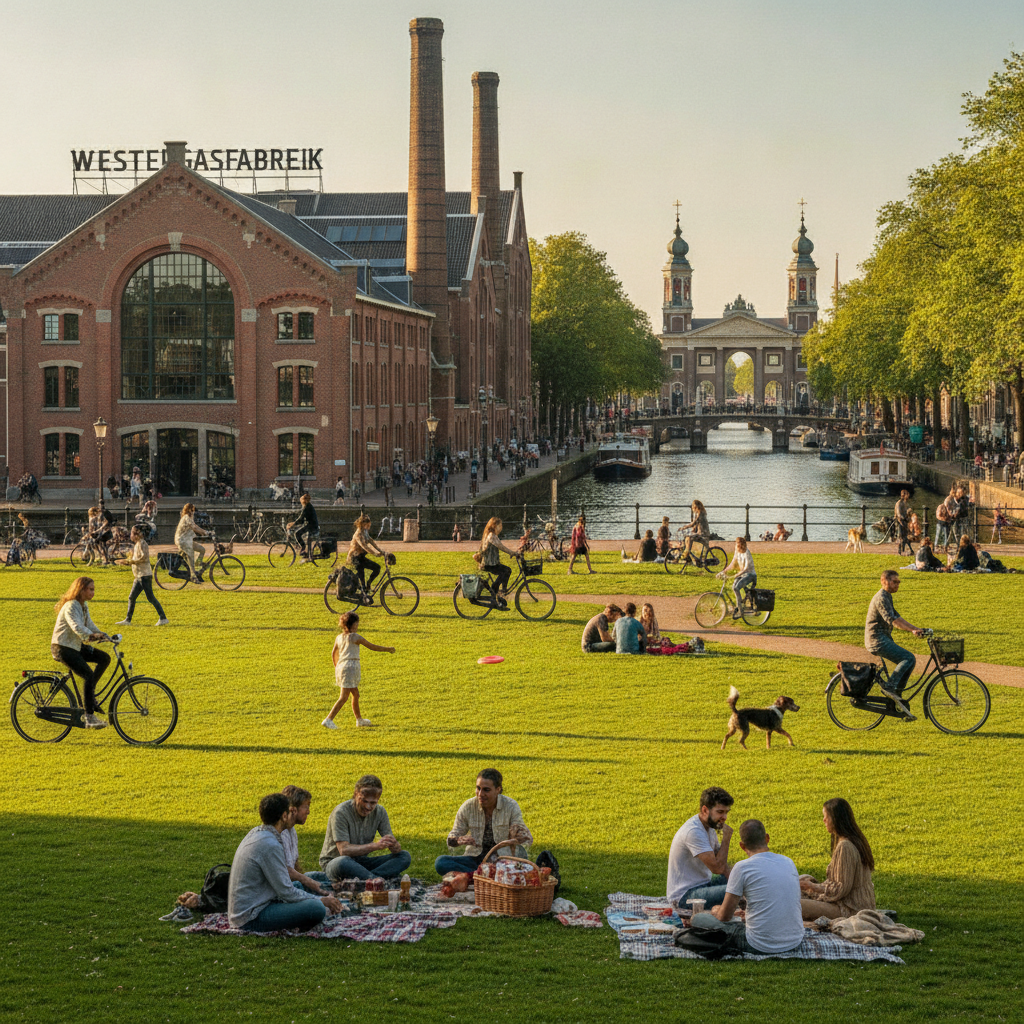
The Westergasfabriek (Western Gas Factory), built between 1883 and 1902 by the Amsterdam Municipal Gas Works and decommissioned in 1967, is Amsterdam's most successful example of industrial heritage conversion: a complex of 13 neo-Gothic brick buildings — the gasometer (gas storage building), the purification house, the meter workshop, the director's house — set in a 14-hectare park (the Westerpark) that was formerly the factory's contaminated site and is now one of Amsterdam's largest and most popular green spaces. The cultural conversion, completed in 2003 and designed by the American landscape architect Kathryn Gustafson, retained the industrial buildings as venues for film premieres, music festivals (Westergasfabriek hosts 300+ events per year), club nights, the weekly Sunday Market (antiques and vintage clothing), and restaurants. The park itself — with the Westerkanaal on its northern edge, meadows, and a children's farm — is where Amsterdam's creative community spends its weekends.
- 2
Haarlemmerpoort & Haarlemmerdijk — The Western Gateway
The Haarlemmerpoort (Haarlem Gate), a neoclassical city gate built in 1840 (the third gate on this site, the previous two having been demolished), marks the western entry to the city center from the Haarlemmerweg, the historic road to Haarlem. The gate is one of only two surviving city gates in Amsterdam (the other being the Muiderpoort in the east), and though it has served as a police station, a government archive office, and a private residence in its post-gate history, it retains its imposing cylindrical form. Beyond the gate: the Haarlemmerdijk and Haarlemmerstraat, two of Amsterdam's most pleasant commercial streets, lined with independent food shops, specialty grocers, delicatessens, and cafés that have survived the gentrification of the surrounding area better than most Amsterdam shopping streets. The Brouwersgracht (Brewers' Canal), which crosses the Haarlemmerstraat at the Korte Prinsengracht, is considered by many Amsterdam residents the most beautiful canal in the city.
- 3
Kinkerstraat & Ten Kate Markt — Multicultural Oud-West
The Kinkerstraat, the main commercial street of the Oud-West (Old West) neighborhood, is one of Amsterdam's most genuinely multicultural shopping streets: Turkish bakeries, Moroccan butchers, Surinamese roti shops, Indonesian toko, Dutch stroopwafel producers, and the Ten Kate Markt (Monday to Saturday), a daily outdoor market in the square behind the Kinkerstraat that serves the neighborhood's large Turkish and Moroccan communities with fresh vegetables, cheap textiles, fish, and the kind of inexpensive household goods that have been driven out of most Amsterdam shopping streets by gentrification. The market and the street around it represent a version of Amsterdam that exists largely outside the tourist economy — genuinely local, multilingual, and operating on a different economic register than the canal ring and the Jordaan.
- 4
Foodhallen — Amsterdam's Indoor Food Market
The Foodhallen (Food Halls), which opened in 2014 in the Bellamybuurt (Bellamy Quarter), are housed in a former tram depot (the Hallen building, built 1902, decommissioned 1960) that also contains a cinema, a library, a hotel, a vintage clothing market, and a Sunday antique market — making it the most successful adaptive reuse project in Amsterdam after the Westergasfabriek. The food hall itself (approximately 20 stalls, open daily) represents Amsterdam's contemporary street food culture in concentrated form: Surinamese bara, Japanese ramen, Dutch bitterballen, Vietnamese bánh mì, American smash burgers, Spanish croquetas, Dutch raw herring — all in a warm, brick-vaulted tram depot interior. Unlike food markets in more tourist-oriented cities, the Foodhallen is genuinely used by Amsterdam residents as a place to eat and socialize, not merely to photograph.
- 5
Overtoom — Amsterdam's Forgotten Artery
The Overtoom, a long straight street connecting the Leidseplein to the Surinameplein in the west, is named after a portage mechanism (an 'overtoom' — literally 'over-draw') used in the 17th century to haul boats across a dike between two waterways at different levels. The street, which runs along the former course of a canal, is now a busy cycle and tram route lined with cafés, international restaurants, small hotels, and the kind of mid-range commercial activity that has been progressively replaced by Airbnb and chain hotels elsewhere in the center. The Vondelpark begins at the southern end of the Overtoom (the two are connected by the Amstelveenseweg), and the area between the Overtoom and the park — the Vondelbuurt — is one of Amsterdam's most pleasant and affordable residential neighborhoods.
- 6
Vondelpark West & the Muscular Oud-West Boundary
The western boundary of the Vondelpark, where it meets the Oud-West neighborhood at the Overtoom and the Constantijn Huygensstraat, is the least-visited part of the park: fewer tourists, more dog walkers, and the park's community gardens, pétanque courts, and the Filmmuseum Café (now EYE's precursor space, relocated). The Constantijn Huygensstraat, running north from the park toward the Overtoom and beyond, is one of Oud-West's most characteristic streets — a mix of 1880s–1900s residential buildings, independent shops, and brown cafés that have largely resisted the gentrification that has transformed the Jordaan and the canal ring. The surrounding streets contain most of Amsterdam's practicing artists and musicians: the rents, while high, are lower than the canal ring, and the neighborhood's density of rehearsal spaces, cheap restaurants, and bicycle access to the center makes it the city's most workable artists' quarter.
Walk this route with audio
Stories play automatically as you reach each stop — no tapping needed.
More in amsterdam
Rijksmuseum, Van Gogh & Museumplein: The Museum Quarter
Jordaan, Anne Frank & the Canal Ring: Amsterdam's Golden Age Heart
Rembrandtplein, Tuschinski & the Amstel: Art, Entertainment, and the Skinny Bridge
Amsterdam Noord, EYE & NDSM: The Creative Waterfront
De Pijp, Albert Cuyp & Heineken: Amsterdam's Most Diverse Neighborhood