NEMO, Maritime Museum & Eastern Docklands: The Harbor City Reinvented
The eastern waterfront of Amsterdam — the area stretching from NEMO science museum past the National Maritime Museum to the artificial islands of the Eastern Docklands (Java Island, KNSM Island, Borneo-Sporenburg) — is the most architecturally ambitious urban development in the Netherlands since the postwar reconstruction. The docklands were the working heart of Amsterdam's harbor from the 17th century until containerization in the 1960s–1970s made the inner harbor obsolete. The conversion of the islands and peninsulas to residential use (1990–2005) became a landmark of Dutch urbanism: rather than clearing the industrial past, the city commission required architects to design around and within the existing warehouse and dock structures, creating one of the densest and most varied collections of contemporary Dutch architecture in the world.
- 1
NEMO Science Museum — A Ship Emerging From the Harbor
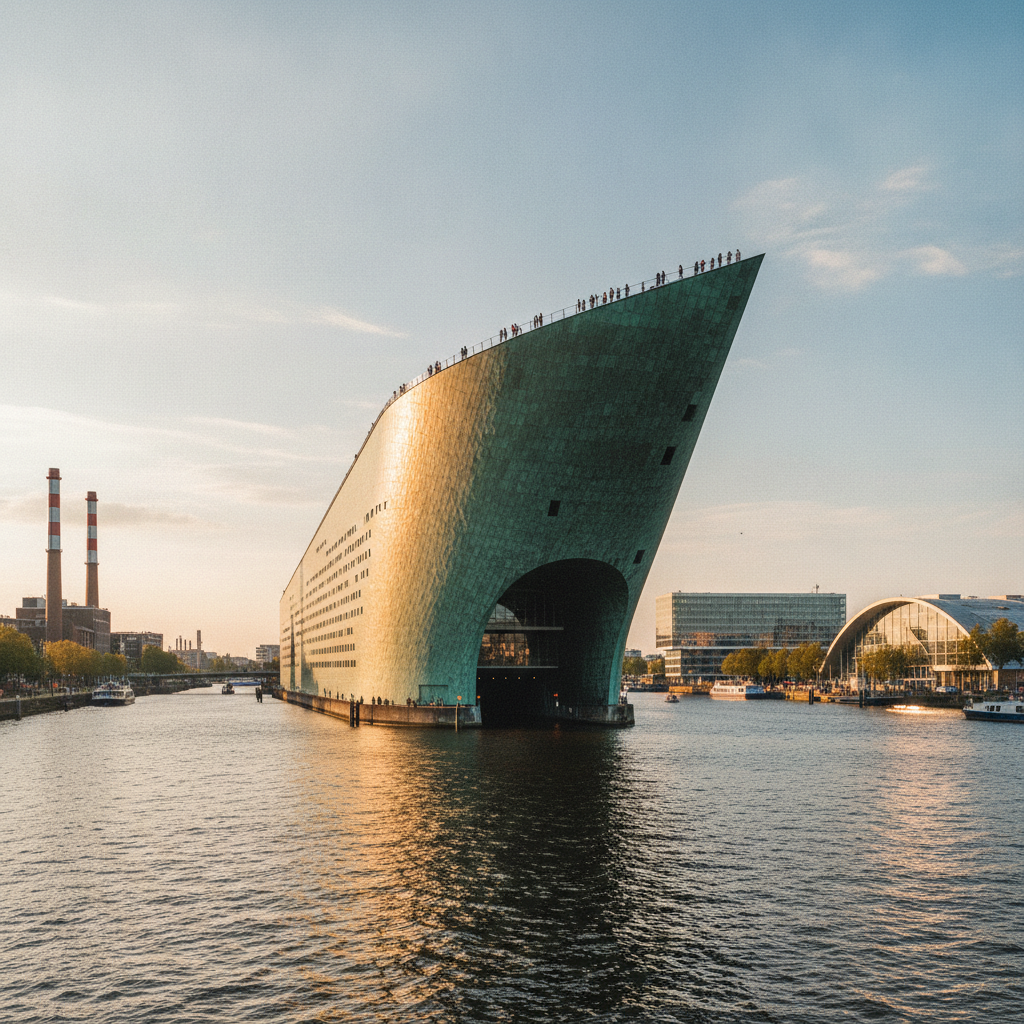
NEMO Science Museum, designed by Renzo Piano and opened in 1997, is built directly above the entrance to the IJ Tunnel (the road tunnel under the harbor) on an artificial promontory in the harbor: a green copper-clad building shaped like the bow of a ship emerging from the water at 30 degrees, its roof terrace at 30 meters offering the best free panoramic view of Amsterdam's center (the building's roof is a public space). The museum's content — five floors of interactive science exhibits aimed primarily at children and families — covers physics, chemistry, technology, and biology with the hands-on, experiment-based approach that has characterized Dutch science education since the 19th century. Piano's building, one of his best of the period, was controversial for occupying harbor space that locals felt should remain open water; the compensating public roof terrace (with café) has largely won Amsterdam over.
- 2
National Maritime Museum — Four Centuries of Dutch Seafaring
The National Maritime Museum (Scheepvaartmuseum), housed in the former Amsterdam Admiralty Warehouse (1656, a massive brick building on its own island in the Eastern Docklands), is the national museum of Dutch maritime history: an extraordinary collection of ship models, navigational instruments, charts, paintings, and artifacts documenting the Dutch Republic's maritime empire (the VOC: Dutch East India Company, 1602–1799; the WIC: Dutch West India Company, 1621–1791), the Dutch naval wars of the 17th century (against England, Spain, and France), and the continuing Dutch relationship with the sea as an existential condition (the Netherlands is one-quarter below sea level). The museum's centerpiece is a full-scale replica of the VOC ship Amsterdam (1748), moored alongside the building, that visitors can board. The 2011 renovation added a glass roof to the central courtyard, creating an extraordinary interior public space under a lattice of white steel.
- 3
Java Island — Urban Design at the Water's Edge
Java Island, one of the artificial islands created in the 19th century for the expansion of Amsterdam's harbor, was redeveloped between 1995 and 2001 as a mixed residential neighborhood of 1,500 dwellings. The urban design by Sjoerd Soeters is a rare success in contemporary Dutch urbanism: four long residential blocks parallel to the island's length, with perpendicular cross-streets every 100 meters, each cross-street with a distinctive architectural character determined by the different architects assigned to each block. The result is a neighborhood with genuine urban variety — different scales, materials, and styles in close proximity — within an overall spatial coherence. The island's western end connects via a pedestrian bridge to the KNSM Island (another docklands redevelopment) and its eastern end to the IJ harbor, where the Muziekgebouw aan 't IJ (2005, a glass concert hall for contemporary music) and the Passenger Terminal Amsterdam anchor the waterfront.
- 4
Borneo-Sporenburg — Low-Rise High-Density Dutch Housing
Borneo-Sporenburg, two adjoining peninsulas between the Eastern Docklands, developed between 1996 and 2005 to a masterplan by the landscape architecture firm West 8 (Adriaan Geuze), is one of the most influential housing developments in Europe: 2,500 dwellings at a density of 100 units per hectare (equivalent to a 10-story apartment block but achieved entirely in 3-story individual houses), creating the highest residential density in the Netherlands achieved without apartment buildings. The houses, designed by 100 different architects under strict rules (three stories maximum, full-width lot, no set-back from the street), create an extraordinary architectural variety within a coherent urban morphology. Three large apartment buildings ('meteors', as the masterplan called them) punctuate the two peninsulas, providing visual markers and higher-density anchor points. The result has been enormously influential on Dutch urbanism and has been studied and imitated internationally.
- 5
Muziekgebouw aan 't IJ — Contemporary Music on the Waterfront
The Muziekgebouw aan 't IJ (Music Building on the IJ), opened in 2005 to designs by the Danish architects 3XN (Kim Herforth Nielsen), is Amsterdam's concert hall for contemporary and experimental music: a glass-and-steel building on the waterfront that combines acoustic precision with visual transparency — the main concert hall (735 seats) is visible from the harbor through the glass facade, and the building's terrace (free, open to the public) has one of the best views of the IJ and Amsterdam Noord. The Muziekgebouw is the primary venue for the Holland Festival (June, the Netherlands' most important performing arts festival) and for the Concertgebouworkest's contemporary music programming. The adjacent Bimhuis (a cylindrical jazz and improvised music venue, 2005, connected to the Muziekgebouw) completes one of the best-designed music facilities in Europe.
- 6
Entrepotdok — The Largest Warehouse Complex in 19th-Century Europe
The Entrepotdok, a 500-meter-long row of 84 interconnected warehouses built between 1708 and 1829 on the Entrepotdok canal (where goods in transit were stored duty-free), was the largest warehouse complex in Europe in the 19th century. The complex was converted to residential and commercial use in the 1980s, in one of Amsterdam's earliest adaptive reuse projects: each of the 84 warehouse bays was converted to a single dwelling with a mezzanine, the original facade (with its Dutch city name above each bay — the warehouses were named after the European cities from which goods were received) preserved and the interiors completely reworked. The result is a remarkable residential street of extraordinary historical depth — 18th-century warehouse facades on a 17th-century canal, containing contemporary apartments — that has become one of Amsterdam's most sought-after addresses.
Walk this route with audio
Stories play automatically as you reach each stop — no tapping needed.
More in amsterdam
Rijksmuseum, Van Gogh & Museumplein: The Museum Quarter
Jordaan, Anne Frank & the Canal Ring: Amsterdam's Golden Age Heart
Rembrandtplein, Tuschinski & the Amstel: Art, Entertainment, and the Skinny Bridge
Amsterdam Noord, EYE & NDSM: The Creative Waterfront
De Pijp, Albert Cuyp & Heineken: Amsterdam's Most Diverse Neighborhood