Jordaan, Anne Frank & the Canal Ring: Amsterdam's Golden Age Heart
The Canal Ring (Grachtengordel) — the semi-circular system of three concentric canals (Herengracht, Keizersgracht, Prinsengracht) dug between 1613 and 1625 during Amsterdam's explosive Golden Age expansion — is one of the most ambitious urban planning projects of the 17th century: 100 kilometers of waterway, 90 islands, 1,500 bridges, and 6,800 buildings, most of them still standing. The area was designated a UNESCO World Heritage Site in 2010. The Jordaan, the neighborhood immediately west of the Prinsengracht, was originally built as a working-class district for the artisans, craftsmen, and laborers displaced by the canal construction — its street plan following the drainage ditches of the polders that previously occupied the land, creating the irregular, small-scale street grid that distinguishes it from the formal geometry of the canal ring. Today the Jordaan is Amsterdam's most desirable neighborhood: independent boutiques, galleries, cafés, and restaurants in the ground floors of 17th-century buildings, and the Anne Frank House, one of the most visited sites in the Netherlands.
- 1
Westerkerk — The Bell Tower Anne Frank Listened To
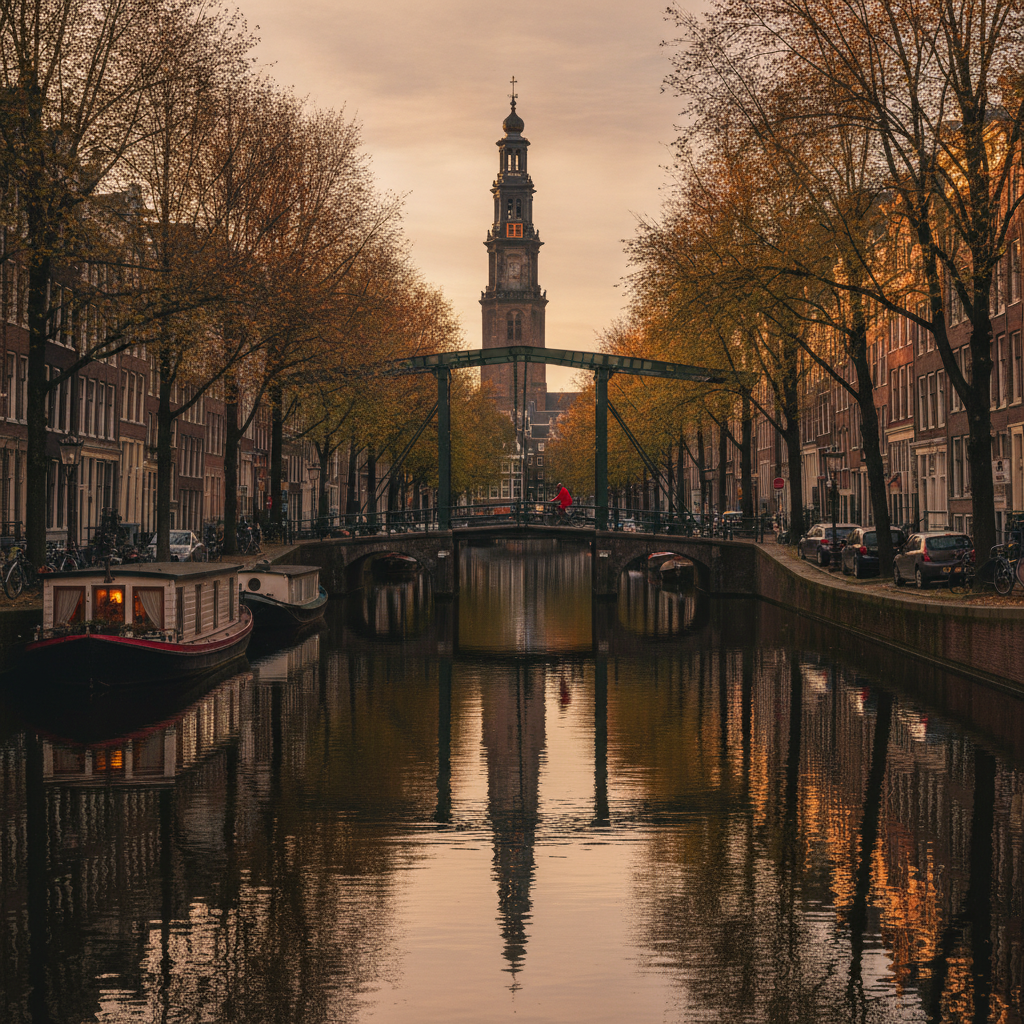
The Westerkerk (Western Church), designed by Hendrick de Keyser and completed in 1631 after his death by his son Pieter, is the largest Protestant church in the Netherlands (2,800 square meters) and the parish church of the Jordaan. Rembrandt, who lived nearby on the Rozengracht, was buried here in 1669 (in an unmarked grave, since he died in poverty; the exact location is unknown). The church tower — 85 meters, the tallest in Amsterdam — is crowned by the blue, red, and gold imperial crown of Maximilian I of Austria (the symbol of Amsterdam, placed here when Amsterdam paid for the tower's construction). Anne Frank, hidden 250 meters away in the annexe at Prinsengracht 263, wrote in her diary about hearing the Westerkerk bells every half hour. The tower can be climbed for panoramic views; the carillon (bells, installed 1636) plays on Tuesday mornings.
- 2
Anne Frank House — The Most Important Hiding Place in the World
The Anne Frank House, Prinsengracht 263–267, is the building where Anne Frank, her family (parents Otto and Edith, sister Margot), and four others hid from the German occupation in the concealed annexe (Achterhuis) behind Otto Frank's spice company for 761 days, from July 6, 1942 to August 4, 1944. Anne Frank, who received the diary on her 13th birthday (June 12, 1942) as the family prepared to go into hiding, kept her record of life in the annexe until three days before the group was discovered and arrested, deported to Auschwitz and Bergen-Belsen (where Anne and her sister Margot died in February–March 1945). Only Otto Frank survived. He arranged for Anne's diary to be published in 1947 (first Dutch edition: 'Het Achterhuis'). The house opened as a museum in 1960, founded by Otto Frank; the annexe and its connecting rooms have been left empty of furniture (the Germans took everything when they arrested the inhabitants), the hooks on which the blackout curtains hung, the marks on the wall where Anne recorded her height, and the photos she cut from magazines still visible.
- 3
Herengracht — The Gentlemen's Canal and the Golden Bend
The Herengracht (Gentlemen's Canal), the innermost of the three main canals, was the most prestigious address in Golden Age Amsterdam: the canal where wealthy merchants, bankers, and company directors built their most elaborate houses, competing in the elegance of their facades, the height of their gables, and the elaborateness of their decorative stonework. The 'Golden Bend' (Gouden Bocht), the stretch of Herengracht between Leidsestraat and Vijzelstraat, is the apex of this competition: a series of double-width mansions built in the 1660s–1680s, at the height of Amsterdam's prosperity, in a style that was already moving from the Dutch brick-and-step-gable tradition toward French-influenced sandstone classicism. Number 605 Herengracht (the Kattenkabinet — the Cat Cabinet, a museum of cat-related art, absurd and wonderful) and number 502 (now the Museum Van Loon, a 17th-century canal house preserved with original furnishings) are open to visitors.
- 4
Prinsengracht & the Jordaan — Small Streets, Big Atmosphere
The Prinsengracht (Prince's Canal), the outermost of the three main canals and the widest, forms the eastern boundary of the Jordaan. The western side of the Prinsengracht — the Jordaan side — is lined with houseboats, a distinctly Amsterdam institution: approximately 2,500 permanent houseboats are moored in Amsterdam's canals, many of them elaborate floating homes with gardens, solar panels, and mail delivered to the water. The Jordaan itself, entered by crossing any of the small bridges over the Prinsengracht, is a neighborhood of extraordinary intimacy: streets 5–8 meters wide, canal-side houses of 3–4 stories, ground floors converted to galleries, antique shops, bakeries, and restaurants. The Noordermarkt (Saturday morning: organic farmers' market; Monday morning: flea market) and the Lindengracht market (Saturday morning) are the best markets in Amsterdam for locally produced food.
- 5
Nine Streets (Negen Straatjes) — The Independent Shopping Quarter
The Nine Streets (Negen Straatjes) is the informal name for the nine small streets that cross the three main canals between Raadhuisstraat and Leidsegracht: Reestraat, Hartenstraat, Gasthuismolensteeg / Berenstraat, Wolvenstraat / Oude Spiegelstraat, and Huidenstraat / Runstraat — each just one or two blocks long, connecting two canals, lined entirely with independent boutiques, galleries, concept stores, and specialty food shops. Unlike the large shopping streets (Kalverstraat, P.C. Hooftstraat), which are dominated by chains and luxury brands, the Nine Streets have no chain stores — a combination of high rents that favor small operators (who can afford short leases) over large chains (who need long leases for return on fit-out investment). The streets are the best place in Amsterdam to buy Dutch design objects, vintage clothing, and artisan food.
- 6
Leidseplein & Leidsestraat — The Entertainment Hub
The Leidseplein, a broad square at the junction of the canal ring and the city center's southern edge, is Amsterdam's busiest entertainment square: ringed by theaters (including the Stadsschouwburg, 1894, Amsterdam's main repertory theater, now Internationaal Theater Amsterdam), cinemas, cafés, and nightclubs, and populated day and night with street performers, cyclists navigating the tram tracks, and tourists attempting to cross the intersection. The American Hotel (1902, by Willem Kromhout, Art Nouveau exterior with a remarkable café interior) and the Paradiso (a rock music venue in a converted 1880s church, where Pink Floyd, The Rolling Stones, and Nirvana have all played) face the square. The Leidsestraat, connecting the square to the canal ring, is one of the few streets in Amsterdam where cars are not allowed but trams are — an arrangement that makes cycling it a memorable experience.
Walk this route with audio
Stories play automatically as you reach each stop — no tapping needed.
More in amsterdam
Rijksmuseum, Van Gogh & Museumplein: The Museum Quarter
Rembrandtplein, Tuschinski & the Amstel: Art, Entertainment, and the Skinny Bridge
Amsterdam Noord, EYE & NDSM: The Creative Waterfront
De Pijp, Albert Cuyp & Heineken: Amsterdam's Most Diverse Neighborhood
NEMO, Maritime Museum & Eastern Docklands: The Harbor City Reinvented