Alexandria: Euclid, Archimedes, Hypatia, and the Hellenistic Scientific Revolution
The extraordinary intellectual achievements centered at Alexandria: Euclid and the Elements of Geometry; Archimedes and his Alexandrian education; Hypatia, the last great Neoplatonist philosopher murdered by a Christian mob in 415 CE; the Catacombs of Kom el-Shoqafa as the largest Roman funerary complex in Egypt; and the Alexandrian synthesis of Greek, Egyptian, and Jewish thought.
- 1
Euclid and the Elements - How Alexandria Defined Mathematics for 2000 Years
Euclid of Alexandria (flourished approximately 300 BCE): the most influential mathematician in history, whose work Elements defined the structure of mathematical reasoning for approximately 2,000 years. The Elements (the Elements (Stoicheia): 13 books covering the geometry of plane figures (Books 1-6), number theory (Books 7-9), three-dimensional geometry (Books 10-13): the most widely studied mathematical work in history: used as the primary mathematics textbook in the Western world from antiquity through the early 20th century: the axiomatic method (Euclid presented mathematics through a small set of self-evident axioms (starting points) from which all other results were derived through logical proof: this axiomatic approach defined the structure of mathematical thinking for 2,000 years and remains the standard for mathematical proof today)). Euclid famous replies (the story of Ptolemy I asking Euclid if there was a shorter way to geometry than through the Elements: Euclid replied that there is no royal road to geometry: a student asked what he would gain from learning geometry: Euclid reportedly told a servant to give the student a coin since he must make a profit from what he learns). The five regular solids (the climax of the Elements is the proof in Book 13 that there are exactly five regular (Platonic) solids: the tetrahedron, cube, octahedron, dodecahedron, and icosahedron: considered by the Greeks to be the fundamental building blocks of the physical universe). The Alexandrian mathematical tradition after Euclid: Apollonius of Perge (the Conics: the definitive ancient treatment of conic sections (circles, ellipses, parabolas, and hyperbolas)): Pappus of Alexandria (4th century CE: the Mathematical Collection).
- 2
Hypatia of Alexandria - The Last Ancient Philosopher and Her Murder
Hypatia of Alexandria (approximately 360-415 CE): the Neoplatonist philosopher, mathematician, and astronomer who was the last great scholar in the ancient Alexandrian tradition and whose murder by a Christian mob in 415 CE marked the symbolic end of the Alexandrian philosophical tradition. The life (Hypatia was the daughter of the mathematician Theon of Alexandria: she became the most respected philosopher and teacher in Alexandria: she edited the definitive versions of Ptolemy Almagest and Euclid Elements used throughout the medieval Islamic and Christian periods: she corresponded with the Roman Emperor and held a position of significant public influence: she was a pagan Neoplatonist who taught Christian, pagan, and Jewish students without distinction). The murder (in 415 CE a mob of Christian monks (parabalonai) associated with the Bishop Cyril of Alexandria attacked Hypatia in her carriage, dragged her to the Caesareum church, stripped her naked, killed her with roof tiles and oyster shells (the accounts vary), dismembered her body, and burned the pieces: the murder was politically motivated (Cyril and the Prefect Orestes were in conflict and Hypatia was associated with Orestes): the murder shocked the educated world and damaged Cyril reputation). The legacy (Hypatia has become the primary symbol of the conflict between classical pagan reason and Christian religious authority: her story was popularized by the 18th-century Enlightenment as an example of religious persecution of science: Carl Sagan discussed her in Cosmos (1980): the 2009 film Agora (directed by Alejandro Amenabar with Rachel Weisz as Hypatia) brought her story to a contemporary audience).
- 3
The Catacombs of Kom el-Shoqafa - The Largest Roman Funerary Complex in Egypt
The Catacombs of Kom el-Shoqafa (the Mound of Broken Pottery): the largest Roman funerary complex in Egypt and one of the Seven Wonders of the Middle Ages according to the medieval Arab scholar al-Andalusi. Discovered accidentally in 1900 when a donkey fell into a shaft in the ground. The structure (the catacombs were cut into the rock in three levels in the 2nd century CE: the levels descend approximately 35 meters below ground: the rotunda with spiral staircase: the triclinium (banqueting hall) where mourners gathered for funerary meals: the main tomb chamber with the primary burial niches). The unique syncretism (the catacombs are the finest example in the ancient world of the blending of Egyptian, Greek, and Roman artistic and religious traditions: the entrance chamber has Egyptian-style paintings and reliefs but the iconography blends Egyptian (Anubis in Roman armor), Greek (the Medusa heads), and Roman (the Roman soldier dress on Egyptian gods) elements: the tomb of Persephone shows Hades (Pluto) abducting Persephone in a completely classical style adjacent to completely Egyptian-style tomb reliefs: the Hall of Caracalla (a subsidiary chamber): the archaeological combination of three civilizations in one funerary space). The discovery (the catacombs were discovered in 1900 when a donkey cart broke through the ground above the entrance shaft: the discovery of the third level (still flooded and not fully accessible to the public) occurred later: the catacombs are the largest ancient funerary complex in Alexandria).
- 4
The Alexandrian Synthesis - Where Greek Philosophy Met Jewish Torah and Egyptian Religion
The intellectual achievement of Hellenistic Alexandria: the extraordinary synthesis of Greek philosophy, Jewish biblical thought, and Egyptian religious tradition that was the primary intellectual movement of the 1st-3rd centuries CE and formed the basis of Christian theology. The Jewish community (the Jewish community of Alexandria was the largest and most important outside Palestine: approximately 100,000-200,000 Jews in Alexandria by the 1st century CE (approximately 30-40% of the city population): the Septuagint (the LXX: the Greek translation of the Hebrew Bible: translated in Alexandria approximately 280-130 BCE: the primary Bible used by early Christians and the foundation of all Christian Old Testament scholarship): Philo of Alexandria (Philo Judaeus: c.20 BCE - 50 CE: the Jewish philosopher who synthesized Jewish Torah with Platonic philosophy: his concept of the Logos (the divine Word or Reason that mediates between God and creation) was directly adopted by the author of the Gospel of John (the Word was in the beginning)). The Neoplatonism (Plotinus (c.204-270 CE): the greatest of the Neoplatonist philosophers: probably born in Egypt: his Enneads are the primary text of Neoplatonism: the philosophy that reality flows from the ineffable One through successive emanations (Nous, Soul, Matter): the philosophical framework adopted and adapted by Christian theology. The early Christian theology (Clement of Alexandria (c.150-215 CE) and Origen of Alexandria (c.185-254 CE) synthesized Greek philosophy with Christian theology in Alexandria: Origen became the most influential biblical scholar in early Christianity: his allegorical interpretation method shaped all subsequent Christian biblical exegesis).
- 5
The Serapeum and Pompey's Pillar - Roman Alexandria's Sacred Center
The Serapeum (the Temple of Serapis) and Pompey's Pillar: the two primary surviving above-ground Roman-era monuments of Alexandria. The Serapeum (the Temple of Serapis (Sarapis): the primary cult center of Alexandria: Serapis was a syncretic deity created by Ptolemy I Soter (approximately 300 BCE) to unify his Greek and Egyptian subjects: the god combined the attributes of the Egyptian Osiris-Apis (the sacred bull of Memphis) with the Greek Asclepius, Zeus, and Helios: the Serapeum was the largest and most magnificent temple complex in Alexandria: it was destroyed by a Christian mob led by Bishop Theophilus in 391 CE (the destruction of the Serapeum was one of the most consequential acts of religious destruction in late antiquity): only the foundation platform and the subterranean galleries survive). Pompey Pillar (the red Aswan granite column known as Pompey Pillar: 26.85 meters high (one of the largest ancient columns in the world): erected in 292-297 CE by the Roman Prefect Publius Pompeius in honor of the Emperor Diocletian (not Pompey the Great who died in 48 BCE - the name is a medieval misnomer): the column stood at the entrance to the Serapeum: the location of the ancient secondary library (the daughter library of the Great Library was in the Serapeum): the Diocletian equestrian statue that stood on top of the column is long gone). The site today (the Pompey Pillar archaeological site includes the foundation platform of the Serapeum, three underground galleries of the Serapeum (including the gallery where the sacred Apis bulls were kept): the site is partially excavated and freely accessible).
- 6
Alexandria Literature - Cavafy, Durrell, Forster, and the Poetry of the Mediterranean City
Alexandria in world literature: the Greek poet Constantine Cavafy and the Lawrence Durrell Alexandria Quartet as two of the most significant works of 20th-century literature set in Alexandria. Constantine Cavafy (Konstantinos Petrou Kavafis: 1863-1933: the greatest Greek poet of the 20th century: born and died in Alexandria: lived his entire adult life in a second-floor apartment in Alexandria (the apartment is now the Cavafy Museum in the Rue Lepsius, now Sharm el-Sheikh Street): wrote 154 canonical poems (1897-1933) in a distinctive combination of modern demotic Greek and classical Katharevousa: the primary themes: Hellenistic history (the world of the Ptolemies, Cleopatra, Mark Antony, and the aftermath of Alexander Great empire), homosexual desire (Cavafy was openly gay in his private life: his poems of homosexual longing were not published in his lifetime), and historical-philosophical meditation (the poem Ithaka (1911): the poem about the journey being more important than the destination: one of the most widely translated poems in the 20th century)). Lawrence Durrell (Lawrence Durrell: the Anglo-Irish novelist: the Alexandria Quartet (Justine (1957), Balthazar (1958), Mountolive (1958), Clea (1960)): a tetralogy set in Alexandria of the 1930s-1940s: notable for exploring the same events from multiple perspectives and the Einsteinian themes of time and space: widely considered one of the finest English-language novels of the 20th century). E.M. Forster (E.M. Forster lived in Alexandria 1915-1919 working for the Red Cross: wrote Alexandria: A History and a Guide (1922) and the short stories in Pharos and Pharillon (1923): two of the finest English-language accounts of the historical city).
Walk this route with audio
Stories play automatically as you reach each stop — no tapping needed.
More in Alexandria
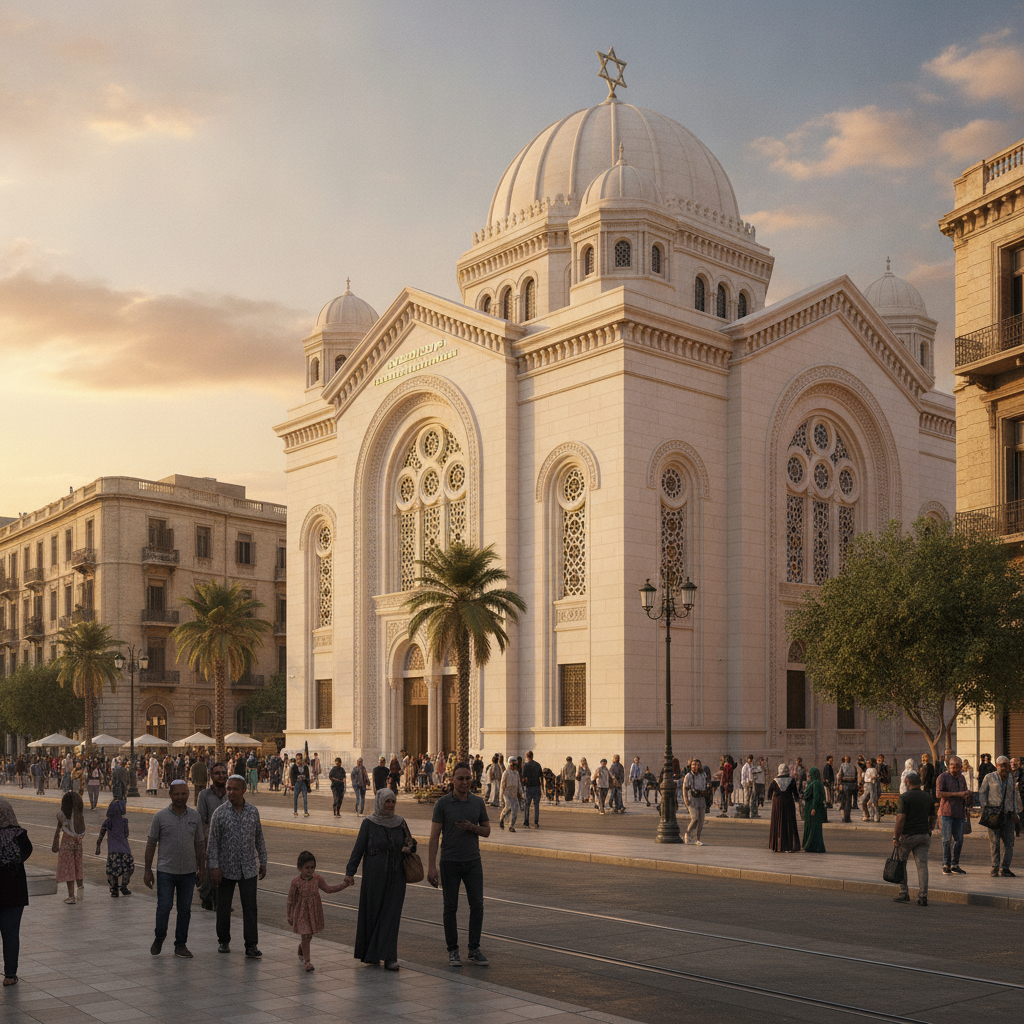
Alexandria Layers: The Jewish Community Heritage, the Ottoman Quarter, the Italian Community, and the Lost Cosmopolitan City
Alexandria Modern History - Napoleon, the British Occupation, Khedive Ismail, and the Cotton Economy
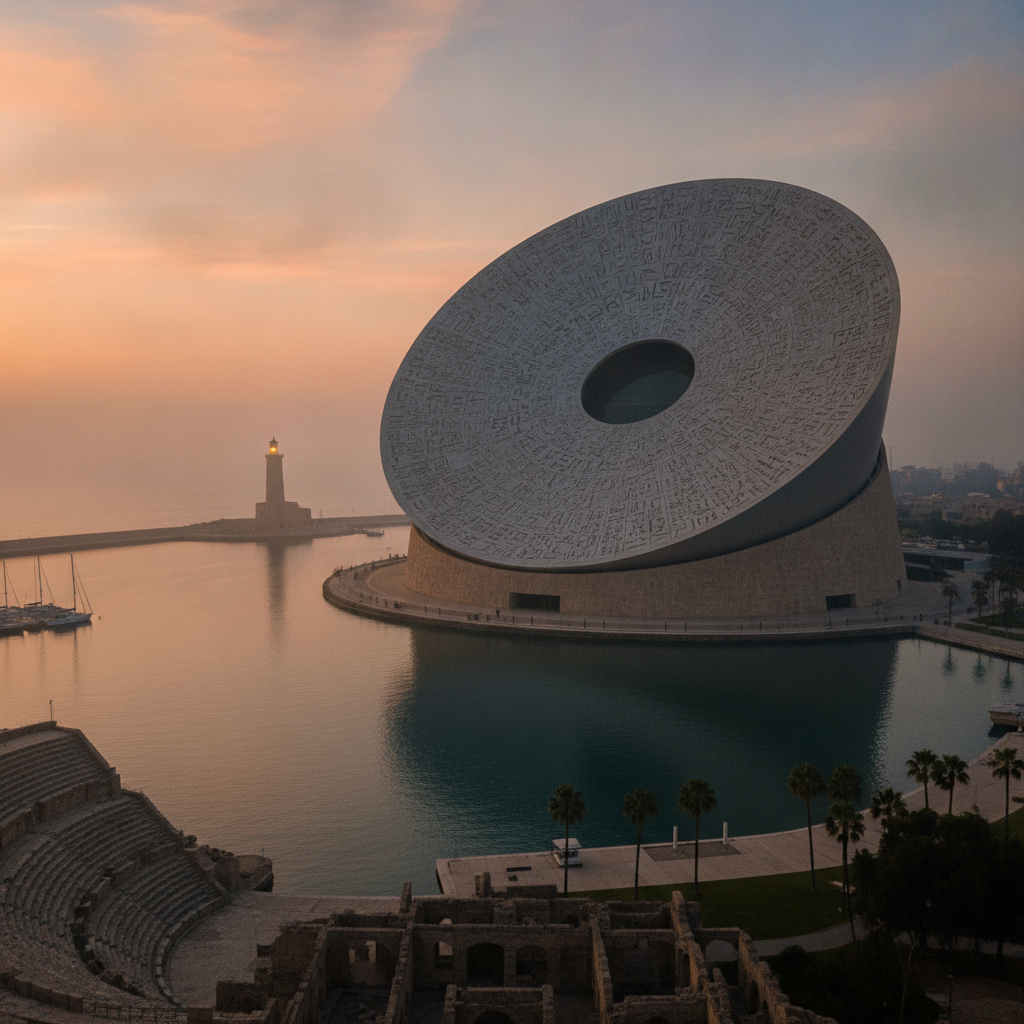
Alexandria: The Great Library, Pharos Lighthouse, Cleopatra, and the Bibliotheca Alexandrina
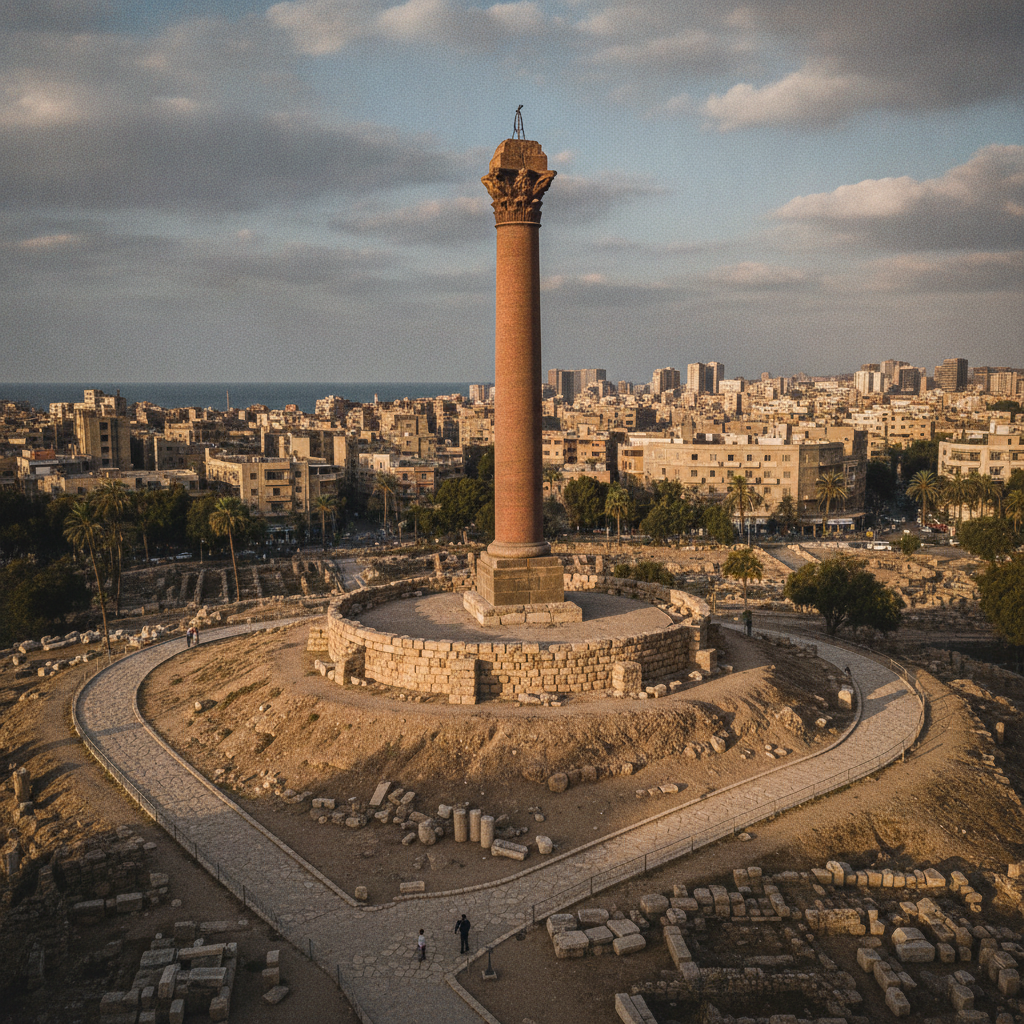
Alexandria Walk: The Pompey Pillar, the Serapeum Platform, the Roman Amphitheatre, and the Complete Ancient Alexandria Walking Circuit
Alexandria Practical: The Cairo Train Connection, the Accommodation, the Day Trip Strategy, the Best Timing, and the Egypt Circuit Role