Albuquerque: White Sands, Tech Scene, International District, Camino Real, Jemez Mountains, and Practical Info
Albuquerque: White Sands National Park (710 sqkm gypsum 270km south, world's largest gypsum dunefield, dunes 18m, gypsum stays cool 40C air, bleached earless lizard white morph evolved 6,000-8,000 years fastest vertebrate natural selection, Trinity Test 1945 on surrounding missile range, closed 8-10x/year for missile tests), tech (Meow Wolf Converg3ncia 2023 USD 1B valuation, Amazon 3,000 jobs, Descartes Labs satellite geospatial ML, CNM Ingenuity cybersecurity certificates), International District (100+ languages, Marshallese largest outside Marshall Islands Compact of Free Association 1986 no visa required, Vietnamese largest Asian-American community NM, Islamic Center Eid celebrations, Global Village Market halal Vietnamese Somali), El Camino Real (2,560km Mexico City to Santa Fe established 1598, 175 years before US, National Historic Trail 2000, Onate 1598 first settlement Ohkay Owingeh 8 years before Jamestown, Acoma massacre January 22 1599 800 killed, Onate statue right foot removed 1998), Jemez Mountains (Valles Caldera 36,480 acres caldera 1.25M years ago 400 km3 rhyolite 1000x Mount St Helens, elk herds 5,000, Bandelier 1150-1600 CE cliff dwellings 64km trails, Jemez Springs hot springs 38-42C), practical (ABQ airport 5M passengers 30 non-stop US cities, ART BRT Central Ave 16km USD 130M 2017, 310+ days sunshine, Balloon Fiesta October best timing, summer monsoon July 4 to September 15 60-70% rainfall, 1,524m altitude adjustment).
- 1
White Sands National Park - The World's Largest Gypsum Dune Field
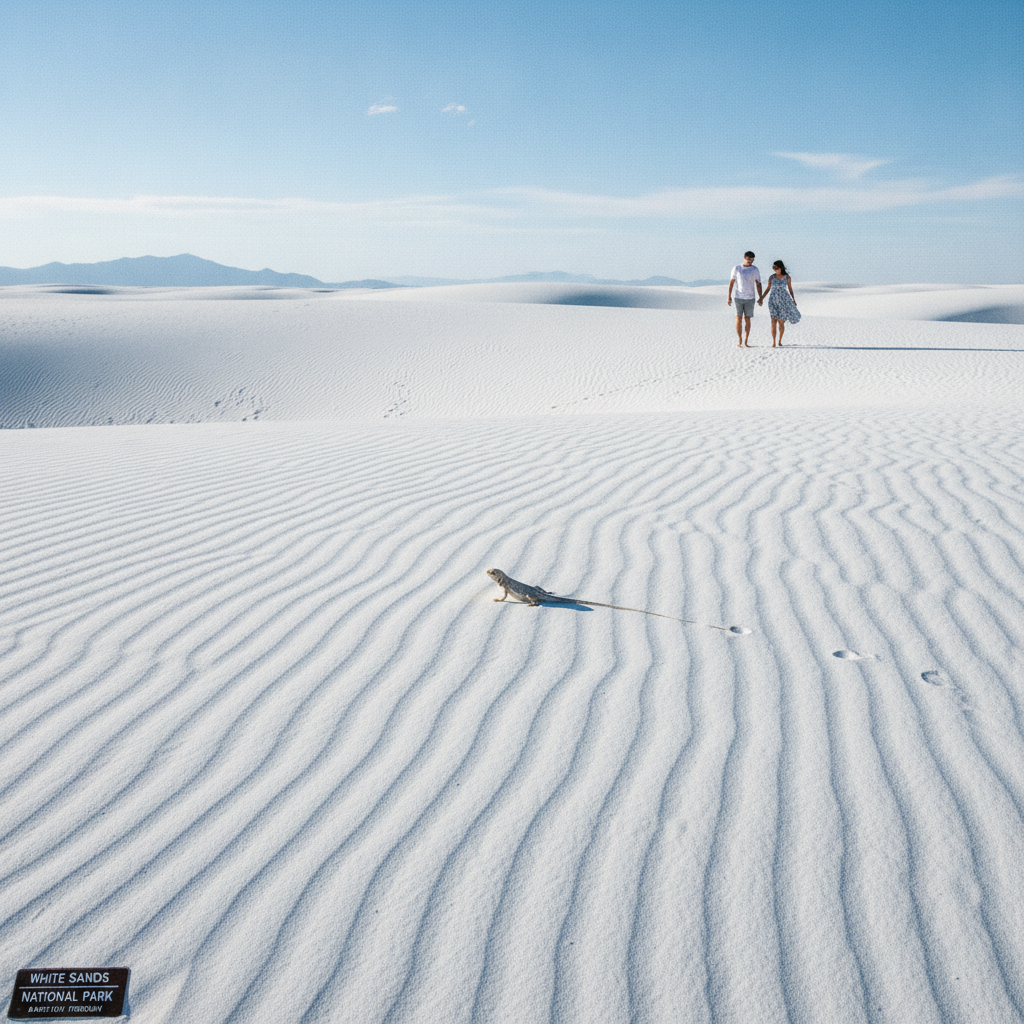
White Sands National Park (at 19955 US Highway 70 W, Alamogordo, New Mexico, 270 km south of Albuquerque, established as a national monument 1933, redesignated as a national park December 20, 2019): the world's largest gypsum dunefield, with 710 square km of pure white gypsum sand dunes, some reaching 18 m in height, covering the Tularosa Basin in the northern Chihuahuan Desert. The geology: the gypsum (hydrated calcium sulfate, CaSO4-2H2O) originates from the Lake Lucero playa (the lowest point in the Tularosa Basin, a dry lake that floods with gypsum-saturated water during winter and spring rainfall), where gypsum crystals grow and are eroded by wind into selenite sand grains that travel northeast via the prevailing winds to build the dunefield. Unlike quartz sand, gypsum does not retain heat — walking barefoot on White Sands dunes in midsummer afternoon (when air temperature exceeds 40C) is possible because the gypsum surface temperature remains comfortably cool. The lake lizard: the bleached earless lizard (Holbrookia maculata ruthveni) and the Apache pocket mouse (Perognathus apache gypsi) have evolved white-phase color morphs over approximately 6,000-8,000 years specifically camouflaged for survival in the white dune environment — one of the fastest documented examples of natural selection in vertebrates. The missile range closure: White Sands National Park is surrounded by White Sands Missile Range (the 8,300-square km Army installation where the Trinity Test occurred in 1945 and where the US Army still conducts missile testing) and is closed to visitors approximately 8-10 times per year when missile tests require airspace closure — typically for 1-3 hours.
- 2
Albuquerque's Growing Tech and Startup Ecosystem
Albuquerque's emerging technology economy: beyond the traditional anchors of Sandia National Laboratories, Kirtland Air Force Base, and the University of New Mexico, Albuquerque has seen significant growth in private sector technology since approximately 2015, driven by comparatively low costs, a large STEM-trained workforce pipeline from UNM and New Mexico Tech (in Socorro, 100 km south), and the amenity value of the outdoor lifestyle. Meow Wolf Albuquerque (the House of Eternal Return was the first Meow Wolf installation in Santa Fe in 2016; the Albuquerque Meow Wolf installation -- Converg3ncia -- opened at the Albuquerque Convention Center in 2023): the Santa Fe-based arts collective and entertainment company Meow Wolf (founded 2008, valued at approximately USD 1B after its 2021 Series B funding round) that creates immersive, psychedelic walk-in art experiences has expanded to include Denver and Las Vegas in addition to the two New Mexico installations. Meow Wolf is the largest private employer in Santa Fe with 200+ employees. Amazon: the Amazon fulfillment centers and delivery stations in the Albuquerque metro area (including the large facility in Albuquerque's south valley) employ approximately 3,000 people and have been among the largest private sector job creators in the metro since 2020. Descartes Labs (data science and geospatial intelligence, founded in Los Alamos 2014, relocated to Albuquerque 2019): one of the most successful New Mexico tech startups, analyzing satellite imagery for agricultural, environmental, and national security applications using machine learning. The CNM Ingenuity program (Central New Mexico Community College, 717 University Boulevard SE): the community college workforce development initiative connecting tech employers with a pipeline of certificate-trained workers in cybersecurity, data science, and manufacturing technology.
- 3
The Albuquerque International District - The Most Diverse Neighborhood in New Mexico
The International District (Central Avenue from Louisiana Boulevard to San Mateo Boulevard, southeast Albuquerque): the most ethnically diverse neighborhood in New Mexico and one of the most diverse neighborhoods by national origin in any American city outside the major coastal metros, with over 100 languages spoken and immigrants from Vietnam, Southeast Asia, East Africa (Somalia, Ethiopia, Eritrea), Central America, the Marshall Islands, Bhutan, Nepal, and Latin America living in a neighborhood covering approximately 9 square km. The Marshallese community (the largest Marshallese population outside the Marshall Islands, with approximately 3,000-5,000 Marshallese residents in the International District): the Compact of Free Association between the United States and the Marshall Islands (1986, renewed 2003) allows Marshallese citizens to live and work in the United States without a visa, and Albuquerque has become the largest Marshallese community in New Mexico following migration from both the Marshall Islands and from existing Marshallese communities in Springdale, Arkansas and Spokane, Washington. The Vietnamese community: the southeast Albuquerque Vietnamese community (concentrated around Central Avenue in the International District) is the largest Asian-American community in New Mexico, with Vietnamese restaurants, groceries, and businesses along Central Avenue. The Laylat al-Qadr (the International District hosts New Mexico's largest celebrations of Islamic holidays including Eid al-Fitr), with the Albuquerque mosque communities (the Islamic Center of New Mexico at 1100 Yale Boulevard SE) drawing thousands of worshippers from across the metro. The Global Village Market on Central Avenue: the informal commercial strip of international grocery stores, halal butchers, Vietnamese pho houses, and Somali restaurants that makes the International District the most culinarily diverse square kilometer in New Mexico.
- 4
El Camino Real de Tierra Adentro - The Royal Road
El Camino Real de Tierra Adentro (the Royal Road of the Interior Land, the 2,560-km trade route from Mexico City, capital of New Spain, to the colonial capital of Santa Fe, New Mexico, established approximately 1598 and used continuously until approximately 1882 when the Atchison, Topeka and Santa Fe Railway made the road obsolete): the most important colonial road in North American history, older than the Santa Fe Trail (established 1821) and predating the United States by 175 years. The road ran directly through what is now Albuquerque and the Rio Grande valley, following the only dependable water source through the Chihuahuan Desert. El Camino Real de Tierra Adentro National Historic Trail (the National Park Service designation protecting and interpreting the road since 2000, with approximately 400 km of the original road still discernible in New Mexico): the trail with its associated museums and sites forming one of the most significant heritage tourism corridors in the American Southwest. The Onate Controversy: Juan de Onate (born approximately 1550, Zacatecas, New Spain; died June 3, 1626, Spain), the colonizer who led the first Spanish settlers up El Camino Real to New Mexico in 1598 (400 men, 130 families, 83 wagons, 7,000 head of livestock), who established the first European settlement in New Mexico at Ohkay Owingeh (San Juan Pueblo) on July 11, 1598 (8 years before Jamestown, 22 years before Plymouth Rock), and who ordered the massacre of Acoma Pueblo (January 22, 1599 -- approximately 800 Acoma people killed in three days of fighting) and the mutilation of all surviving Acoma men over age 25 (right feet amputated). Onate's statue in the Albuquerque North Valley was vandalized by the removal of its right foot in 1998 during the 400th anniversary of the New Mexico colonial founding.
- 5
Albuquerque Day Trips - Bandelier, Valles Caldera, and the Jemez Mountains
The Jemez Mountains (the mountain range 90-130 km northwest of Albuquerque, reaching elevations of 3,430 m at Redondo Peak): the ancient volcanic highland formed by the Valles Caldera supervolcano complex, with hot springs, red rock canyons, Hispanic mountain villages, and two National Park Service units. Valles Caldera National Preserve (at 090 NM-4, Jemez Springs, NM, 140 km northwest of Albuquerque, established as a National Preserve August 20, 2000): the 36,480-acre caldera (the collapsed magma chamber of the Jemez volcanic complex that erupted approximately 1.25 million years ago in the Bandelier Tuff eruption -- the most recent supervolcanic eruption in New Mexico, approximately 1,000 times larger than the 1980 Mount St. Helens eruption, expelling approximately 400 km cubed of rhyolite ash and lava): now a high grassland meadow within the 22-km-wide caldera, with elk herds of up to 5,000 animals (one of the largest elk herds in the Southwest), fishing in the Valles stream, and winter cross-country skiing. Bandelier National Monument (at 15 Entrance Road, Los Alamos, NM, 165 km north of Albuquerque via US-550, established February 11, 1916): the monument protecting the ancestral Pueblo cliff dwellings built in the canyon walls of the Pajarito Plateau between approximately 1150 and 1600 CE, with 33,000 acres of wilderness, 64 km of trails, and the Frey Trail connecting to the Tsankawi mesa-top ruins. The Jemez Springs hot springs (on the Jemez River, at 17500 NM-4, Jemez Springs): the natural geothermal springs producing water at 38-42C (100-108F) in the red rock canyon of the Jemez River, accessible from the village of Jemez Springs (population 302).
- 6
Albuquerque Practical Guide - Getting There, Getting Around, and When to Visit
Albuquerque International Sunport (the commercial airport at 2200 Sunport Boulevard SE, Albuquerque, IATA code ABQ): the largest airport in New Mexico, with non-stop service to approximately 30 US cities and direct international service to limited Mexican destinations, handling approximately 5 million passengers annually. The Albuquerque Rapid Transit (ART) system: the Bus Rapid Transit line running along Central Avenue from Coors Road on the west to the Albuquerque Sunport on the east, with 16 km of dedicated bus lanes, 14 stations, and service every 7.5 minutes during peak hours -- the most significant public transit investment in Albuquerque history (completed 2017 at USD 130M, but operational issues with the electric ART buses led to a switch to conventional diesel buses in 2019, making the ART a politically contested project). The Rio Grande corridor accommodation: hotel concentration is highest downtown (near the Albuquerque Convention Center and Old Town), in the University District, and along Central Avenue -- mid-range options average USD 100-150/night for a decent 3-star hotel. The climate calendar: Albuquerque has 310+ days of sunshine per year, with the best weather from April-June (warm days, cool nights, wildflowers) and September-October (the Balloon Fiesta, harvest season, milder temperatures after the summer monsoon). The summer monsoon (typically July 4 to September 15): the North American Monsoon brings afternoon and evening thunderstorms to Albuquerque with 60-70% of annual rainfall occurring in this 10-week period -- temperatures drop dramatically during storms but return to 35C+ the next morning. Altitude adjustment: at 1,524 m visitors from sea level should plan for increased sun exposure, faster alcohol metabolism, and mild altitude effects for 24-48 hours.
Walk this route with audio
Stories play automatically as you reach each stop — no tapping needed.
More in albuquerque
Albuquerque: Breaking Bad Country, Sky Tram and the Hispanic Cultural Heart
Albuquerque: Pueblo Nations, Sandia Labs, Turquoise Trail, Arts, Petroglyphs, and New Mexican Food
Albuquerque: Balloon Fiesta, Nuclear Heritage and Green Chile Country
Albuquerque: Music, Native Art, Explora, Wine and Beer, Architecture, and Duke City Identity
Albuquerque: Balloon Fiesta, Old Town, Sandia Mountains, Route 66, and the Rio Grande