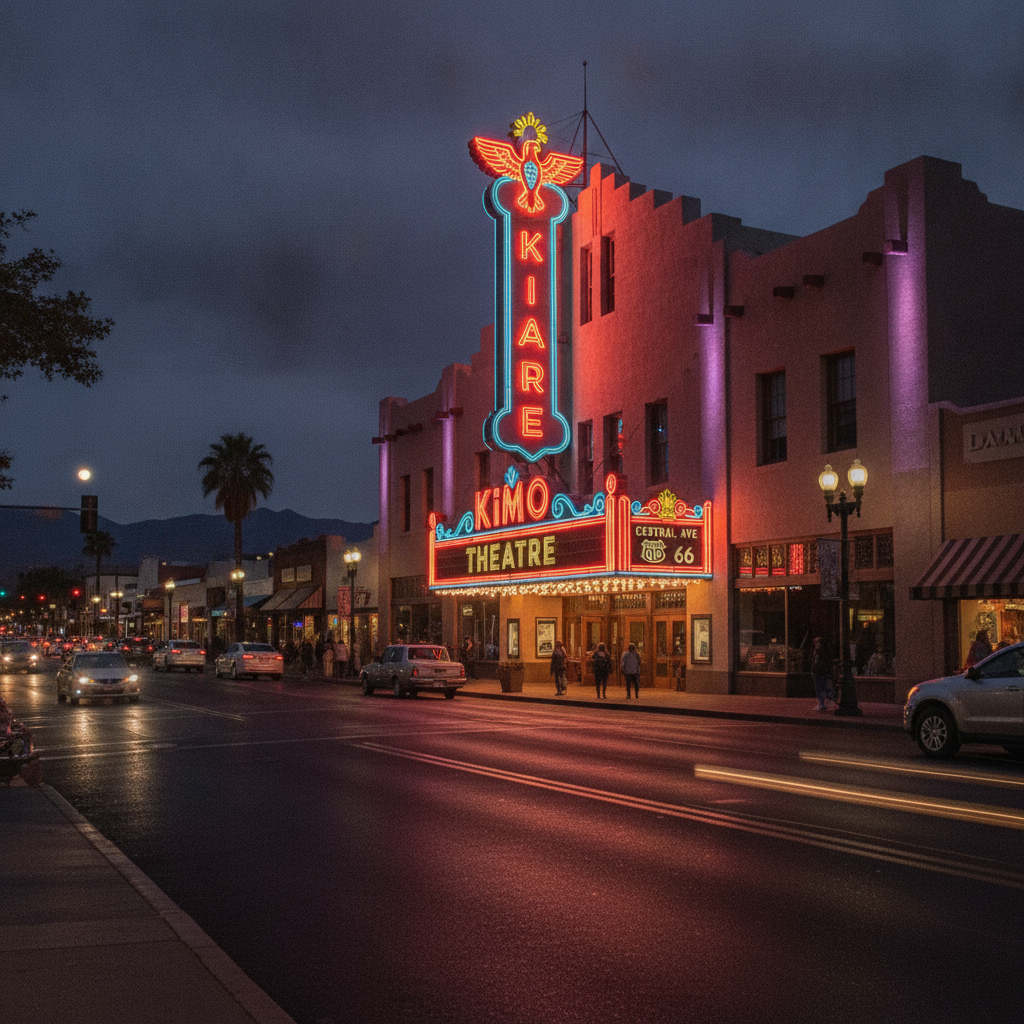
Albuquerque: Pueblo Nations, Sandia Labs, Turquoise Trail, Arts, Petroglyphs, and New Mexican Food
Albuquerque: 19 Pueblos (Sky City Acoma mesa 1150 CE oldest continuously inhabited North America, Sandia Pueblo north boundary, Isleta south, San Ildefonso Maria Martinez black-on-black pottery USD 60K auction, Zia sun symbol taken 1925 never compensated), Sandia National Laboratories (established November 1 1945 non-nuclear components all US nuclear weapons 14,000 employees USD 3.7B budget largest employer NM, Kirtland AFB 22,000 personnel, National Museum Nuclear Science and History only congressionally chartered), Turquoise Trail (NM 14 65km Albuquerque-Santa Fe, Cerrillos mines oldest turquoise North America mined since 900 CE traded to Aztec Mexico, Madrid coal boomtown 1920 population 3,000 closed 1954 entire town put for sale revived by artists 1974 USD 50 per building), UNM arts (36,000 students 1889, John Gaw Meem Pueblo Revival 42 buildings 1934-1958, Maxwell Museum 2.5M Native American objects, Tamarind Institute 1960 world most important collaborative lithography, 4th or 5th most artists per capita), Petroglyph National Monument (1990 7,244 acres 24,000 petroglyphs 1300-1650 CE West Mesa basalt five volcanoes 150,000-200,000 years ago, Rinconada Canyon 300 petroglyphs free self-guided), New Mexican food (Hatch green chile 130M lbs annually state question officially Red or Green 1999, sopapillas complimentary tradition, Frontier Restaurant 1971 1M customers/year bottomless sopapillas plate-sized cinnamon rolls, El Pinto 1962 largest full-service NM national salsa brand, Duran oldest traditional).
- 1
Pueblo People - 19 Nations and 10,000 Years in the Middle Rio Grande
The 19 Pueblos of New Mexico: the federally recognized sovereign tribal nations of the Pueblo people, all located within approximately 240 km of Albuquerque along the Rio Grande valley and its tributaries — Taos Pueblo (90 km north), Ohkay Owingeh (formerly San Juan Pueblo, 110 km north), Santa Clara Pueblo, San Ildefonso Pueblo (the home of Maria Martinez, born 1887, died 1980, the most famous Native American artist in American history, who revived the black-on-black pottery technique of the ancient Mimbres and Tewa potters and whose work commands prices up to USD 60,000 per piece at auction), Pojoaque Pueblo, Nambe Pueblo, Tesuque Pueblo, Santa Fe Pueblo, Cochiti Pueblo, Santo Domingo Pueblo (Kewa), San Felipe Pueblo, Zia Pueblo (the Zia sun symbol on the New Mexico state flag was taken without permission from the Zia people in 1925 and has never been formally compensated for), Santa Ana Pueblo, Sandia Pueblo (immediately adjacent to Albuquerque's northern boundary, with the Sandia Resort and Casino at 30 Rainbow Road NE), Isleta Pueblo (immediately south of Albuquerque, with the Isleta Eagle Golf Course and Isleta Casino Resort), Laguna Pueblo, Acoma Pueblo (the Sky City, 100 km west), Zuni Pueblo (230 km west), and Jemez Pueblo (90 km north). Sky City at Acoma Pueblo (at the top of a 110-m sandstone mesa, the oldest continuously inhabited settlement in North America, with archaeological evidence of habitation since approximately 1150 CE): the most dramatic human settlement in the American Southwest, accessible only by a guided tour from the Acoma Visitor Center (at 1 Sky City Road, Acoma, New Mexico, 40 km south of I-40 at Exit 102).
- 2
Sandia National Laboratories and the Nuclear Age
Sandia National Laboratories (at Kirtland Air Force Base, Albuquerque, 860 hectares on the southern edge of the city): one of the three United States National Nuclear Security Administration laboratories (with Los Alamos National Laboratory 170 km north and Lawrence Livermore National Laboratory in California), responsible for the non-nuclear components of all U.S. nuclear weapons — specifically the engineering design, testing, and evaluation of arming, fuzing, and firing systems, and the safety, reliability, and surveillance of the entire U.S. nuclear stockpile. Sandia was established on November 1, 1945 (one month after the Trinity test and the bombings of Hiroshima and Nagasaki), with the specific mission of transforming the laboratory physics of the Manhattan Project into deliverable military weapons. Sandia employs approximately 14,000 people (the largest single employer in New Mexico) and has an annual budget of approximately USD 3.7B. Kirtland Air Force Base (at 20004 Wyoming Boulevard SE, Albuquerque, 7,100 acres, 22,000 military and civilian personnel): the largest military installation in New Mexico and one of the major Air Force bases in the American Southwest, with the Air Force Nuclear Weapons Center, the National Atomic Museum (now the National Museum of Nuclear Science and History at 601 Eubank Boulevard SE, Albuquerque) — the only congressionally chartered museum of nuclear history in the United States, with artifacts including actual B-29 and B-52 bomber aircraft, the Honest John nuclear missile, the Little Boy and Fat Man display models, and a comprehensive history of the Manhattan Project from the 1930s theoretical physics through Trinity and the Cold War. The museum is the most visited attraction in Albuquerque after the Balloon Fiesta and Old Town.
- 3
The Turquoise Trail and Madrid, New Mexico
The Turquoise Trail National Scenic Byway (New Mexico State Road 14, the 65-km designated scenic byway from Tijeras on the east side of the Sandia Mountains through the former coal mining communities of Madrid, Cerrillos, and Golden to Santa Fe): the most scenic route between Albuquerque and Santa Fe, passing through the Cerrillos Hills (the oldest turquoise mining district in North America, mined continuously since approximately 900 CE by Pueblo peoples and later by Spanish colonists — the turquoise from the Cerrillos mines was traded throughout the pre-Columbian Southwest and into Mesoamerica; archaeologists have identified Cerrillos turquoise in Aztec sites in Mexico City). Madrid, New Mexico (at 2879 State Highway 14, Madrid, approximately 45 km southeast of Albuquerque): the former coal mining boomtown (population 3,000 in 1920, population 0 in 1954 when the coal mine closed and the entire town was abandoned, listed in Ripley's Believe It Or Not as the only inhabited town ever put up for sale as a single package) that was purchased by artists and hippies beginning in 1974 for as little as USD 50 per building and has been transformed into the most concentrated arts community in New Mexico outside Santa Fe, with 50+ galleries, studios, and shops in the original coal company buildings. The Mine Shaft Tavern (at 2846 State Highway 14, Madrid, built 1947): the most famous bar in the Turquoise Trail, with a 16-m pine log bar, live music on weekends, and a tradition (since 1974) of being the first and last bar most Turquoise Trail visitors encounter. The Old Coal Town Museum (at 2846 State Highway 14, Madrid): the collection of original mining equipment including the steam locomotive that served the Madrid mine.
- 4
The University of New Mexico and the Albuquerque Arts Scene
The University of New Mexico (main campus at Central Avenue and University Boulevard NE, Albuquerque, established 1889, 36,000 students, the state flagship research university): the dominant educational institution of New Mexico and one of the major research universities of the American Southwest, with a distinctive Pueblo Revival architectural campus designed by architect John Gaw Meem (born 1894, Brazil; died 1983, Santa Fe) — the most prolific practitioner of Pueblo Revival and Spanish Colonial Revival architecture in the American Southwest. Meem designed 42 buildings on the UNM campus between 1934 and 1958, establishing the Pueblo Revival style as the official UNM architectural language. The UNM campus museums: the Jonson Gallery (the studio of painter Raymond Jonson, 1891-1982, a major figure in American modernism who moved to Albuquerque in 1924), the Maxwell Museum of Anthropology (the largest collection of Native American artifacts in the world outside the Smithsonian, with approximately 2.5 million objects), and the University Art Museum (now the UNM Art Museum, one of the largest university art museums in the American Southwest). The Albuquerque arts scene: the city has one of the largest concentrations of working artists per capita of any American city (frequently cited as the 4th or 5th highest in the US, after New York, Los Angeles, Santa Fe, and sometimes New Orleans), driven by the low cost of living, the quality of natural light (300+ days of sunshine, the high desert light that attracted Georgia O'Keeffe, Ansel Adams, and Laura Gilpin), and the proximity to the major art market of Santa Fe. The Tamarind Institute (at 2500 Central Avenue SE, UNM campus): the most important center for collaborative lithography in the world, founded 1960 in Los Angeles, relocated to UNM in 1970, that has trained over 400 master printers and collaborated with hundreds of major artists.
- 5
Petroglyph National Monument and West Mesa Volcanoes
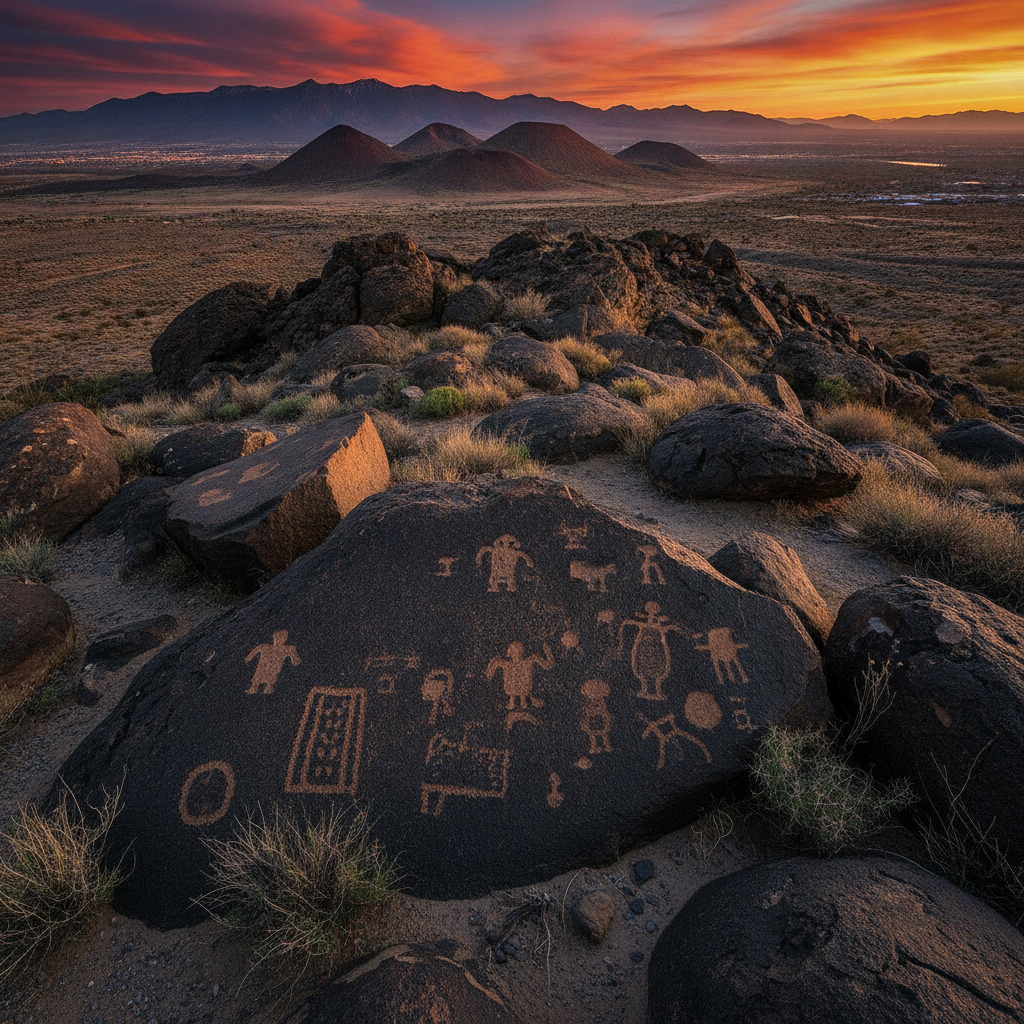
Petroglyph National Monument (at 6001 Unser Boulevard NW, Albuquerque, established January 10, 1990, 7,244 acres): the monument protecting the West Mesa volcanic escarpment and the approximately 24,000 petroglyphs (rock carvings) pecked into the dark basalt boulders of the escarpment by ancestral Pueblo people over 700 years (approximately 1300-1650 CE) and by Spanish Colonial settlers in the 17th and 18th centuries — one of the largest concentrations of petroglyphs in North America. The West Mesa volcanoes: the five volcanic cones (Volcano Day, JA Volcano, Black Volcano, Bond Volcano, and Butte Volcano) that erupted approximately 150,000-200,000 years ago and created the 24-km-long, 60-90 m high basalt escarpment that forms the western boundary of the Albuquerque metro area. The petroglyph images: the Pueblo-period carvings depict masks, kachina faces, spirals, stars, animals (roadrunners, insects, lizards, birds, deer), human figures, handprints, and abstract geometric designs — an encyclopedic record of the spiritual and daily life of the ancestral Pueblo people of the Middle Rio Grande. The Rinconada Canyon Trail (3.2 km loop): the most concentrated petroglyph viewing trail in the monument, with over 300 petroglyphs visible from the trail — a free, self-guided experience that is one of the most accessible ancient rock art sites in the United States. The Boca Negra Canyon Unit: the developed section of the monument with paved trails, restrooms, a small visitor center, and the highest concentration of petroglyphs accessible in a single visit — over 200 petroglyphs within a 1-km loop.
- 6
Albuquerque Food Culture - Green and Red Chile, Sopapillas, and the New Mexican Kitchen
New Mexican cuisine (the indigenous culinary tradition of New Mexico, distinct from both Mexican food and Tex-Mex food): the official state cuisine of New Mexico, characterized above all by the use of New Mexico green chile (Hatch green chile from the Hatch Valley 270 km south of Albuquerque — the most famous chile-growing region in the United States, producing approximately 130 million pounds of chiles annually) and New Mexico red chile (the dried and ground version of the same Capsicum annuum varieties, with Hatch chile the most prized). The defining question of New Mexico: every restaurant serving New Mexican food asks customers Christmas, red, or green? — referring to which chile sauce (red, green, or both: Christmas) accompanies the plate. The New Mexico state question is officially and literally Red or Green? (the official state question was designated as such by the New Mexico legislature in 1999). The sopapilla (the deep-fried puffy bread that accompanies virtually every New Mexican meal, traditionally eaten with honey, the New Mexican version derived from Spanish Colonial fritters of the 18th century and distinct from the Chilean sopaipilla): complimentary sopapillas are a New Mexican restaurant tradition, with restaurants like the Frontier Restaurant (at 2400 Central Avenue SE, Albuquerque, open since 1971, serving approximately 1 million customers per year, the most visited restaurant in Albuquerque by volume) offering bottomless sopapillas. The Frontier Restaurant sweet rolls: the cinnamon rolls the size of a dinner plate, the most famous single menu item in Albuquerque. The El Pinto Restaurant (at 10500 4th Street NW, North Albuquerque, founded 1962 by the Thomas family, now the largest full-service restaurant in New Mexico by seating capacity, producing the El Pinto brand salsa in volumes now distributed nationally). The Duran's New Mexico Restaurant (at 1800 Central Avenue SW): one of the oldest and most consistently praised traditional New Mexican restaurants.
Walk this route with audio
Stories play automatically as you reach each stop — no tapping needed.
More in albuquerque
Albuquerque: Breaking Bad Country, Sky Tram and the Hispanic Cultural Heart
Albuquerque: Balloon Fiesta, Nuclear Heritage and Green Chile Country
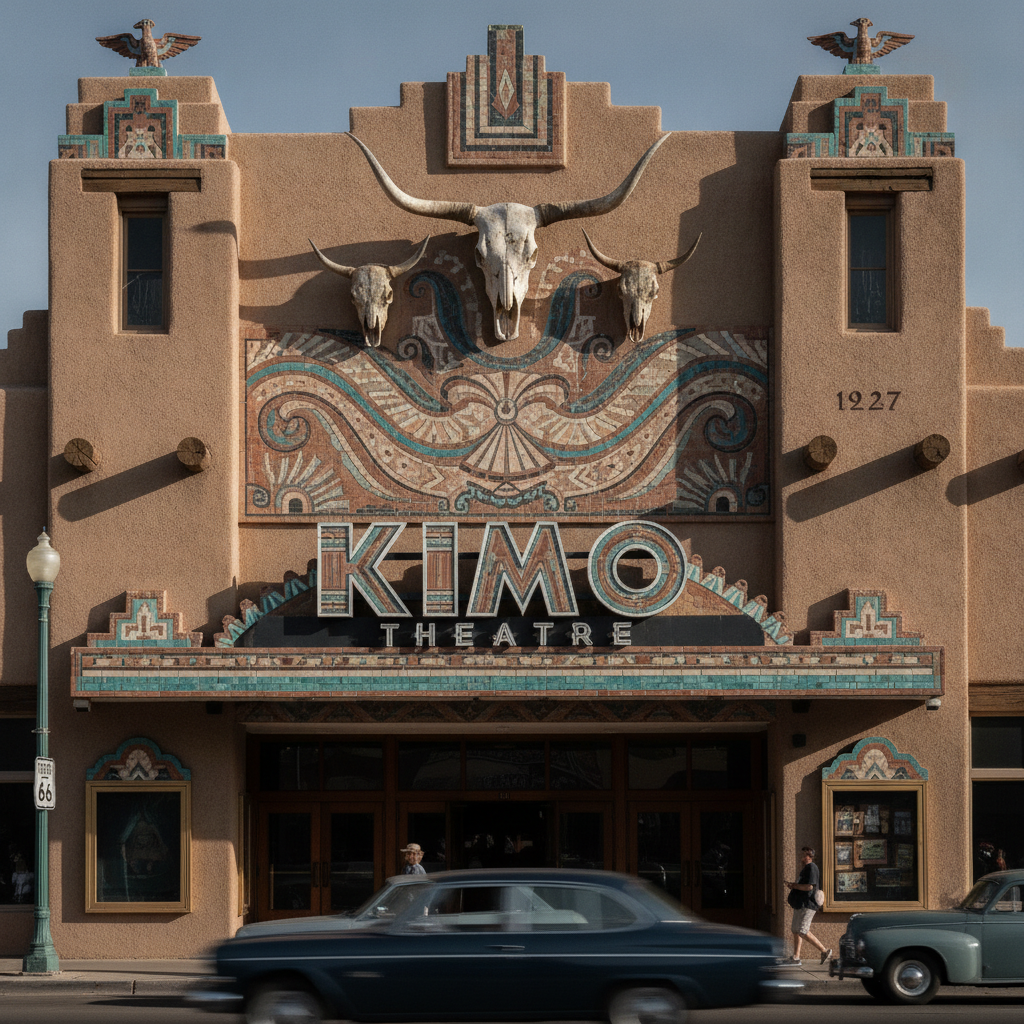
Albuquerque: Music, Native Art, Explora, Wine and Beer, Architecture, and Duke City Identity
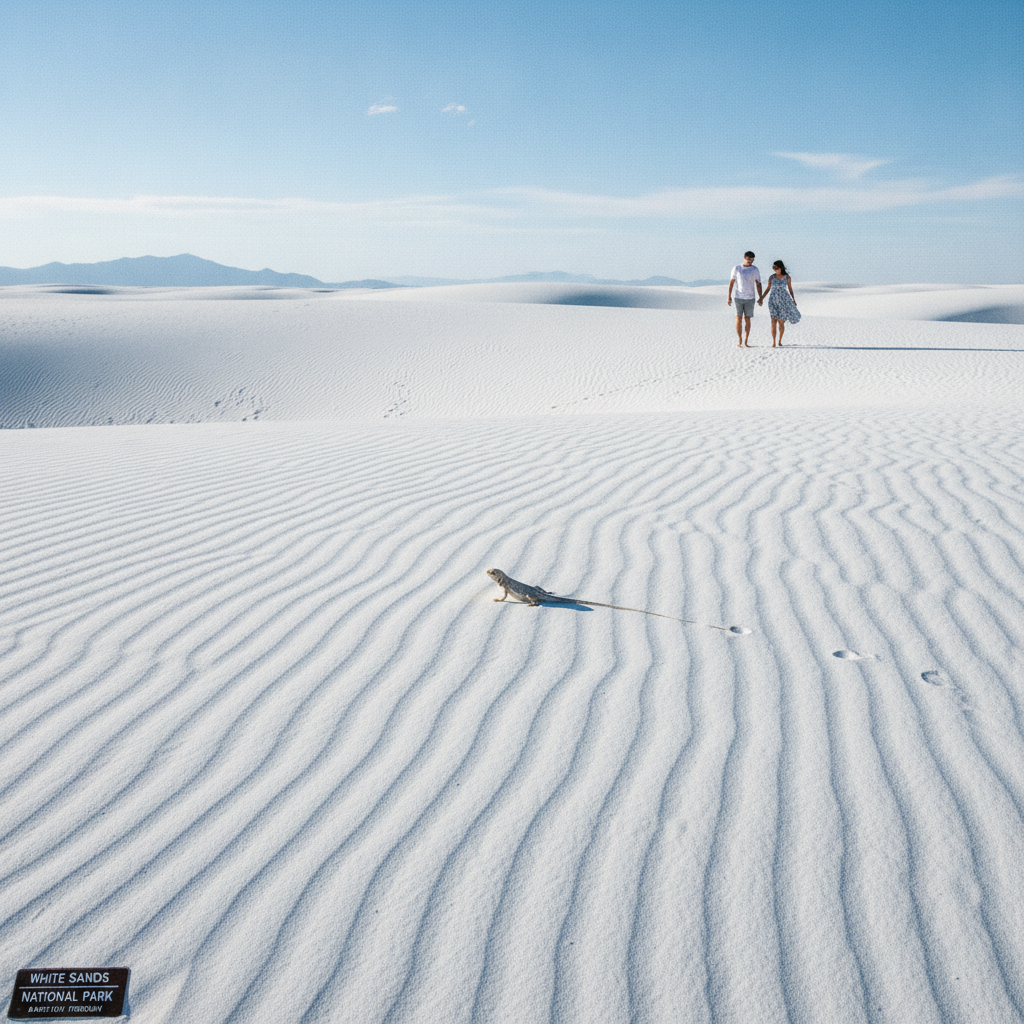
Albuquerque: White Sands, Tech Scene, International District, Camino Real, Jemez Mountains, and Practical Info
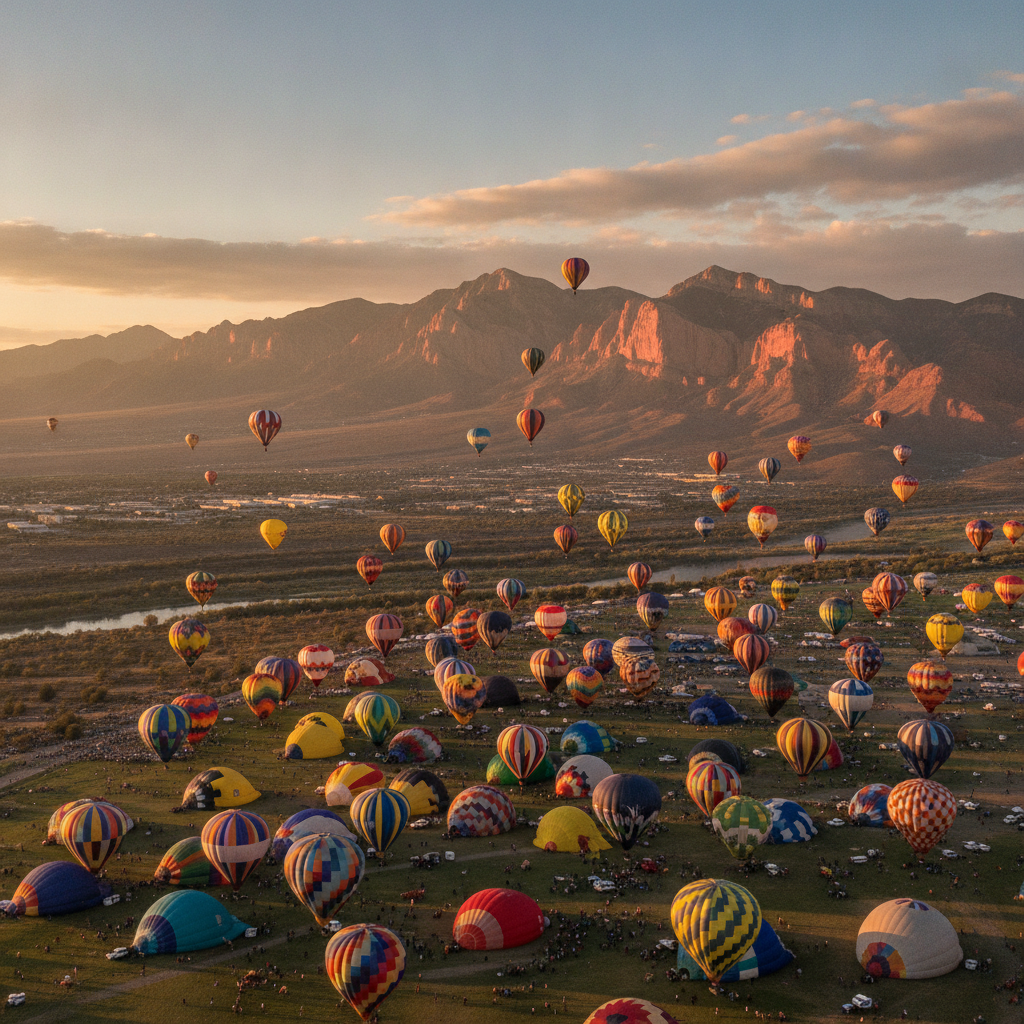
Albuquerque: Balloon Fiesta, Old Town, Sandia Mountains, Route 66, and the Rio Grande